
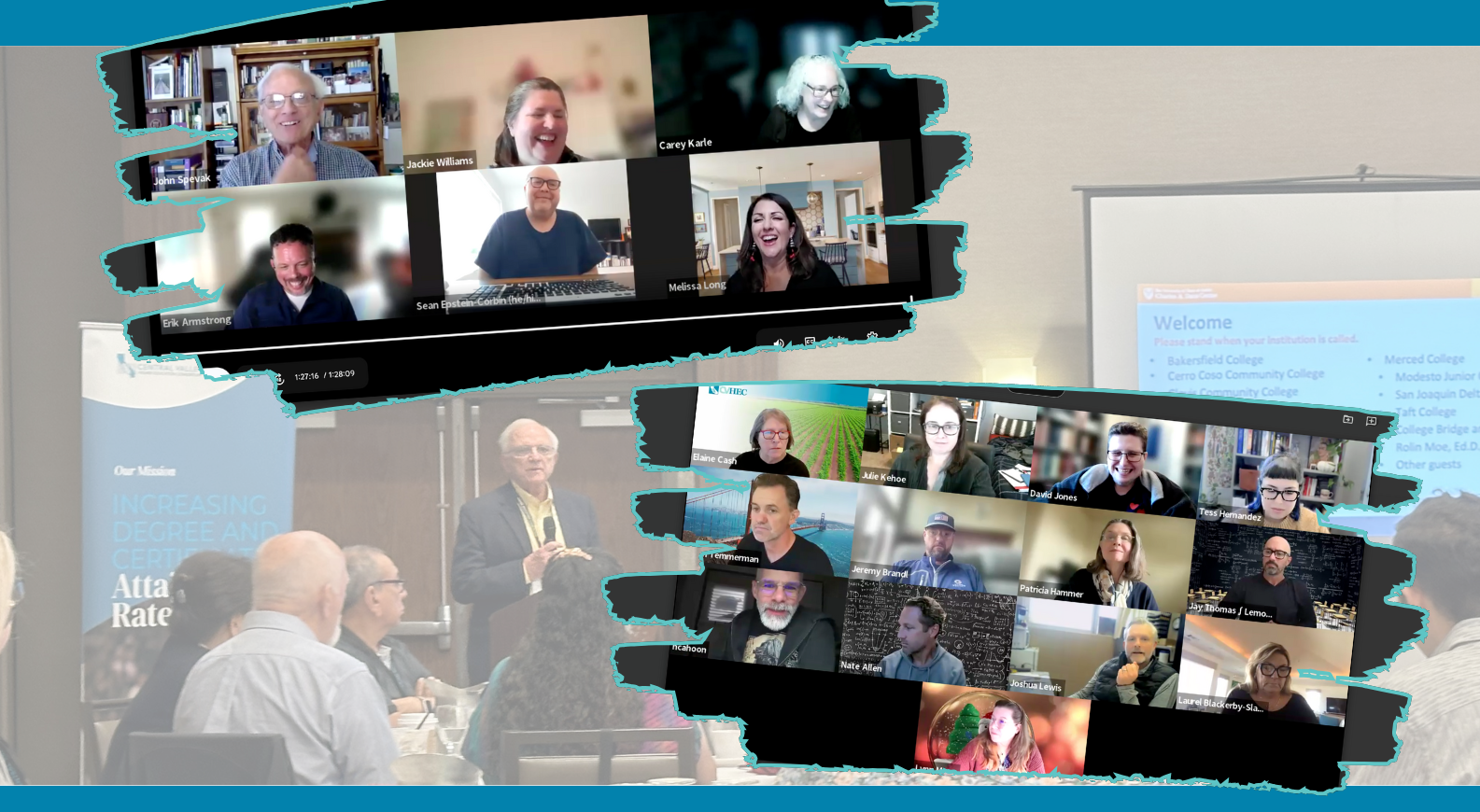
Math educators from CVHEC -member community colleges resumed their work on the Math and English Task Forces with virtual meetings this fall and plans for in-person convenings this spring.
CVHEC Math and English Task Forces
power up for AI talks and AB1705
‘Faculty coming together across institutions to develop solutions
that are informed by policy but rooted in the realities of their classrooms’
BY TOM URIBES
CVHEC Communications Lead
(JAN. 14, 2026) — Artificial Intelligence and math legislation are the hot topics for the Central Valley Higher Education Consortium’s Math and English Task Forces as faculty from across CVHEC’s 10-county region reconnected during the fall 2025 semester to continue reshaping how community colleges support student success.
The two faculty-led task forces, which include at least one professor from each of CVHEC’s 15 member community colleges, were reconvened virtually in October and November:
- The Math Task Force met three times by Zoom to discuss calculus with a corequisite, an innovative pre-calculus course, and collecting and analyzing data related to implementing AB 1705.
- The English Task Force met once by Zoom specifically on the topic of artificial intelligence and how it relates to teaching and learning within English courses.
“These task forces reflect the strength of faculty leadership in the Central Valley,” said Dr. John Spevak, CVHEC project lead and Merced College vice-president emeritus. “When professors come together across institutions, they’re able to develop solutions that are informed by policy but rooted in the realities of their classrooms.”
The consortium is now planning for follow up sessions this spring, Spevak reported to the CVHEC Board of Directors at its Dec. 2 meeting in Visalia.
The Math Task Force follow up is set for an April 10 in-person daylong convening in Fresno while a date for the English Task Force spring meeting is in the planning stages.
CVHEC formed the task forces soon after the passage of California Assembly Bill 705 in 2017 which mandated the elimination of remedial English courses and allowed students to go directly into transferable English courses. That legislation also increased the options of transferable math courses students could take; mandated the elimination of remedial math courses for entrance into statistics and similar courses; and allowed students to go directly into transferable statistics and similar courses.
The more recent passage of AB 1705, an amplification of AB 705, affected math more than English by expanding AB 705 to include STEM math courses.
The past two years, the Math Task Force focused on the mandated implementation of AB 1705, which began this semester and will be evaluated by the California Community Chancellor’s Office in spring 2027.
Spevak reported that in follow-up sessions during the fall 2025 semester, math educators met virtually three times and worked, through sharing and collaboration, toward finding ways for the largest numbers of students to succeed in transferable calculus courses and, when necessary, pre-calculus courses.
Meanwhile, the English Task Force focused on the impact, challenges and opportunities of AI for community college English professors and students, he said, with a meeting held Oct. 29 via Zoom.
ETF: AI’s effect on student creative and critical thinking
In that session, the English professors acknowledged there are many opportunities AI provides, Spevak reported, but they all had serious concerns on AI’s effect on student creative and critical thinking and the challenges of ensuring that students are submitting work that is truly their own, especially within online courses.
“English faculty are on the front lines of these changes,” Spevak said. “They’re thinking deeply about how to use new tools responsibly while preserving the core goals of reading, writing and critical analysis.”
He said CVHEC leaders see the English Task Force discussion as a starting point for broader conversations about AI across disciplines in the coming semesters once a spring meeting date is set.
Next steps for the ETF include forming a panel of three faculty members to present concerns about AI to college presidents at a CVHEC board meeting; organizing a CVHEC regional AI in-person meeting across disciplines, beyond English and math; and drafting a statement on the use of AI in composition spaces for the consortium’s English Task Force to share with regional and statewide officials.
“Anyone interested in pursuing this topic further with the group is encouraged to register when the details are announced in the next CVHEC newsletter,” Spevak said.
MTF: meeting the new calculus requirements challenge for student success
For the Math Task Force, Spevak told the board that participation in three two-hour virtual sessions was strong with faculty expressing appreciation for CVHEC’s role in convening colleagues from across the region.
Professors reported learning from one another’s successes and setbacks, and many said they planned to apply new ideas at their home institutions, Spevak reported.
“They discovered that the various colleges are moving forward in many different ways,” he said. “The professors also said they learned a great deal from the discussions, with many taking back to their colleges what they learned from their colleagues. All agreed there is much more work to be done in evaluating the new courses and revising them to provide for improved student success.”
The first math meeting, held Oct. 24 and led by Professor Shelley Getty of Taft College, focused on calculus with a corequisite. Math professors from various colleges shared the challenges and successes they have had in offering a calculus with a corequisite course this fall, the first semester California community colleges are mandated to offer such a course.
The second session Nov. 7, led by Fresno City College professor Jeremy Brandl, examined the innovative one-course prerequisite to calculus offered this fall. Professors compared curricular approaches and discussed challenges unique to their campuses, Spevak said.
The third meeting, led by Taft College professor Nathan Cahoon on Nov. 21, centered on data collection and analysis requirements, including the evidence colleges must submit to the California Community Colleges Chancellor’s Office by spring 2027 to justify continuation of the new prerequisite option.
Since the December board meeting, Spevak informed the MTF members that the April 10 follow-up meeting would also include high school teachers, institutional researchers and counselors from each CVHEC member college.
The consortium has also requested that the CCC send a representative from the Chancellor’s Office as well as one or more representatives from the system’s Research and Planning Group, which explores ways in which gathering, analyzing, and acting on data can strengthen student success; it includes many CCC institutional researchers.
He said that by the April 10 MTF follow-up meeting, data from the fall 2025 semester — the first one under the new AB 1705 directions/commands — should be available. Venue and registration details for that spring meeting also will be forthcoming.
“We might have some statewide data related to student success collected and analyzed by then, too,” Spevak told the task force in an email Jan. 3. “We can also share our successes and challenges this past fall, regarding especially any new and/or innovative courses that were initially implemented.”
TF: key forum for faculty leadership, regional problem-solving, equitable student success
For CVHEC Executive Director Dr. Benjamín Durán, the task forces exemplify the consortium’s region-wide approach to problem-solving.
“As California community colleges continue implementing sweeping instructional reforms, CVHEC’s Math and English Task Forces remain a key forum for faculty leadership, regional problem-solving and sustained attention to equitable student success throughout the Central Valley,” said Dr. Duran, who also is superintendent/president-emeritus of Merced College (1998-2012).
He adds that through both task forces, participating faculty embody and practice the value of regional collaboration — what CVHEC refers to as “the Central Valley Way” — in responding to statewide policy shifts.
“By sharing concerns, data and effective practices, professors are working collectively to improve outcomes in gateway courses that are critical to degree completion and transfer,” Dr. Duran said.
(Recordings of the four fall Zoom meetings are available on the CVHEC website):
MTF zoom meetings Oct. 24, Nov. 7 and 21
ETF zoom meeting Oct. 29 ,2025
REGISTRATION — Math Task Force April 10
MEDIA CONTACT: Tom Uribes (text: 559.348.3278)
cvheccommunications@mail.fresnostate.edu
See:

