
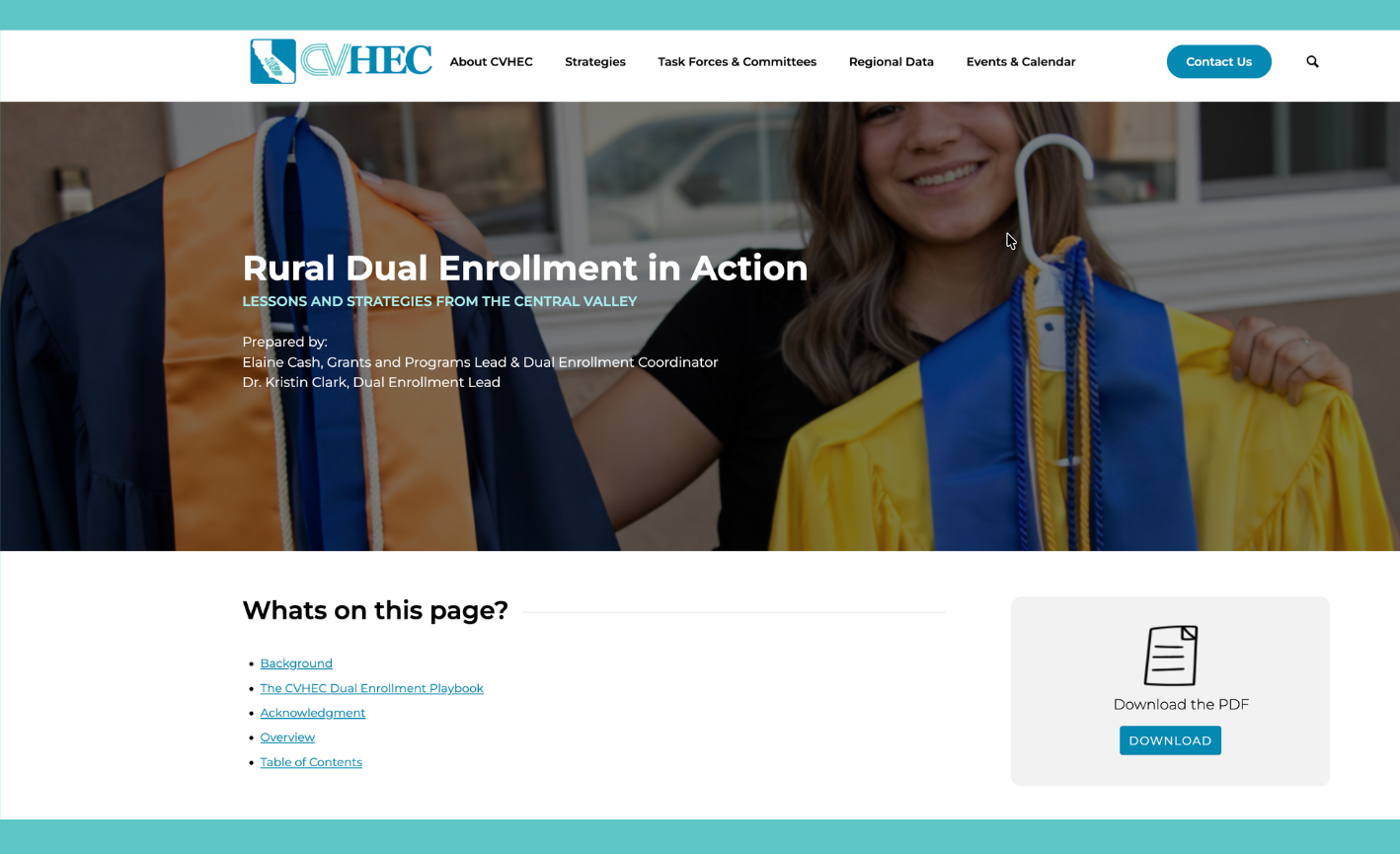
 The 57-page report — “Rural Dual Enrollment in Action: Lessons and Strategies from California’s Central Valley” — chronicles how several CVHEC-member community colleges have developed effective and replicable dual enrollment models with a rural feeder high school despite challenges such as geographic isolation, limited staffing and scarce resources. It is also intended as a general reference for school districts seeking to establish dual enrollment at their respective campuses. Featuring eight case studies in this first issue, the playbook will be updated annually, adding new data and stories as dual enrollment continues to grow and evolve across the region.
Opening Doors the Central Valley Way
CVHEC’s Dual Enrollment Playbook showcases
rural innovation, collaboration and student success across the region
BY TOM URIBES
CVHEC Communications Lead
(MAR. 16, 2026) – When Dr. Paul Lopez, principal at Mendota High School, looks around his campus on the west side of California’s Central Valley these days, he sees something once considered impossible.
“At first, people doubted this program could work,” he recalls. “Now they can’t imagine Mendota without it.”
He’s talking about dual enrollment, the powerful opportunity that allows high school students to take college classes, earn credits and get a head start on higher education.
In Mendota, a small rural farming town on the western edge of Fresno County, the partnership between Coalinga College and Mendota Unified School District has become a model of what can happen when educators dream big for their students.
That story — and many others like it — is now captured in the newly published Central Valley dual enrollment playbook released today by the Central Valley Higher Education Consortium (CVHEC).
The 57-page report — “Rural Dual Enrollment in Action: Lessons and Strategies from California’s Central Valley” — chronicles how several CVHEC-member community colleges have developed effective and replicable dual enrollment models with a rural feeder high school despite challenges such as geographic isolation, limited staffing and scarce resources.
Intended as a general reference for school districts seeking to establish dual enrollment at their campus by sharing successful dual enrollment strategies in place, it is now available online announced CVHEC Executive Director Benjamín Durán.
He describes the playbook as a living document that gathers case studies, interviews and data from across the consortium’s ten-county region.
“The result portrays how collaboration between CVHEC community colleges and Central Valley K–12 schools is redefining pathways to college,” Duran said.
Authored by CVHEC team members Dr. Kristin Clark and Elaine Cash, CVHEC’s dual enrollment co-leads, the playbook presents eight case studies. Duran said CVHEC plans to update the playbook annually, adding new data and stories as dual enrollment continues to grow and evolve across the region.
The CVHEC community college members and selected feeder schools/districts featured in this first release are:
- Coalinga College (Mendota High School)
- Columbia College (Summerville High School & Sonora High School)
- Lemoore College (Lemoore & Caruthers High Schools)
- Merced College (Merced Union High School District)
- Porterville College (Porterville Unified High School District and Burton High School)
- Reedley College (Sanger Unified School District)
- Taft College (Taft Union High School)
(One urban school is included because of its work with CVHEC’s Math Bridge Program):
- San Joaquin Delta College (Stagg High School × College Bridge Model)
Duran said this playbook is more than a guide.
“It’s a living document — part storytelling, part strategy manual — that reflects how the Central Valley is reshaping college access, particularly for students in rural communities,” he said. “It celebrates the determination and innovation of our rural institutions and their partners. It tells the story of how small colleges with limited resources are building life-changing opportunities for students and entire communities. That’s the Central Valley Way.”
Duran commended the consortium’s dual enrollment team for this endeavor.
Clark is chancellor-emerita of the West Hills Community College District and served on the CVHEC Board of Directors that is made up of the chancellors, presidents and campus directors of 28 member institutions of higher ed in the valley. She joined the CVHEC team a year ago following her retirement from WHCCD in 2024. Cash is former superintendent of the Riverdale School District, who joined CVHEC in 2023 as grants coordinator and now also serves as dual enrollment co-lead with Clark.
“Chancellor Clark and Superintendent Cash are to be commended for marshalling the forces needed to engage the K-12 professionals, who are on the front lines of educating our students, and compiling their remarkable stories that provide groundbreaking data for continued dual enrollment success in the Central Valley,” Duran said.
Clark said the report is “a story of people, not just programs — teachers who step up to meet minimum qualifications so they can teach college-level courses, counselors who guide first-generation students into dual credit classes, and administrators who build partnerships that thrive on trust and shared vision.” (See full list of report respondents below).
She said the playbook journey began in July 2019, when CVHEC convened regional educators to form the Central Valley Dual Enrollment for Equity and Prosperity (CVDEEP) Task Force to tackle the question: “How can we expand equitable access to college courses for every high school student in the Central Valley?”
From that first meeting emerged a collective goal: build a comprehensive regional playbook to document and share successful dual enrollment strategies. Plans were paused in 2020 as schools shifted to pandemic response, but the vision endured.
By February 2025, with the pandemic behind them, CVHEC reignited the effort with the naming of Clark and Cash as co-leads. At that year’s CVHEC Dual Enrollment Convening, California Community Colleges Chancellor Sonya Christian lauded the region’s progress, noting that Central Valley dual enrollment participation was growing faster than in any other part of the state — a testament to what collaboration could achieve.
“Central Valley colleges have shown tremendous momentum in expanding dual enrollment pathways,” Chancellor Christian said at the event.
“The work led by the Central Valley Higher Education Consortium in collaborating, facilitating and realizing dual enrollment is truly a gold star standard for the rest of the country. This area is leading the state in the number of students earning college credit while still in high school. Their phenomenal effort ensures equity in access, a key pillar in the work we are doing with our Vision 2030 plan.”
Rural Colleges, Big Impact
Clark said entries in “The Dual Enrollment Playbook” focus on small, rural colleges and their K–12 partners — “institutions often overlooked in statewide reports but rich with lessons learned.”
At Coalinga College, for example, the 2024–25 academic year saw 150 dual enrollment course sections offered across local high schools, enrolling more than 3,000 students. She noted that many of those classes are taught by high school instructors who have qualified to teach college-level material — a strategy that keeps access local while maintaining rigor.
“Across the region, colleges and districts are designing intentional pathways that align high school coursework with college and career goals,” Clark said. “These partnerships aren’t just about giving students a head start — they’re about transforming local economies and lifting entire communities.”
Cash added that dual enrollment isn’t only an educational innovation — it’s an economic one.
Between 2016 and 2019, more than 120,000 Central Valley high school students participated in dual or concurrent enrollment. By 2024–25, that number had soared to nearly 140,000, a 50.9% increase.
According to the California Community Colleges Chancellor’s Office, every $1 invested in higher education returns nearly $2 in public benefits through increased tax revenue and reduced public assistance.
“For rural families, dual enrollment is a game-changer,” Cash explained.
“The playbook demonstrates how dual enrollment allows students to earn college credit for free, complete degrees faster, and enter the workforce sooner. It’s one of the most effective tools we have for breaking cycles of poverty and opening doors of opportunity.”
Clark said each story in the playbook reveals a shared truth: behind every successful program are real people who believe in their students — and in each other.
“This guide isn’t just a collection of strategies,” said Dr. Clark. “It’s a testament to what happens when colleges and K–12 districts align around a common mission. The Central Valley Way is about community, perseverance, and the belief that every student — no matter where they live — deserves access to higher education.”
The playbook’s first public presentation will take place at the statewide 2026 California Dual Enrollment Equity Conference March 17 in San Diego where Clark and Cash will present a session, “Random Acts to Roadmaps: Dual Enrollment in Rural Schools.” From the playbook, they will highlight best practices and equity-driven strategies that have enabled rural and under-resourced schools and colleges across the Central Valley to build sustainable, high-impact dual enrollment pathways.
The conference is presented March 16-19 by the California Dual Enrollment Program (CADEP), Career Ladders Project, and EdTrust–West. Last fall, CLP and EdTrust-West released three new “Dual Enrollment Practitioner Guides” to help TK-12 and college educators make dual enrollment more equitable, accessible and impactful for California students—especially Black, Latine, and Native American youth — in concert with the California Community Colleges.
Clark said the CVHEC guide was designed to avoid duplication of those efforts “by focusing primarily on the successful case studies of smaller, more rural colleges in our consortium and their K-12 partners.”
About CVHEC
The Central Valley Higher Education Consortium is a coalition of 28 colleges and universities spanning ten counties in California’s Central Valley. Its mission is to increase degree attainment and close equity gaps through collaboration in areas like dual enrollment, transfer pathways and workforce development. Through initiatives like the Dual Enrollment Playbook, CVHEC continues to champion student success and the power of collaboration — the Central Valley Way.
Access the Playbook:
“Rural Dual Enrollment in Action: Lessons and Strategies from California’s Central Valley”
Now available at CVHEC Dual Enrollment.
Providing invaluable participation in the development of this playbook:
- Richard Aguilar, director of Dual Enrollment – Reedley College
- Sam Aunai, vice president of Educational Services – Coalinga College
- Mike Baldwin, director of Dual Enrollment – Columbia College
- Gretchen Birtwhistle, Career Technical Education teacher/coordinator – Sonora High School
- Greg Bormann, vice president of Instruction, Taft College
- Christina Braaten, College and Career specialist – Lemoore High School
- Callie Branan, director of Outreach and Recruitment – Lemoore College
- Marni Cahoon, Adjunct Math faculty – Taft College
- Courtney Castle, Counselor/Program coordinator – Sonora High School
- Dr. Lynn Cevallos, president – College Bridge
- Brett Christopher, principal – Summerville High School
- Stacey Cool, program administrator – Merced Union High School District
- Kirstin Coronado, superintendent – Sanger Unified Area
- Kris Costa, vice president of Educational Services – Lemoore College
- Jamee Dahl, College and Career counselor – Summerville High School
- Jon Endicott, dean of Student Services – Coalinga College
- Mary Alice Finn, Principal – Taft High School
- Dr. Sandra Fuentes, Dean of Early College – Reedley College
- Carmen Garvis, Dual Enrollment Coordinator – Sanger High School
- Gloriann Garza, Program Manager – Porterville College
- Travis Kirby, Principal – Mendota High School
- Dr. Paul Lopez, Superintendent – Mendota High School
- Jaime Lopez, Dean of Instruction – Taft College
- Bethany Matos, Dean, Firebaugh Center – Coalinga College
- Martin Medina, Principal – Summit Collegiate High School
- Dr. Leslie Minor, president – Taft College
- Alyssa Mitchell, College and Career Counselor – Lemoore High School
- Cindi Olsen, Program Specialist, Columbia College
- Lissette Padilla, director of Dual Enrollment – Coalinga College
- James Preston, President – Lemoore College
- Dr. Thad Russell, vice president of Instruction – Porterville College
- Reyna Sanchez, Guidance Counselor – Caruthers High School
- Jackie Schwegel, Math Faculty – San Joaquin Delta College
- Karen Sells, Principal – Sonora High School
- Vivie Sinou, dean of Regional & Distance Education – San Joaquin Delta College
- Gregory Soto, dean of Student Services – Merced College
- Martha Stemky, District Leader – Porterville Unified School District
- Lorena Villa, Interim Early College Coordinator – Porterville College
- Erin Wingfield, interim vice president of Student Services – Porterville College
- Veronia Zarco, dean of Counseling – Granite Hills High School
MEDIA CONTACT: Tom Uribes
Communications/Media Lead
Central Valley Higher Education Consortium (www.cvhec.org)|
cvheccommunications@mail.fresnostate.edu | 559.348.3278 (text)

