
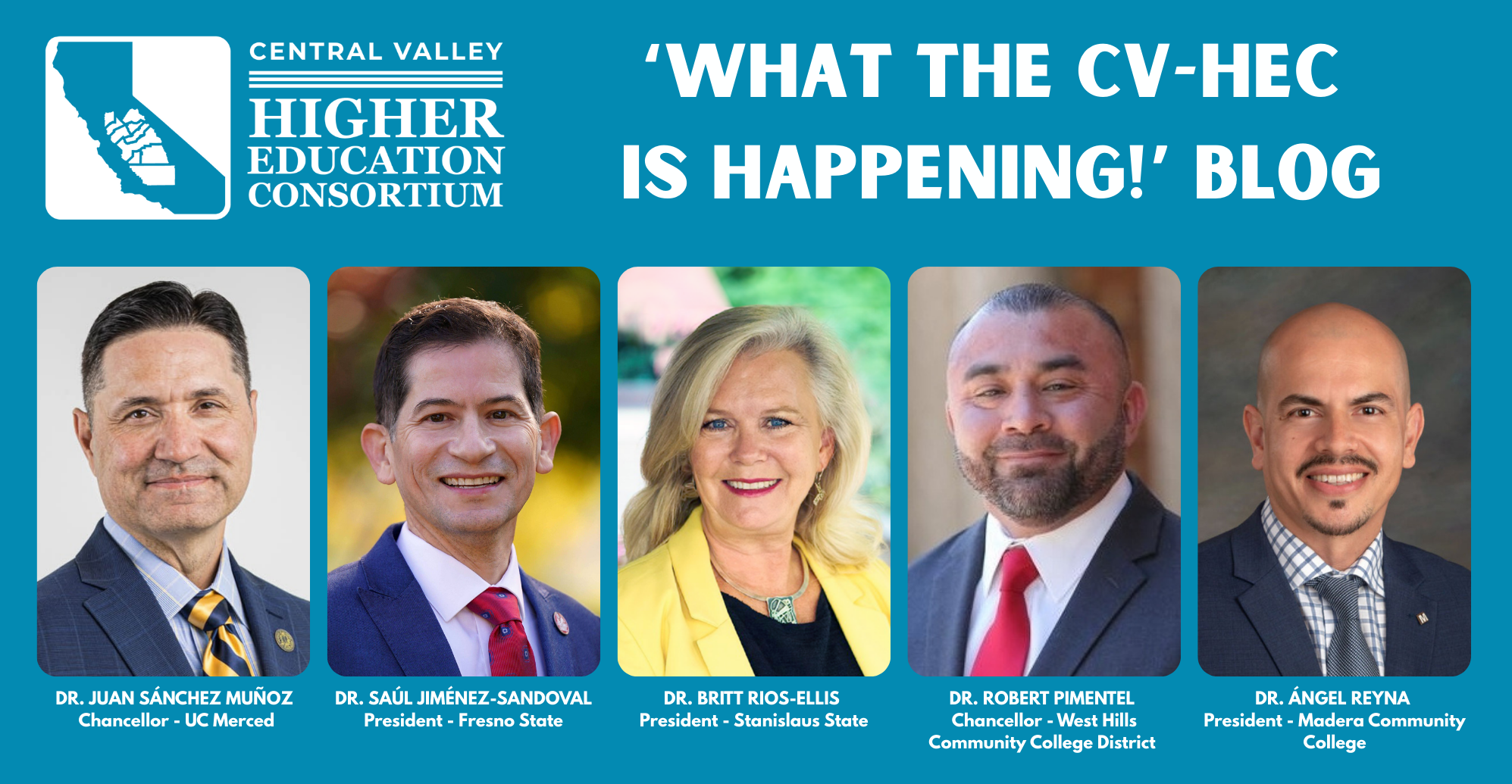
This month’s “What the CV-Hec is Happening” Blog features this op ed first published Nov. 13 in The Fresno Bee penned by five Central Valley Higher Education Consortium board members: Britt Rios-Ellis, M.S., Ph.D., president of California State University, Stanislaus; Robert Pimentel, Ed.D., chancellor of West Hills Community College District; Ángel Reyna, Ed.D., president of Madera Community College; Juan Sánchez Muñoz, Ph.D., chancellor of UC Merced; and Saúl Jiménez-Sandoval, Ph.D., president of California State University, Fresno. They articulate how a higher education provides a powerful and proven pathway for students and communities to rise. Beginning at a local community college and continuing at a public or private four-year institution, higher education unlocks the full potential of every region, every community and every young person — especially within the Central Valley. Reprinted here with minor updates. (We welcome feedback as well as ideas for future blog topics: Tom Uribes, cvheccommunications@mail.fresnostate.edu).
Higher education: ‘enabling ambitious aspirations
that benefit individuals, families, our state and our nation’
BY CVHEC BOARD MEMBERS:
Dr. Britt Ríos-Ellis, Dr. Juan Sánchez Muñoz,
Dr. Saúl Jiménez Sandoval, Dr. Ángel Reyna and Dr. Robert Pimentel
(JAN. 14, 2026) — California is the world’s fourth-largest economy and a global leader in innovation, technology, agriculture and opportunity. In 2023, California contributed 12.2% of the $4.67 trillion in total federal revenue. Maintaining a highly educated workforce has historically been at the core of California’s prosperity. But the future of our state depends on unlocking the full potential of every region, every community and every young person — especially within the Central Valley.
Home to more than 4 million residents, the Central Valley is the primary producer of the food and fuel that powers California — and, by extension, the nation. Within just 2% of the nation’s farmland, the Central Valley produces over 25% of U.S. food supply. Yet, despite its vital contributions, the region faces persistent challenges in public and private investment, educational access and economic mobility.
California’s integrated higher education system — community colleges and the California State University and University of California systems — offers a powerful and proven pathway for students and communities to rise. For many in the Central Valley, their academic journey begins at a local community college and may continue at a public or private four-year institution.
The data regarding the personal, social, health and financially related benefits to higher education are uncontestable. For example, a recent study by Lightcast highlighted that community colleges alone contribute over $173 billion to the state economy. Moreover, the UC and CSU systems generate more than $80 billion and $26.9 billion, respectively, in annual economic activity.
Higher education in California is firmly rooted in the values of access, affordability, relevance and excellence. It allows students from anywhere in the state to stay rooted in their communities while pursuing highly rigorous higher education that leads to lives of fulfillment and prosperity.
While all higher education has the objective of uplifting students to new heights, students do not all begin from the same place. By investing in higher education in the Central Valley, these institutions ensure that young people earn degrees and engage in fields of study that lead to immediate and personal impact as well as careers that elevate communities and regions.
From Bakersfield to Stockton, higher education empowers students from rural towns and urban centers, from agricultural families and first-generation households. It strengthens the Valley’s workforce, economy and our communities. It further enables California to remain the economic engine of the nation.
This is not just our priority, it’s a collective commitment. And that energy is exercised through the power of collaboration by way of the Central Valley Higher Education Consortium.
Incorporated as a 501c3, in 2002, the consortium membership consists of 28 public and private institutions of higher education in the Central Valley’s 10-county region from San Joaquin to Kern Counties dedicated to improving the region’s college-going culture. The CEOs of each institution – chancellors, presidents and campus directors – serve as the CVHEC Board of Directors dedicated to improving college degree and certificate attainment rates for the social and economic development of our region.
Serving over 250,000 students valley wide, we are working together across our various higher education sectors and systems, with elected officials, business leaders, students, families and communities to ensure every Central Valley student has the opportunity to pursue their dreams.
Together, we are enabling ambitious aspirations that benefit individuals, families, our state and our nation. When all of higher education work together, we better serve our students, families, communities and California.
Britt Rios-Ellis, M.S., Ph.D. is president of California State University, Stanislaus. Robert Pimentel, Ed.D is chancellor of West Hills Community College District. Ángel Reyna, Ed.D., president of Madera Community College, Juan Sánchez Muñoz, Ph.D., chancellor of UC Merced and Saúl Jiménez-Sandoval, Ph.D., president of California State University, Fresno, also contributed to this piece.
(A version of this blog was first published in The Fresno Bee • Nov. 13, 2025)

