“What the CV-Hec is Happening” Blog • November 10, 2026: English teacher Ginny Sandu
 For our November “What the CV-HEC is Happening” guest blog, Ms. Ginny Sandhu, a high school English teacher and graduate of CVHECs Masters Upskilling Program, returns to provide perspective on the Dual Enrollment Instructor Convening presented Oct. 14 by the Fresno-Madera K-16 Collaborative and the Career Ladders Project and how it motivates DuE teachers like her. CVHEC’s program provides funding for high school teachers to earn a master’s degree that qualifies them to teach dual enrollment courses as Ms. Sandhu now does at Sunnyside High School in the Fresno Unified School District. She enjoys not only teaching dual enrollment but advocating for its success as a way to give back for the opportunity the Masters Upskilling Program provided her so CVHEC invited her to blog about her perspective at the dual enrollment conference and its takeaways for high school teachers. Her first CVHEC guest blog in January 2023 shared the value of the upskilling program. She also traveled with CVHEC to the California Dual Enrollment Equity Conference in 2025 to share her program experiences on a panel and in a podcast. (CVHEC blog ideas are welcome: Tom Uribes, newsletter editor, cvheccommunications@mail.fresnostate.edu).
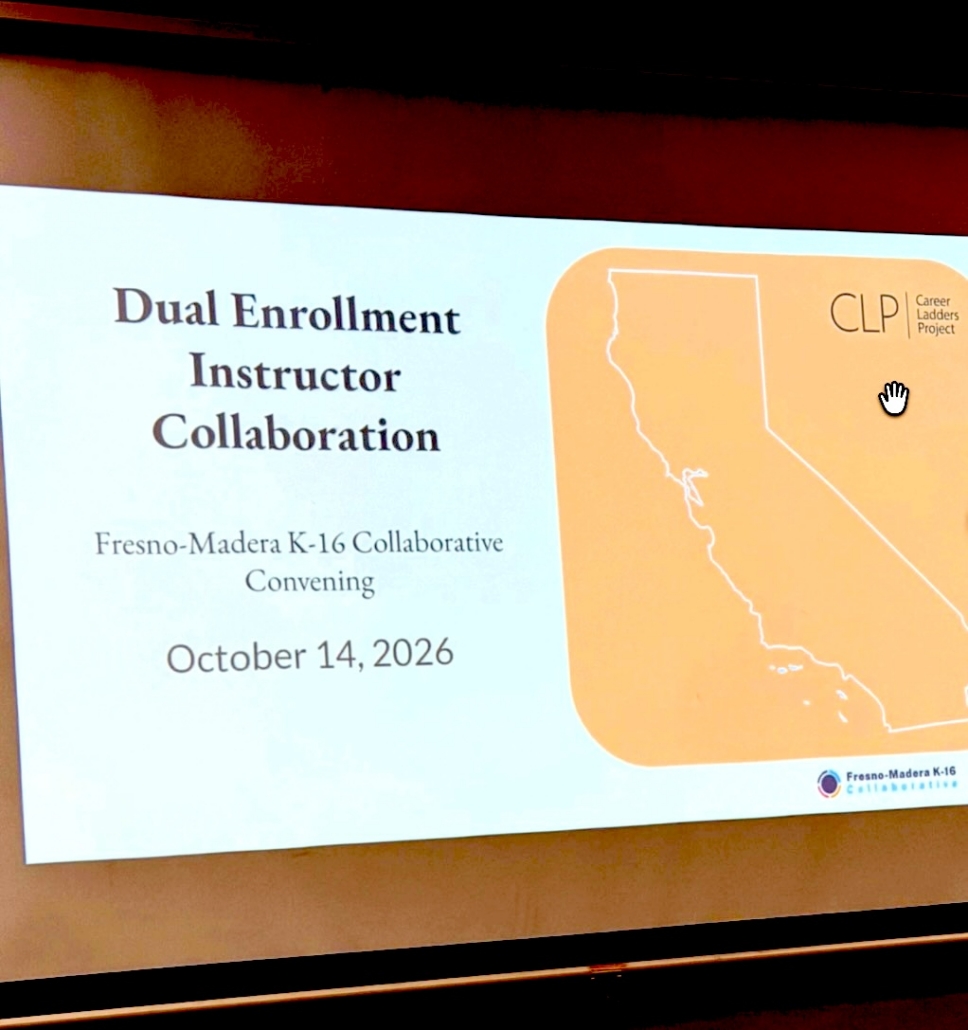
Dual Enrollment Instructor Convening
Elevating Dual Enrollment Partnerships
From ‘Good and Growing’ to EXEMPLARY!
BY GINNY SANDHU
Sunnyside High School – Fresno Unified School District
A profound full-circle moment in my own teaching and educational journey of 18 years played out before me on October 14 when I joined educators from across the Central Valley for the Dual Enrollment Instructor Convening held at Clovis Community College.
Hosted by the Fresno-Madera K-16 Collaborative and the Career Ladders Project, the convening created space for Central Valley high school and college educators as well as administrators and executives to strengthen partnerships, share practices and new ideas, explore research and resources, and collaborate to improve student experiences by expanding opportunities for them.
For me, the day-long experience was a full-circle moment because it unfolded against a backdrop of becoming an unofficial ambassador for the Central Valley Higher Education Consortium (CVHEC) as a graduate of its Masters Upskilling Program in 2021. This consortium initiative, funded through the Fresno-Madera K-16 Collaborative, enabled me to earn my master’s in English that qualified me to teach dual enrollment courses at Sunnyside High School (Fresno Unified School District) where I have been teaching since 2019.
By helping fund my master’s degree, CVHEC and FMK16C invested in my ability to teach dual enrollment (DuE) courses. My first opportunity to give back was in 2025 when CVHEC took me to the California Dual Enrollment Equity Conference held in Sacramento that year to speak on its Masters Upskilling panel sharing my own experience. At that conference, I was also featured in a podcast by the California Department of Education, along with CVHEC Executive Director Benjamín Durán and Associate Director Ángel Ramírez.
Now, five years into teaching dual enrollment (English) and supporting DuE initiatives as an FUSD site lead, this Oct. 14 convening gave me another opportunity to carry this investment forward. I was thrilled that CVHEC invited me to offer my perspective of this experience through this blog as another opportunity to give back regarding my DuE experiences.
The event broadened my understanding of my labor, fortified my capacity to support students and educators, and enabled me to now extend the mentorship that I once received from my CVHEC and FMK16C mentors.
Dr. Naomi Castro, chief program officer for Career Ladders Project, opened the convening with enthusiasm and hope in her voice.
Her team designed the agenda with individual reflection and shared learning in mind. Participants explored a selection of professional learning resources through QR codes linking to Dual Enrollment research, instructional guides, data visualizations, and student videos from the Central Valley. This self-directed approach allowed educators to practice autonomy and focus on resources most relevant to their area(s) of interest. Eventually, the collaborative portion of the day divided participants into content-specific groups for further collaboration.
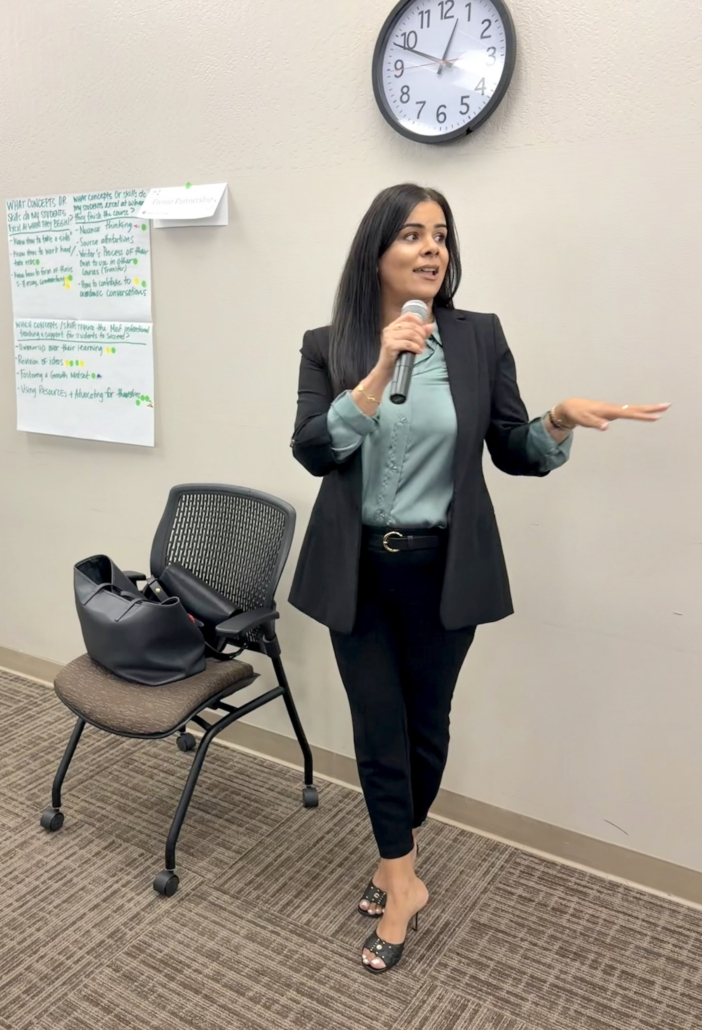
I joined Rebecca Benas, a Fresno City College English professor, and two other instructors from Kerman Unified and Fresno Unified. The collaboration provided an opportunity to examine common instructional challenges, grading practices, and how educators across high school and college settings can better align their practices. In fact, the conversation with Prof. Benas opened the door to continued dialogue about academic rigor, rubrics, grading, and emerging questions around artificial intelligence.
We discussed the possibility of monthly meetings for high school and college instructors. Such a proposal would require broader agreement among stakeholders, but for now it represents a promising opportunity to turn a single day of professional learning into sustained collaboration.
One central message that was reiterated throughout the convening was that building effective dual enrollment programs requires more than providing access to college courses. It requires aligned academic expectations, intentional partnerships, and ongoing communication between the institutions responsible for student success.
In light of this, when asked about the challenges dual enrollment pathways currently face, Dr. Castro shared: “The next big issue is elevating partnerships so that they’re exemplary. Right now, they’re good and they’re growing; let’s get them to be exemplary.”
She added that it is hard to deny the benefits of dual enrollment as she highlighted what DuE programs encompass.
“Dual enrollment offers a free way to start earning college credit, and for students to really see themselves as successful college students,” Dr. Castro said. “It really opens the doors to them.”
She expressed the importance of keeping our students at the center of our labor, particularly students who are first-generation, low-income, or historically underserved by higher education.
“I think California is building a really strong foundation right now in dual enrollment, especially the CCAPS-College and Career Access Pathways.” Dr. Castro elaborated regarding dual enrollment initiatives: “We’re building the structures, we’re building funding streams, we’re collaborating with each other–we’re doing a lot of really great things.”
Tressa Overstreet, Executive Director of College and Career Readiness for Fresno Unified, amplified Dr. Castro’s message about the need for stronger collaboration across educational systems. She described how misunderstandings and institutional silos can make alignment difficult, while emphasizing the potential that emerges when educators come together to develop shared practices at a convening like this.
“I think that we have incredible educators in the Central Valley at all levels, and we need to develop a collective efficacy that together we are going to lift opportunities for students,” Overstreet said. “Together we’re going to build promising practices. Together we’re going to change the narrative and disrupt poverty in the Central Valley.”
Dr. Castro concluded the convening with an invitation to next year’s California Dual Enrollment Equity Conference where in 2025, as mentioned above, I shared and learned from incredible educators with the same resolve. I hope to return to the CDEE conference on March 8, 2027 in Anaheim to learn how our collective work 1) situates itself on the world stage in the age of globalization and AI, and 2) continues to address equity and access issues.
This convening last month was more than a simple professional development; it was an opportunity for me to examine how institutional collaboration can translate into more coherent, equitable pathways to higher education. I was reminded that dual enrollment pathways depend not only on access to college credit, but also on the intentional alignment of pedagogy, consistent alignment of academic expectations across educational institutions, and strong partnerships.
Perhaps the most significant takeaway for me was this: educational investments reach their greatest potential when individual opportunity becomes collective capacity and when that capacity expands, students and institutions can envision and achieve impossible metrics — just like I have — just like my colleagues at this conference have.
caption to come
