
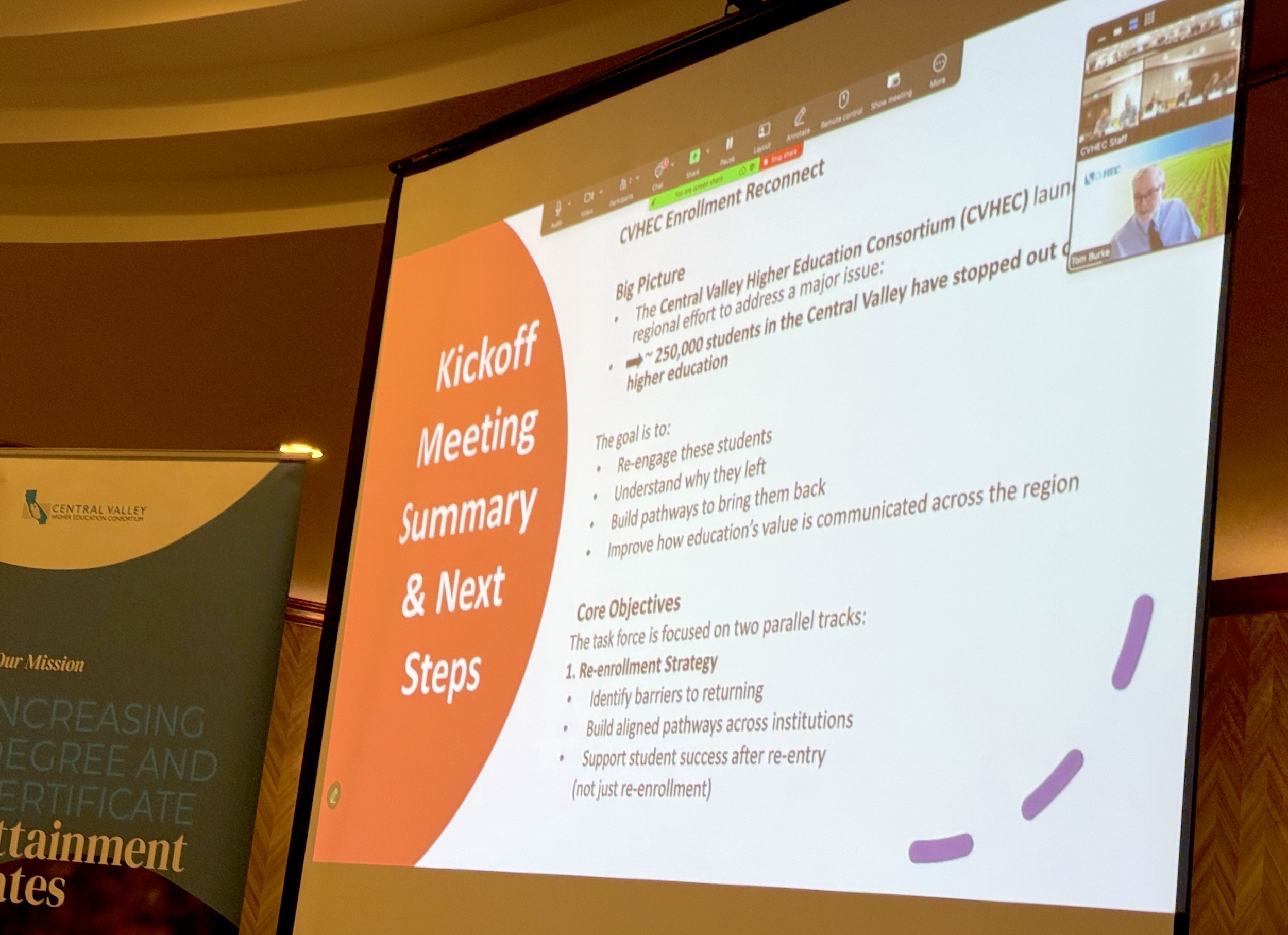
At its April 24 quarterly meeting, the CVHEC Board of Directors heard updates regarding four priorities it adopted last year shaping the future of higher education across the region: artificial intelligence, workforce alignment, data sharing and enrollment reconnect.
The ‘accelerating pace of change’
CVHEC Board hears updates for new initiatives task forces
amidst call for continued unity as a region for student success
BY TOM URIBES
CVHEC Communications Lead
(MAY 20, 2026) — On an early Friday morning a month into spring 2026, a hotel conference room in Fresno was brimming with an energy that is rarely seen as the CEOs of 28 colleges and universities arrived from all points throughout California’s Central Valley.
Amidst handshakes, hugs and general reconnection vibes the higher ed leaders sat down to assemble as the Central Valley Higher Education Consortium (CVHEC) Board of Directors April 24 at the DoubleTree Inn.
It was a unique convergence of the valley’s chancellors, presidents and campus directors who make up the CVHEC board — a power dynamic that drives academic success and collegial collaboration for more than 250,000 college students throughout the region’s 10 counties.
After breakfast – and two hours before moving into the organization’s public 2026 Central Valley Higher Education Summit also presented that day — the board members used that quarterly meeting as an opportunity to engage in detailed strategy discussions and governance decisions shaping the consortium’s next phase of work.
Welcomed by board chair Dr. Juan Muñoz Sánchez, chancellor of CVHEC-member UC Merced, and consortium Executive Director Dr. Benjamín Durán, the board members mostly heard task force updates focused strongly on four major strategic priorities they adopted last year:
- Artificial Intelligence
- Workforce Alignment
- Data Sharing
- Enrollment Reconnect
“By convening ahead of the 2026 Central Valley Higher Education Summit, board members were able to align on priorities and strategies — hearing task force reports directly before engaging with a broader audience of educators, policymakers and community stakeholders later in the day,” said Duran, who also is president-emeritus of Merced College.
In addition to the task force presentations by team liaisons and board members, the executive director provided updates on several ongoing CVHEC initiatives.
He highlighted the consortium’s progress on math education, including work by CVHEC’s Math Task Force for implementation of Assembly Bill 1705 and the Central Valley Math Bridge Program with College Bridge, both aimed at improving student success in transfer-level math.
Duran also pointed to the recent release of the CVHEC Dual Enrollment Playbook, which offers strategies to expand equitable access to dual enrollment opportunities with eight case studies; and ongoing progress within the Central Valley Transfer Project and its PPM 2.0 software model adopted by the California Community Colleges system statewide.
“These efforts are all connected,” Duran noted, underscoring “how improvements in transfer, dual enrollment and math preparation support broader goals around access, completion and workforce readiness.”
The board also recognized a leadership transition as Taft College Interim President Dr. Leslie Minor of the West Kern Community College District announced her retirement effective this June. The district is currently in the search process for the Taft College presidency. Her departure will also mark the end of her service on the CVHEC board.
“President Minor is a first-generation graduate who has spent many years serving students in Oregon and California and has been involved in community organizations like Big Brothers and Sisters, Rotary, Kiwanis, Long Beach Farms and the National Forest Service,” Duran said. “Her talents, service and dedication throughout her career has contributed immensely to the success of countless college students.”
Setting the stage for the summit
But the thrust of the board meeting was propelled via progress reports for the four Strategic Priorities Task Forces launched at CVHEC’s board retreat hosted by member-campus UC Merced in August 2025.
Each initiative and its task force, supported by CVHEC team liaisons who are also former presidents or chancellors, is aimed at addressing some of the most pressing and interconnected challenges facing higher education and workforce development in the Central Valley, Duran said.
“The four strategic priorities — AI, workforce alignment, data sharing and enrollment reconnect — emerged as deeply interconnected efforts requiring sustained collaboration across institutions and sectors.”
He noted that throughout the April board meeting, “a consistent theme was the importance of regional alignment in addressing complex challenges that no single institution can solve alone.”
One of the task force leads, Dr. Kristin Clark noted in her presentation what may be the underlying motivator for the consortium’s direction the next few years: “The pace of change is only accelerating. Our ability to work together as a region will determine how well we adapt — and how well we serve our students.”
That message carried across all four task force updates as presented here, reinforcing CVHEC’s role as a convener and catalyst for collective action in the Central Valley’s higher education ecosystem. These initiatives were also the subject of one of the summit panels later in the day featuring four board members. (See video). Link to come
AI TASK FORCE: balancing urgency with readiness
In the first presentation to the board, Clark, chancellor-emerita of the West Hills Community College District who serves as AI Task Force co-lead with Tom Burke, framed artificial intelligence as both an unprecedented opportunity and a complex institutional challenge.
“Students are already using AI at a high level — often ahead of faculty and administrators,” Clark said, emphasizing the urgency for colleges and universities to respond in a coordinated and intentional way.
She outlined how AI is reshaping teaching, research and workforce preparation, while also raising concerns about academic integrity, faculty preparedness and increased workload demands. She said the task force has organized its work around four pillars:
- teaching and research
- workforce preparation and professional development
- operational efficiencies
- policy development
“Among its top priorities is building AI literacy across campuses — ensuring that both students and employees understand how to use emerging tools effectively and ethically,” Clark said. “The group is also focused on assessing student readiness in an AI-driven environment and creating consistent policies that can be shared across institutions.”
She acknowledged barriers such as limited access to professional development, uneven adoption among faculty and a lack of clear guidance. Still, she emphasized that collaboration is the region’s strongest asset.
“This is a moment where CVHEC can play a critical role as a convener,” she said. “If we share what’s working and align our efforts, we can better prepare students for an AI-enabled workforce and ensure the Central Valley remains competitive.”
Looking ahead, the task force is exploring opportunities such as a regional AI-focused conference to accelerate knowledge-sharing and alignment.
ENROLLMENT RECONNECT: re-engaging 250,000 stopped-out students
Addressing one of the region’s most significant educational challenges, Enrollment Reconnect Task Force leads Tom Burke, co-lead of the CVHEC Central Valley Transfer Project, and Michael Pierick of UC Merced reported on efforts to re-engage an estimated 250,000 Central Valley residents who have left college without completing a degree.
“This is not just about bringing students back,” said Burke, who is also chancellor-emeritus of CVHEC-member Kern Community College District. “It’s about understanding why they left and removing those barriers.”
The presentation highlighted a complex mix of structural and cultural obstacles. Students who stop out often face financial aid complications, academic probation and competing responsibilities such as jobs and childcare, the leads reported.
At the same time, broader issues — imposter syndrome, concerns about immigration enforcement, and inconsistent messaging about the value of higher education — can discourage students from returning.
Pierick stressed the importance of reshaping how higher education is perceived across the region.
“We have to tell a clearer, more consistent story about the value of education for individuals, families and communities,” he said.
The task force is pursuing a coordinated regional strategy, beginning with a planned survey of stopped-out students to better understand their experiences and needs. It is also mapping existing re-enrollment and degree completion programs to identify opportunities for alignment and scale.
Plans include developing a shared knowledge hub and launching a potential region-wide outreach campaign to deliver unified messaging. Early models, such as Bakersfield College’s re-enrollment center, were highlighted as examples that could inform broader efforts.
Duran noted that the consortium’s own communications strategy includes a committee made up of communications professionals from each of the 28 CVHEC member-institutions that will be charged with undertaking general messaging strategies and campaigns to bolster the task force work.
The task force leaders emphasized that success would depend on data-driven decision-making, stronger cross-institution collaboration, and more effective storytelling about the economic and social impact of higher education.
WORKFORCE ALIGNMENT: From fragmented efforts to regional strategy
Workforce Alignment Task Force Leads Stan Carrizosa and Lori Bennett and Reedley College President Jerry Buckley outlined a plan to better connect educational programs with labor market demand, focusing on the need for a more coordinated regional approach.
“We’re moving from isolated efforts to a true regional strategy,” said Carrizosa, president-emeritus of CVHEC-member College of the Sequoias. “When we align what we already offer, we can significantly increase completions and better meet workforce needs.”
He pointed to projections showing demand for approximately 2,000 additional manufacturing technicians in the coming decade as an example of the urgent need to align training pathways with industry needs.
A key proposal is the creation of the Central Valley Talent & Workforce Alignment Group (CV-TWAG), a collaborative body designed to bring institutions together to align programs, share expertise and coordinate workforce planning. The goal is to establish a unified regional alliance capable of competing more effectively for state and federal funding, including anticipated U.S. Department of Labor grants.
Buckley emphasized that the initial focus will be on aligning existing programs — such as certificates, stackable credentials and degree pathways — before expanding into new areas.
“We don’t have to solve everything at once,” he said. “If we start with a few high-impact areas, we can demonstrate success and build from there.”
Bennet, president-emerita of Clovis Community College who also serves as CVHEC’s math faculty mentor lead, said future priorities include deeper industry engagement in curriculum design, expanded credit for prior learning and stronger intersegmental pathways connecting community colleges, universities and workforce systems.
Board members responded positively to the collaborative framework, noting its potential to improve both student outcomes and regional economic development.
Yosemite College District Chancellor Lena Tran related her recent visit to Washington DC where she met with Labor Department officials and learned of new federal funding opportunities that she encouraged CVHEC member institutions to consider pursuing. ?
DATA SHARING: building the foundation for better decisions
Clark also presented the Data Sharing Task Force update, emphasizing the need for improved coordination in how education and workforce data are collected, shared and used across the region.
“Right now, our data systems are fragmented, and that limits our ability to understand what’s really happening with students across institutions,” she said.
Key challenges include inconsistent data definitions, the absence of a shared platform and complex legal requirements governing data-sharing agreements she reported.
“These barriers make it difficult to track student pathways, measure outcomes and scale effective programs.”
Clark described CVHEC’s role as a regional convener working to align partners around common metrics and explore the development of a shared data infrastructure.
The task force is taking a phased approach, beginning with a pilot project focused on a high-impact question—such as tracking student movement across the region’s higher education systems. The group will also study existing models, including the National Student Clearinghouse, to inform its strategy.
“This is a ‘start small, scale strategically’ effort,” Clark said. “If we can demonstrate value early, we can build the momentum and partnerships needed to expand.”
Priority actions include developing standardized data templates, researching legal frameworks and identifying resources to support the work. Clark noted that dedicated staffing and sustained collaboration will be essential to long-term success.
Improved data sharing, she added, will strengthen everything from institutional decision-making to policy advocacy and student success outcomes.
NEXT STEPS:
The task forces meet regularly and next steps are ____________????
Or a closing quote from Ben or Juan?
See also:
- Board retreat produces 4 advisory boards for goal development – Central Valley Higher Education Consortium
- CVHEC names team liaisons for its strategic advisory groups
LIST OF TF MEMBERS: (see separate document)
….
####
###

