
“What the CV-Hec is Happening” Blog • May 19, 2026
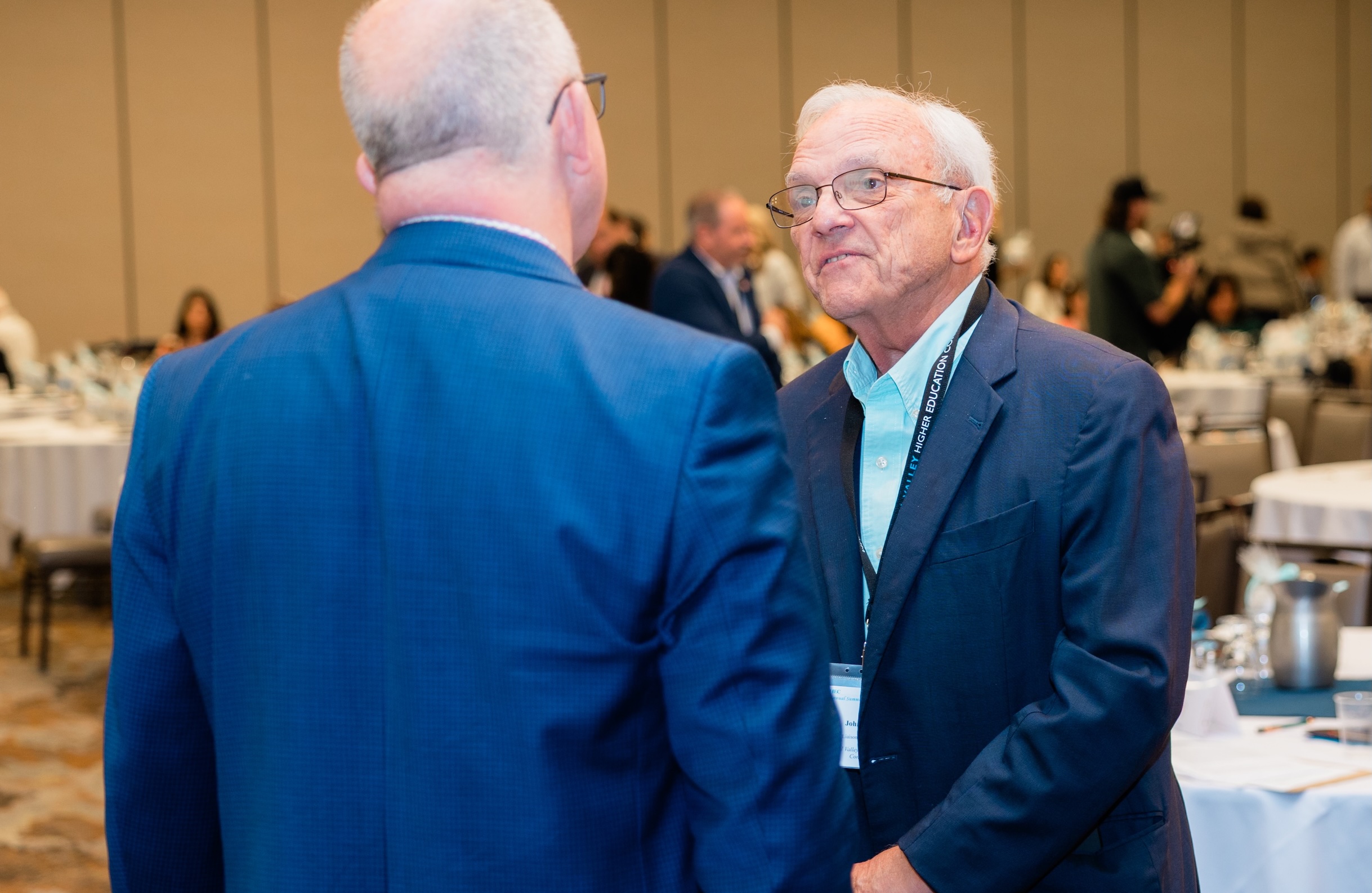
CVHEC’s John Spevak culminates nine years with the consortium in June and offers some farewell comments in this month’s blog.
Hopping off the ‘CVHEC Express’
Outgoing CVHEC team stalwart reflects on a decade with the consortium
BY JOHN SPEVAK
CVHEC Liaison to the Faculty
(MAY 19, 2026) — June 30 will be my last day as part of the Central Valley Higher Education Consortium staff, after a nearly decade of collaborating with some remarkable individuals, including my staff colleagues here and the colleagues I’ve worked with at the 28 institutions that comprise CVHEC.
This month’s “What the CV-Hec is Happening” Blog is a bittersweet one for the consortium as it features Dr. John Spevak, CVHEC’s faculty liaison who departs the team this June closing out a nine-year stint within a stellar 40-year career in higher education … all in the Central Valley. Here the Chicago native, who earned a Ph.D. in English at the University of Chicago in 1978, looks back on his time and accomplishments with the consortium. The U.S Air Force veteran counts five retirements to his resume, insisting this will be the final one. He leaves with a caution that CVHEC is “needed more than ever” with many questioning the value of higher education and urging college graduates to “use their talents to make this world a better place.”
It all started quite innocently for me. In the fall of 2017, out of the blue, I got a call from an old friend and colleague, Ben Durán, who was president at Merced College when I was a vice president. The previous year, Ben had come out of retirement to serve as executive director of CVHEC.
“John, how would you like to join me at CVHEC?” inquired Ben. “Sure, what the heck,” I replied.
Years before, while at Merced College, I had also been a very small part of CVHEC, after Fresno State President John Welty had initiated it.
Now Ben presented a new challenge: to join the team as northern regional coordinator. He was concerned that people in the northern part of the valley (as well as the southern part) might be feeling that CVHEC, which had its offices in Fresno, was too Fresno-centric.
He asked me to personally visit the president of each institution in the northern region of the Central Valley, from San Joaquin Delta to UC Merced. That assignment suited me perfectly; I still had some connections from my Merced College days. I enjoyed revisiting each campus, and each chief executive officer welcomed me kindly. Today, I rest assured that this objective has been fulfilled: all of our member institutions, throughout the valley, feel they are valued.
When I look back at the agenda of the first CVHEC staff meeting I attended in 2017, I realize it included a number of items which still resonate today: Guided Pathways, Math Pathways, Corequisite Remediation, and a CVHEC Regional Data Platform.
Soon after that meeting, AB 705 was passed by the California legislature, and that bill, along with the later AB 1705, consumed most of my decade at CVHEC. Before long the organization created two AB 705 task forces, one for English and one for math. I agreed to facilitate the English Task Force, but other educators, like Jim Gilmore at Reedley College, facilitated the Math Task Force.
The English group which I facilitated, professors from all public CVHEC institutions – 15 community colleges, three CSUs and UC Merced — included bright instructors who were willing to give “acceleration” a try. Once they did, they realized that many English students who would have previously had to take one or more remedial courses, could, with enough wraparound support, pass what is now called English 1000. I continued to facilitate this dedicated group through 2026, when we recognized we had fulfilled the task of the task force.
The math group also moved forward, although more slowly and sometimes a little reluctantly. Although I didn’t facilitate Math Task Force meetings, I sat in (via Zoom) on many of them. They understood the intent of AB 705, especially in allowing non-STEM majors to complete their graduation math requirement with a course like statistics. The math profs in the task force often had to take a lot of flak from their fellow math profs, but they endured.
Once COVID hit, math professors had other issues to deal with, and the task force stopped meeting. But when AB 1705 was passed in 2022, we at CVHEC felt we needed to reconvene the task force. For some strange reason, I agreed to facilitate that group, helped in large part by the Dana Center out of the University of Texas at Austin. This was a bigger challenge than AB 705 for everyone, since it focused on STEM math, especially calculus.
Eliminating all prerequisites for calculus, as the Chancellor’s Office had directed, seemed highly impractical, math professors thought, especially for students who completed only the required two years of math in high school. During the next three years the group met, had animated discussions, and came to the conclusion they would go forward with student success in math during AB 1705 era “The Central Valley Way.” This past April the Math Task Force met for the last time, again recognizing for the most part its task has been completed.
During my decade at CVHEC I was involved in one other large project moving forward successfully, dual enrollment. In the summer of 2019 CVHEC convened its first gathering related to dual enrollment, when the term CVDEEP was coined (Central Valley Dual Enrollment for Equity and Prosperity). It was clear that dual enrollment was a topic of importance, so CVHEC convened a second meeting on March 5, 2020 (just before COVID shut everything down).
During that meeting representatives from rural high schools said how hard it was to get community college faculty to travel to their schools and said they wished their high schools had more teachers with master’s degrees in English and math who could teach dual enrollment courses.
Soon after, CVHEC came up with the idea of “M.A. Upskilling” in English and math for high school teachers. After a lot of work and with the important collaboration with two CVHEC members, National University and Fresno Pacific University, we developed a program that was funded in great part by the Fresno K-16 Collaborative. At that time CVHEC also came up with the idea of assigning community college faculty as mentors for those high school teachers going through the M.A. programs.
The first cohort of M.A. students and mentors started in 2021, and today the M.A. Upskilling project and mentorships continue, not just in the central region of CVHEC but also in the northern and southern regions as well.
CVHEC has been involved for the past decade in many other accomplishments, most notably Program Mapper, but for that I was only a cheerleader for my fellow CVHEC colleagues, Stan Carrizosa and Tom Burke.
It’s been quite a ride on the CVHEC Express since 2017, an exhilarating and productive one. I’m proud of the success CVHEC has had during that time, not only with those projects in which I’ve been directly involved, but also the many others for which I’ve cheered.
Looking ahead, CVHEC will be needed more than ever. Many people in this valley, this state and this nation are questioning the value of higher education. CVHEC will need to continue to stress the importance of a college education, including two-year career degrees, and to remind Californians that a student can earn a degree in this state without going into debt.
Another challenge is to remind the public that higher education sends into this world individuals who can immediately contribute not only to the workplace and the economy but also to their communities and their society. Graduates from CVHEC institutions, with the breadth of their education, understand the value of the sciences, the social sciences and the humanities. They realize that a meaningful life includes not only earning an income to support themselves and their families but also understanding their responsibility to use their talents to make this world a better place.
Now, as I leave the consortium, I know the organization is in good hands, with Ben Duran at the helm and a staff of leaders younger than I am continuing to play key roles. I know the dedicated CVHEC team will continue to prosper in working toward success in all member institutions for all students “The Central Valley Way.”

