Successful CVHEC partnership with Kern K-16, KCSOS strengthens dual enrollment opportunities
(SEPT. 10, 2026) — The Central Valley Higher Education Consortium’s Master’s Upskilling initiative –designed to strengthen dual enrollment opportunities by helping high school teachers earn master’s degrees — reached a major milestone with 88 Kern County high school teachers completing master’s degrees in mathematics or English.
This cohort marks the final phase of the three-year Kern County expansion of this program funded through the statewide Regional K-16 Education Collaborative that CVHEC presented with several of its 28 member-institution of higher education in programs throughout the South, Mid and North Valley regions
In the South Valley, the Kern Regional K-16 Education Collaborative received its final quarterly report in June announcing that 42 teachers have earned master’s degrees in Math Education and 46 have earned master’s degrees in English. The report marks the formal completion of CVHEC’s “Increasing MA Degrees to Improve Dual Enrollment” project.
The accomplishment represents the culmination of a multi-year partnership between CVHEC and the Kern Regional K-16 Education Collaborative, created to address one of the challenges facing expansion of dual enrollment: having enough qualified high school teachers who meet the minimum qualifications to teach college-level courses.
The Masters Upskilling Project was first launched in 2021 with the Fresno/Madera K-16 Collaborative. In 2022, the program expansion was funded for the South Valley by the Kern Regional K-16 Education Collaborative and in 2024 for the North Valley by the WE Will! K-16 Workforce and Education Collaborative.
The project focused on upskilling high school math and English teachers through master’s degree programs, preparing them to teach dual enrollment and, where appropriate, community college courses. The Kern K-16 initiative was part of a statewide effort funded through an $18 million competitive grant announced in 2022 to improve students’ transitions from high school to postsecondary education and ultimately the workforce. CVHEC received $1.7 million to produce up to 100 qualified dual enrollment teachers in English and math over three years.
For Kern County, the investment has translated into a substantially larger pool of teachers who are academically prepared to bring college-level instruction to high school classrooms.
“This project was designed to solve a very practical problem for dual enrollment — making sure we have qualified teachers available to teach the college courses our students need,” said Tom Burke, CVHEC’s MA Upskilling Lead and Transfer Project Coordinator. “The completion of these degrees means 88 more teachers are now positioned to help expand those opportunities for Kern County students.”
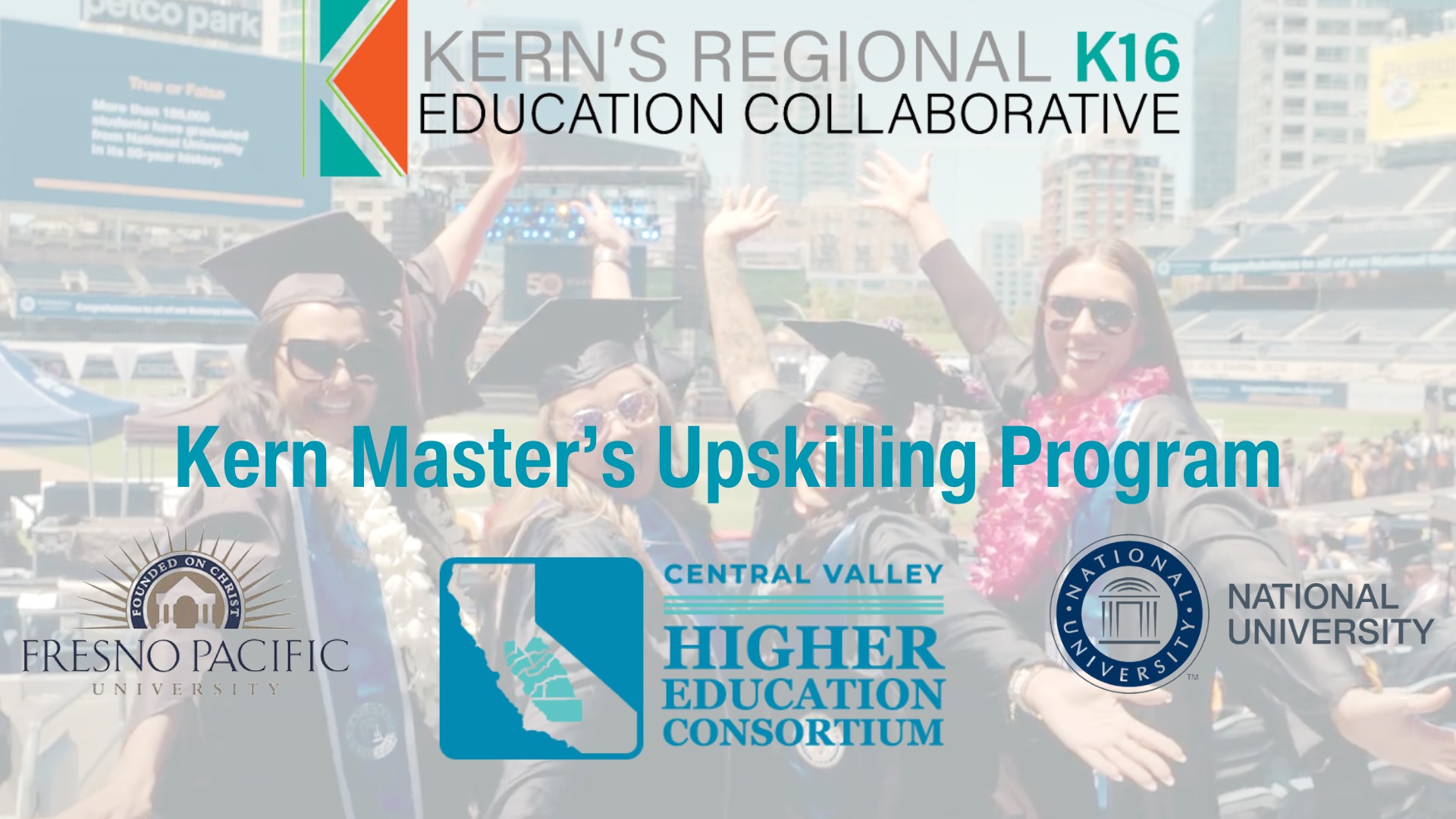
The program provided participating teachers with financial assistance toward their graduate education through CVHEC partnerships with Fresno Pacific University, which provides the mathematics master’s program, and National University, which provides the English master’s program. The initiative also incorporated a mentoring component, pairing high school teachers with community college faculty who could help them navigate graduate study and prepare for their eventual roles as college instructors.
That mentoring relationship became one of the program’s defining features led by Dr. Vikash Lakhani, English Faculty Mentor coordinator; and Dr. Lori Bennett and Liz Rozelle , Math Faculty Mentor coordinators.
Community college mentors met with participants regularly, offering guidance on graduate coursework, teaching strategies, college-level expectations and the process of entering community college adjunct faculty pools. CVHEC’s mentor program also sought to make the transition from high school teacher to dual enrollment instructor less daunting by providing a connection to faculty already working in higher education.
The impact extends beyond the teachers who earned the degrees. The Kern K-16 report specifically identifies the project’s purpose as supporting college preparation and early credit by increasing the number of high school teachers qualified to teach dual enrollment and community college courses.
“The real measure of this work is what happens next,” Burke said. “These teachers have invested in themselves professionally, but their new qualifications create opportunities for thousands of students to earn college credit while they are still in high school. That is the ripple effect we hoped this project would create.”
The latest report shows that the final cohorts completed their programs during the reporting period. Fifteen math teachers graduated in the third math cohort, bringing the project total to 42. Eight English teachers graduated in the fourth English cohort, bringing the English total to 46.
The project also is continuing to produce connections between the participating teachers and community colleges. Mentors are helping teachers who have completed the program learn how to apply for adjunct positions in local community college districts, according to the report.
Although the formal project has ended, CVHEC and the Kern Regional K-16 Collaborative see the 88 graduates as an important foundation for continued expansion of dual enrollment.
“The completion of the Master’s Upskilling Project demonstrates what can happen when K-12 and higher education institutions work together around a shared regional goal,” said Dr. Benjamín T. Durán, CVHEC executive director. “We have helped create a stronger pipeline of qualified teachers while simultaneously creating more opportunities for high school students to experience college-level learning and earn early credit.”
Durán said the project also reflects CVHEC’s broader approach to regional collaboration: bringing colleges, universities and school systems together to address barriers that individual institutions cannot easily solve on their own.
“This is more than 88 degrees,” Durán said. “It represents 88 educators who have expanded their professional capacity and who can now help more students see college as something they can begin — and succeed in — before they graduate from high school.”
The Kern Regional K-16 report describes the project as complete, with some mentor and mentee activity continuing. It also identifies the next priority: continuing to expand dual enrollment so the teachers who have completed the program can teach the courses for which they are now qualified.
“For CVHEC, the goal has never been simply to increase the number of master’s degrees,” Burke explained. “It has been to use those degrees as a tool for strengthening the connection between high school and college — giving students earlier access to college-level coursework while creating a deeper pool of qualified educators throughout the South Valley.”
He added that the completion of the Kern project marks a significant milestone in that effort, while laying the groundwork for continued growth in dual enrollment across the region.

