Dual Enrollment: The Central Valley Way

Who Was at the Table?
San Joaquin Delta College
- Vivie Sunu – Dean of Dual Enrollment
- Jacquelynn Schwegel – Math Professor, College Bridge Program
Stagg High School
- Gina Saxton – High School Math Teacher and College Bridge Partner
College Bridge
- Lynn Cevallos – President, College Bridge

A Math Bridge Partnership – San Joaquin Delta College
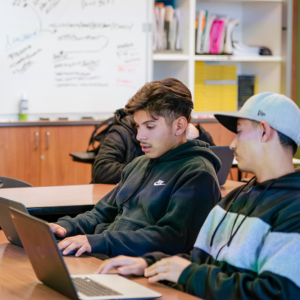
San Joaquin Delta College has a long history of offering dual enrollment, but its recent implementation of a bridge program to prepare students for college and STEM pathways is a model for all colleges, especially those in the Central Valley. Math faculty coordinate with high school math teachers through the College Bridge Program, which ensures high school students have access to math that will set them up for college success.
“In Stockton, many high schools only require two years of math to graduate — sometimes just Algebra 1 and a personal finance course. Students were arriving to the college unprepared for STEM programs.”
Jacquelynn Schwegel
Math Bridge is the process of encouraging students who have struggled in math to not just take an additional math class, but to elect to take their most challenging math class yet…and then helping them to succeed.

Dr. Lynn Cevallos
San Joaquin Delta College 2024-2025 Academic Year
16,100
Total full-time equivalent (FTE) enrollment (credit)
180
Number of dual enrollment course sections offered (CCAP)
5
Number of dual enrollment course sections taught by high school teachers who meet minimum qualifications (MQs)
3,961
Total number of students enrolled in dual enrollment courses (CCAP)
9,695
Total number of high school students enrolled in courses
Statistics from California Community College Chancellor’s Office Data Mart 2024-2025
Pathways: San Joaquin Delta College offers five dual enrollment pathways.
Best Practices and High Impact Strategies for Teaching Math in High Schools
1. Team Teaching for Student Success
The hallmark of the program is team teaching, where a college professor partners with a high school teacher to support students:
- High school teachers lead classes on the days that college faculty are not on site, providing consistent, daily mentorship.
- High school teachers go above and beyond by hosting after school or weekend review sessions.
“Math teachers play a critical role, even hosting weekend review sessions with pizza to keep students engaged.” – Jacquelynn Schwegel
2. Integrated Scheduling and Real-World Skills
The course mirrors the structure of college-level learning:
- Flipped Learning Model: Students engage with selected lessons online to simulate the learning process and prepare them for in-class lessons.
- College Readiness Skills: Students learn to manage Canvas, check email, and meet deadlines independently.
- Completion of Transfer level Math While in High School: By completing college-level statistics, many students satisfy their general education math requirement for a bachelor’s degree while still in high school.
“If you’re a junior or senior and complete this course, you may have completed the only math you need for a bachelor’s degree while in high school.” – Jacquelynn Schwegel
3. Building Student Confidence
Through supportive structures and consistent mentorship, students begin to see themselves as college-ready:
- Early in the semester, students rely on the high school teacher for guidance.
- By semester’s end, they confidently engaged with the college professor, building self-advocacy skills essential for future success.
“These students now understand that professors are there to help. They’ve learned to ask questions and seek support — a critical skill for college success.” – Jacquelynn Schwegel
Outcomes and Impact
The program’s first year produced strong results, demonstrating the power of this high-touch model:
Pass Rate: 77% (17 of 22 students), higher than the pass rate for the same course taught to college students.
High Achievement: Six students earned A’s in college statistics.
Confidence Growth: Students transitioned from tentative learners to empowered college-ready students.
Lessons Learned
1. Team Teaching for Student Success
The hallmark of the program is team teaching, where a college professor partners with a high school teacher to support students:
- High school teachers lead classes on the days that college faculty are not on site, providing consistent, daily mentorship.
- High school teachers go above and beyond by hosting after school or weekend review sessions.
“Math teachers play a critical role, even hosting weekend review sessions with pizza to keep students engaged.” – Jacquelynn Schwegel
2. Integrated Scheduling and Real-World Skills
The course mirrors the structure of college-level learning:
- Flipped Learning Model: Students engage with selected lessons online to simulate the learning process and prepare them for in-class lessons.
- College Readiness Skills: Students learn to manage Canvas, check email, and meet deadlines independently.
- Completion of Transfer level Math While in High School: By completing college-level statistics, many students satisfy their general education math requirement for a bachelor’s degree while still in high school.
“If you’re a junior or senior and complete this course, you may have completed the only math you need for a bachelor’s degree while in high school.” – Jacquelynn Schwegel
3. Building Student Confidence
Through supportive structures and consistent mentorship, students begin to see themselves as college-ready:
- Early in the semester, students rely on the high school teacher for guidance.
- By semester’s end, they confidently engaged with the college professor, building self-advocacy skills essential for future success.
“These students now understand that professors are there to help. They’ve learned to ask questions and seek support — a critical skill for college success.” – Jacquelynn Schwegel

Bottom Line
San Joaquin Delta College’s College Bridge Program demonstrates how intentional, high-touch dual enrollment utilizing a bridge program can transform outcomes for students who may not otherwise see themselves as college-bound. By building math confidence, removing barriers, and fostering strong relationships, the program prepares students for success in STEM pathways and beyond — while serving as a model for other rural and urban schools seeking to expand equitable dual enrollment access.
“This is about giving students the confidence to see themselves as college-ready — and capable of thriving in higher education.”
Jacquelynn Schwegel
Rural Dual Enrollment in Action
LESSONS AND STRATEGIES FROM THE CENTRAL VALLEY