
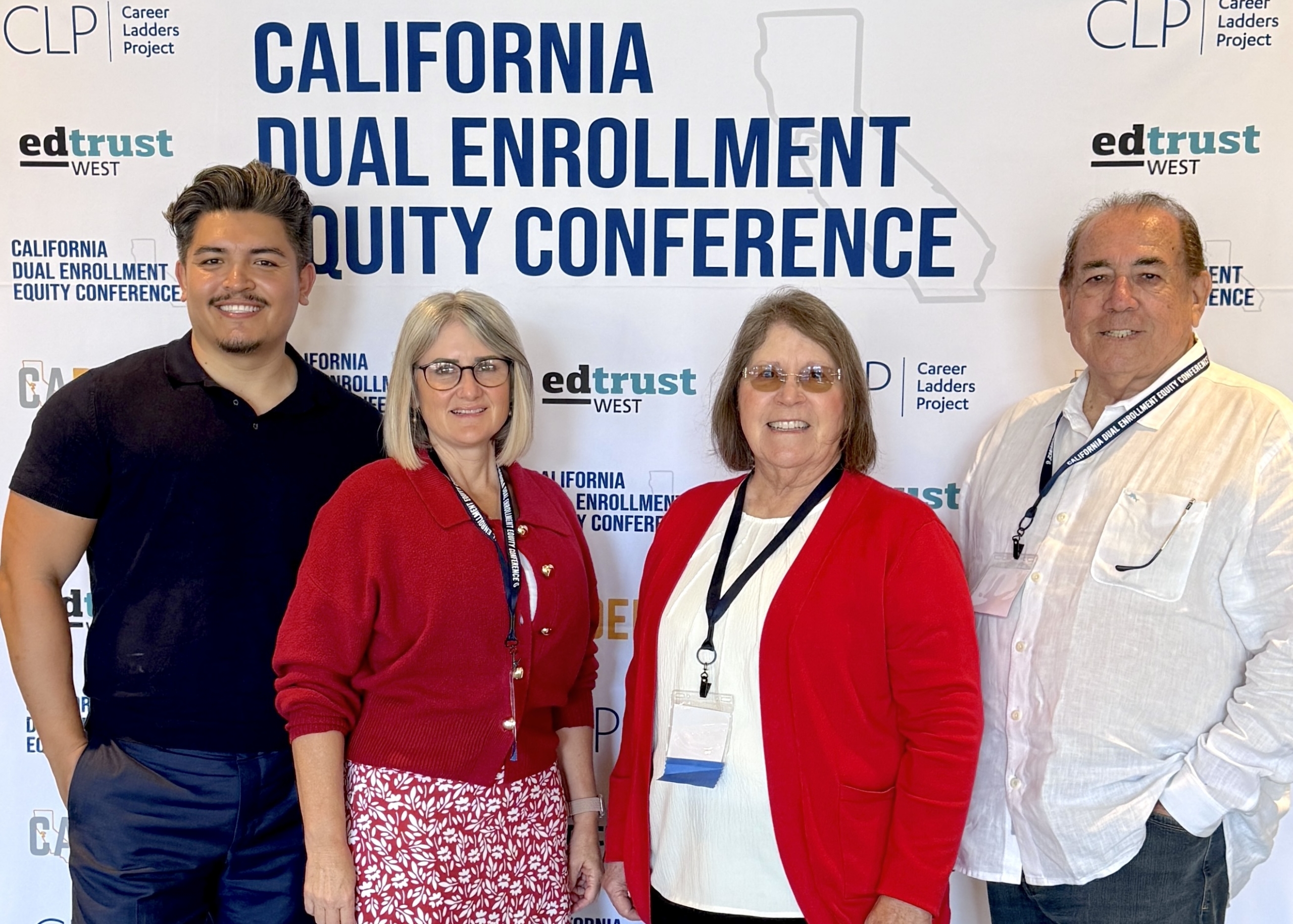
The CVHEC delegation attending the the California Dual Enrollment Equity Conference in San Diego March 16-19 where the consortium’s new dual enrollment playbook was unveiled: Associate Director Ángel Ramírez; Dual Enrollment Co-leads Dr. Kristin Clark and Elaine Cash; and Executive Director Benjamín Durán.
Connecting with rural dual enrollment realities
CVHEC Playbook presented at California Dual Enrollment Equity Conference
(APRIL 15, 2026) — A near full house and enthusiastic cohort of front-line practitioners at the California Dual Enrollment Equity Conference last month provided for an energetic public unveiling of the Central Valley Higher Education Consortium’s Dual Enrollment Playbook, a newly released roadmap for expanding college access in rural California by chronicling the successes of CVHEC member colleges and partnering school districts.
The conference, held March 16–19 in San Diego and hosted by the California Dual Enrollment Program, the Career Ladders Project and EdTrust–West, drew more than 1,000 educators and practitioners from across the state — an indication of growing interest in equitable dual enrollment expansion throughout California.
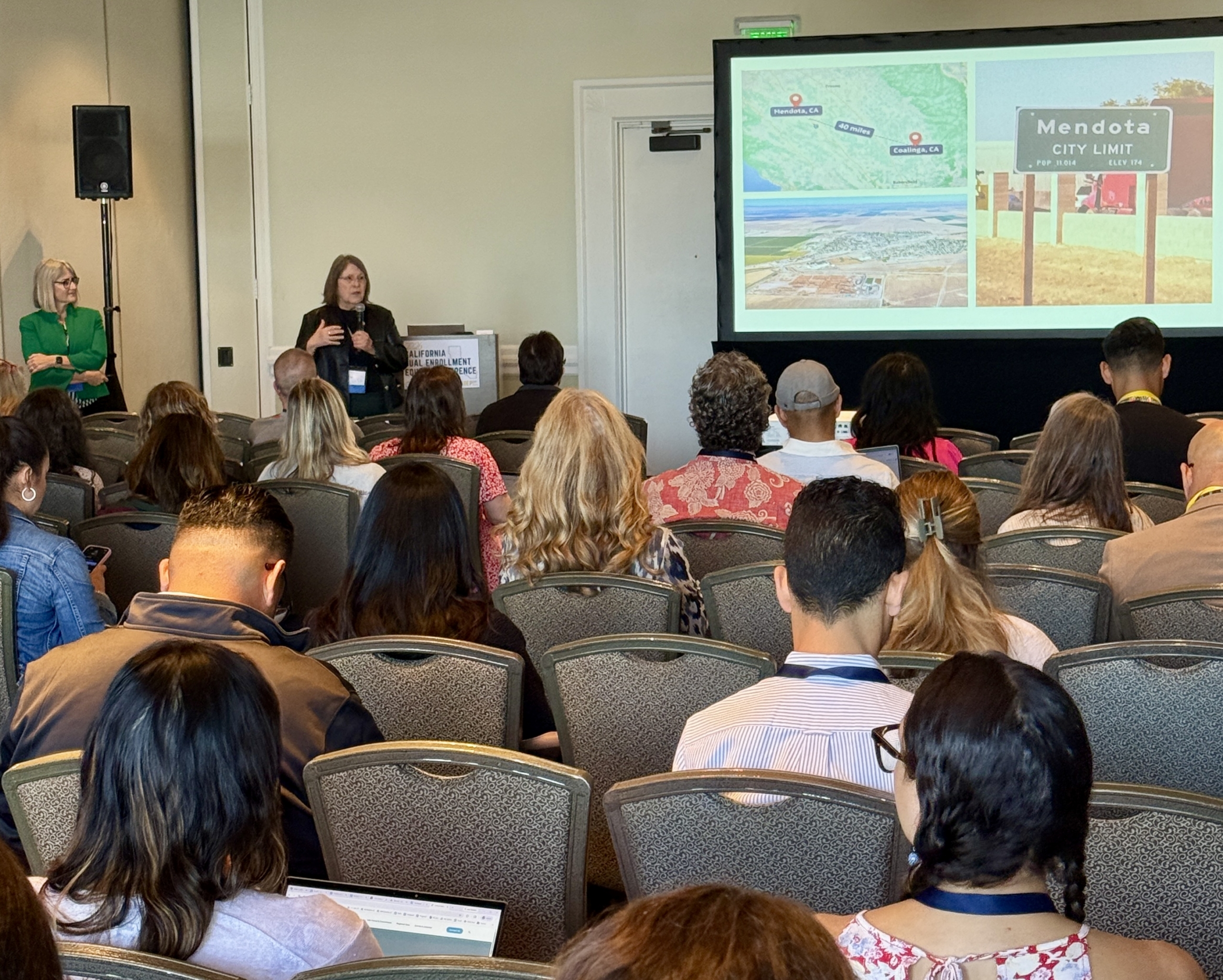 CVHEC’s session at the event, “Random Acts to Roadmaps: Dual Enrollment in Rural Schools,” was led by the consortium’s dual enrollment co-leads, Dr. Kristin Clark and Elaine Cash. The CVHEC delegation to the conference also included Executive Director Benjamín Durán and Associate Director Ángel Ramírez.
Clark and Cash authored the 57-page online playbook, “Rural Dual Enrollment in Action: Lessons and Strategies from California’s Central Valley,” that was released March 16 and presented for the first time the next day in the CDEEC session before an eager statewide audience.
The CVHEC dual enrollment duo discussed how the playbook documents practical strategies to help rural and under-resourced schools build sustainable dual enrollment programs that allow high school students to earn college credit.
Compiling eight case studies from smaller, rural community colleges and their K–12 partners, the report offers both storytelling and step-by-step guidance for building effective programs despite common challenges such as geographic isolation, limited staffing and scarce resources. (One urban school is included because of its work with CVHEC’s Central Valley Math Bridge Program. See full list of playbook participants below).
“The room at the dual enrollment conference especially connected with the realities rural districts face,” Clark noted, adding that many attendees, many of whom serve similar rural communities, remained after the session to ask questions and express appreciation for highlighting rural perspectives often underrepresented in statewide conversations.
Drawing from 2025 interviews with educators across the CVHEC’s 10-county region for the playbook, Clark and Cash outlined key elements behind successful rural dual enrollment efforts. These include intentional pathway design aligned with workforce needs, strong institutional leadership, creative staffing solutions, productive K–12 and college partnerships, high-touch student support systems, and an unwavering commitment to equity and access.
As the CVHEC presenters described barriers such as faculty shortages and long travel distances, participants responded with nods of recognition and shared experiences. The discussion evolved into an active exchange, with educators contributing ideas and strategies from their own regions.
“The strong turnout made one thing clear: there’s real momentum around the work CVHEC colleges are leading that expand access to high-quality dual enrollment,” Clark said.
Cash emphasized the importance of moving beyond fragmented efforts toward more intentional, structured approaches.
“Participants appeared highly engaged, responding with visible enthusiasm and active participation,” she said. “Many shared their own experiences and challenges, creating a dynamic exchange of ideas focused on moving from disconnected efforts to more intentional dual enrollment opportunities.”
According to Cash, the playbook struck a chord as both a practical and adaptable tool. Attendees expressed interest in applying its strategies locally, particularly valuing its grounding in real-world examples from practitioners.
“The Dual Enrollment Playbook seemed to resonate as a practical and adaptable tool for building sustainable programs in rural settings,” Cash said. “There’s strong demand for structured, scalable approaches in rural education.”
The playbook represents years of collaborative work led by CVHEC, beginning in 2019 with the formation of the Central Valley Dual Enrollment for Equity and Prosperity (CVDEEP) Task Force seeking to answer a central question: how to expand equitable access to college coursework for every high school student in the Central Valley.
The playbook was one of the long-term initiatives set in motion by the task force to illustrate how partnerships between community colleges and feeder high schools can create replicable pathways to college and careers.
Executive Director Durán said the result portrays how collaboration between CVHEC community colleges and Central Valley K–12 schools is redefining pathways to college.
That collaboration has already produced measurable results. Between 2016 and 2019, more than 120,000 Central Valley high school students participated in dual or concurrent enrollment. By the 2024–25 academic year, participation had grown to nearly 140,000 — an increase of more than 50 percent.
“State leaders have taken notice, citing the region as a model for expanding access and equity,” said Durán, a president-emeritus of Merced College.
Cash said the playbook underscores dual enrollment’s broader impact: giving students the opportunity to earn college credit at no cost, accelerate degree completion, and enter the workforce sooner. For many rural and low-income students, these opportunities can be transformative, she noted.
And throughout the conference session, the duo repeatedly emphasized that the success of these efforts rests on the voices and experiences of educators and partners across the Central Valley region – a movement that will only grow as the playbook will be a “living document” that will be updated annually with new data and stories as programs evolve.
“We’re especially grateful to the colleges and high schools who partnered with us and shared their experiences so openly,” Clark said. “Their voices are at the heart of CVHEC’s dual enrollment story.”
As the CVHEC session in San Diego concluded, the energy in the room reflected both validation and urgency, Durán, observed.
“Based on their reactions, we could see that for many attendees, the playbook offered not just inspiration, but a roadmap as intended — one grounded in proven strategies and adaptable to diverse rural contexts,” he said.
“With this strong engagement at the conference and growing statewide interest, the goal now is to continue scaling these efforts and ensure that more students, regardless of geography and other barriers, have access to the opportunities dual enrollment provides,” Durán added.
Also at the CDEEC, representatives of CVHEC partner College Bridge presented a session, “Intentional & Supported Dual Enrollment for Students Who Struggle,” by Nicole Korgie, vice president of Operations, and Owynn Lancaster, vice president of Academic Strategy, along with Kristi Rieg, Merced College math professor. (They are part of the Central Valley Math Bridge Program in partnership with CVHEC and Rand Corporation).
Access the CVHEC Playbook:
“Rural Dual Enrollment in Action: Lessons and Strategies from California’s Central Valley”
The CVHEC community college members and selected feeder schools/districts featured in the consortium’s first dual enrollment playbook are:
- Coalinga College (Mendota High School)
- Columbia College (Summerville High School & Sonora High School)
- Lemoore College (Lemoore & Caruthers High Schools)
- Merced College (Merced Union High School District)
- Porterville College (Porterville Unified High School District and Burton High School)
- Reedley College (Sanger Unified School District)
- Taft College (Taft Union High School)
(One urban school is included because of its work with CVHEC’s Math Bridge Program):
- San Joaquin Delta College (Stagg High School × College Bridge Model)
For Dual Enrollment Week 2026 underway April 13-17, CVHEC is featuring the playbook case studies.
See:
- CVHEC Presents Dual Enrollment Playbook (Newsletter -March 16)
- KSEE (spotlight link to come)

