

CCC Chancellor Sonya Christian to deliver keynote at Central Valley Dual Enrollment Convening Feb. 3 in Fresno Agenda includes pre-conference session for schools new to dual enrollment Dr. Sonya […]


CVDEEP Task Force convening for educators in 10-county region to look at strategic planning, policy changes, student success and equity REGISTER HERE The Central Valley Dual Enrollment for […]

To schedule an information session: individual OnDemand appointments
BY TOM URIBES
CVHEC Communications Coordinator
The success of the Kern Master’s Upskill Program has resulted in the creation of an additional English cohort of 15 slots that will begin in March 2025 – meaning more Kern high school teachers can obtain funding to earn a master’s degrees qualifying them to instruct dual enrollment courses at Kern County high schools as well as to become adjunct community college instructors.
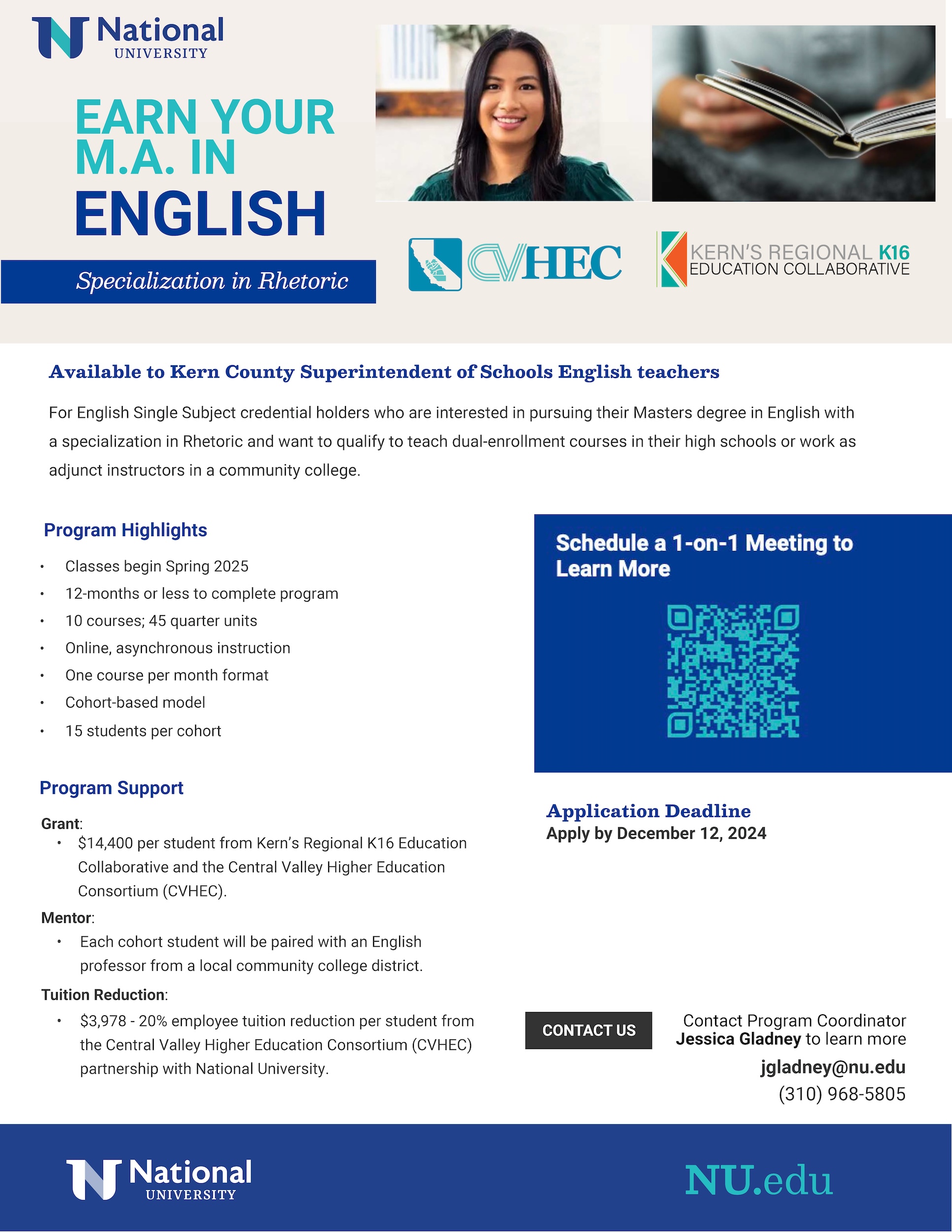 The program by the Central Valley Higher Education Consortium, in partnership with the Kern Regional K-16 Education Collaborative through the Kern County Superintendent of Schools (KCSOS), provides eligible high school teachers with a grant and tuition reduction through two consortium members: Fresno Pacific University offers a Master’s degree in Mathematics education and National University offers a Master’s degree program in English.
For this new fourth cohort, English Single Subject credential holders who are interested in pursuing a Master’s degree in English with a specialization in Rhetoric can receive a $14,400 grant from the Kern K16 Collaborative and CVHEC and a $3,978 (20%) “employee tuition reduction” per student because of National University’s partnership with CVHEC.
Jessica Gladney, program coordinator for National, said interested high school English teachers may learn more about the program and apply by attending information sessions available through individual OnDemand appointments to fit their own schedule.
Additionally, mentors are assigned to each of the 15 students to counsel them during the course of their postbaccalaureate degree studies as well as help access adjunct hiring pools at the local community colleges.
The Kern Master’s Upskill Program is part of an $18 million statewide competitive grant in June 2022 to improve student progress from high school to postsecondary education and ultimately into the workforce under KCSOS, which serves as the administrative agent for the Kern K-16 Collaborative.
CVHEC was awarded $1.7 million to produce, over three years, up to 100 qualified dual enrollment teachers to teach English and Math. Tom Burke, a CVHEC regional coordinator and chancellor-emeritus of the Kern Community College District, was appointed the consortium’s Kern Masters Upskilling Program lead.
Burke recently reported that in the past academic year since the Kern program’s inception, 48 students earned their master’s degrees: 32 English master’s degrees have been conferred in three cohorts to date with nine still in progress and 16 math master’s degrees have been conferred from the first of three cohorts. (In the math program, cohort two currently has 11 students on course to graduate in May 2025 while cohort three commenced this current fall semester with 22 master’s candidates scheduled to complete requirements in spring 2026).
He added that this newly-funded fourth Kern English cohort, combined with the first three, will increase the number of high school teachers with a English master’s degree in Kern County by 56, just a little over half of the intended goal.
“We are appreciative that the Kern K-16 recognizes the success and value of CVHEC’s Master’s Upskill Program that inevitably supports dual enrollment opportunities for our students and professional advancement for our high school teachers,” said Burke.
KCSOS spokesperson Kimberly Graham said Kern K-16 approved the additional funding for the CVHEC Upskilling project “to support the formation of an additional cohort because it addresses limitations the first three cohorts faced in achieving maximum participant outcomes.”
She calls it a strategic move because increasing the number of qualified high school teachers who can teach dual enrollment English courses aligns with the overarching goal of the Kern K-16 program as well as a long-term strategy for educational equity and success in the region.”
“The Kern K-16 program aims for greater educational access and equity, and the continued investment in the CVHEC project will support this by upskilling teachers and expanding dual enrollment opportunities for students,” said Graham who is the chief leadership support officer for the KSOS Local, Regional and Statewide Systems of Support.
“Adding a fourth English cohort contributes to the educational development of the region by preparing students for college-level coursework earlier in their educational paths.”
She added that by collaborating with National University, the project ensures that high school teachers receive flexible and rigorous online master’s degree programs, making them eligible to teach at the community college level.
The consortium has also implemented the program in two Central Valley K-16 regions: the Fresno/Madera K-16 Collaborative where the program was first launched in 2021 with a $1,830,500 grant and this fall with the WE Will! K-16 Collaborative in the North Valley under two $400,000 state grants.
It includes the CVHEC Mentor Program pairing each enrolled high school teacher with an English or math professor from a local community college district to help navigate the process to becoming an adjunct community college faculty member and provide other support along the way.
In Kern, the Mentor Program coordinators are Dr. Liz Rozell (math) and Dr. Vikash Lakhani (English). Burke said the program is currently recruiting for math mentors. English mentors will be recruited in the spring. They receive a $2,000 stipend.
For questions about enrollment, please contact Jessica Gladney at jgladney@nu.edu or 310.968.5805.
For questions about CHVEC and its Master’s Mentor Program, Burke may be contacted at tburke5@att.net.
See:
· Kern Master’s Upskilling Program: 2nd cohort graduates – next cohort recruitment underway
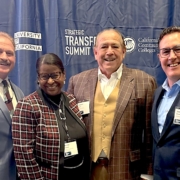
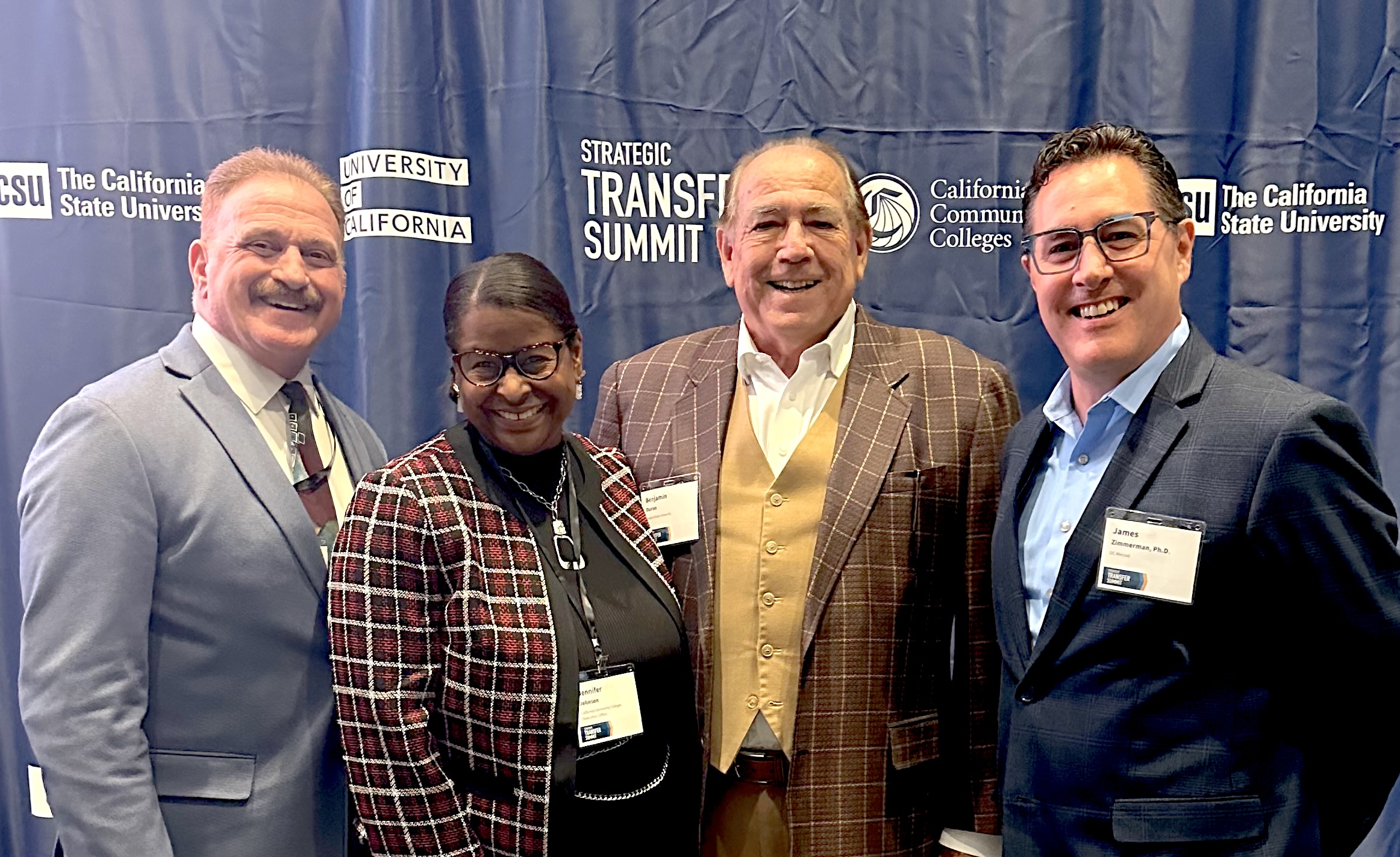
Executive Director Benjamín Durán (third from left) led the CVHEC delegation at the Strategic Transfer Summit with Transfer Project Lead Stan Carrizosa, Jennifer Johnson of California Community Colleges Foundation and Dr. James Zimmerman of UC Merced. (Photo below): The California Economic Summit in October was attended by Ángel Ramírez, Elaine Cash, Tom Uribes (back), Priscilla Arrellano posing with Assemblyman Joaquin Arambula.
Central Valley Higher Education Consortium delegations are making the rounds this fall at several state and national conferences including the recent Strategic Transfer Summit presented by the California Community Colleges Nov. 8 at UC Merced.
Other destinations include the Complete College America National Conference in Indianapolis Nov. 18-20; the American Mathematical Association of Two-Year Colleges (AMATYC) in Atlanta Nov. 14-17 through the Dana Center with CVHEC Math Task Force members Jeremy Brandl of Fresno City College and Shelley Getty of Taft College; and the Community Colleges League of California Nov. 22 in Sacramento.
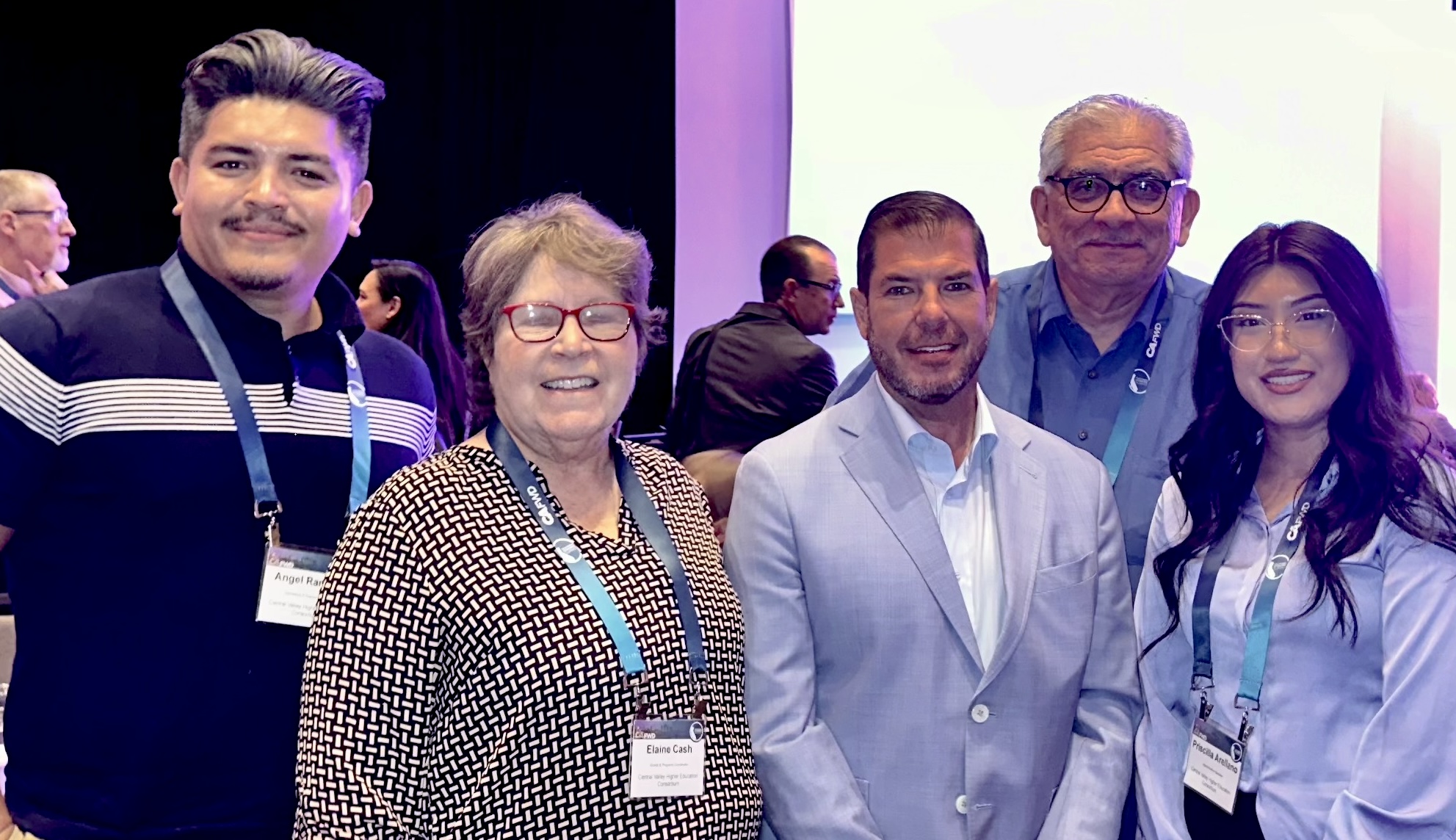 CVHEC also attended the California Economic Summit held Oct. 8-10 in Sacramento.
At the recent Transfer Summit, CVHEC’s Transfer Project team presented an update on its progress in partnering with the consortium’s 15 community college members using the Program Pathway Mapper software for a smoother transfer process for students. Leading the CVHEC delegation at the UC Merced event was Executive Director Benjamín Durán and Transfer Lead Stan Carrizosa along with James Zimmerman vice chancellor of UC Merced and Jennifer Johnson California Community Colleges Foundation.
Carrizosa said the summit, attended by the chief executive officers of the state’s three public higher ed segments – the University of California, the California State University and the California Community Colleges – provided a prime opportunity to showcase the consortium’s Transfer Project.
“The participation of the statewide CEOs of CCC, CSU & UC — coupled with powerful student testimony — makes this event an inflection point that sets our Transfer Project on its next upward trajectory,” Carrizosa said.
 CVHEC’s Transfer Project has been designated as a California Community Colleges Demonstration Project by Chancellor Sonya Christian to serve as a model systemwide.
This month, Duran will also attend the CLCC in Sacramento as well as lead the CVHC delegation to the CAC national conference in Indiana. Attending the CAC with him will be Angel Ramirez, operations/finance director; Elaine Cash, grants coordinator; and Tom Uribes, communications/media coordinator.
For the CA Economic Summit in October, Ramirez, Cash and Uribes were joined by Priscilla Arrellano, administrative specialist.

[UPDATE DEC. 18, 2024]: This event is rescheduled for Feb. 3, 2025. See updated story: https://bit.ly/CVHEC-DualEnrollConv25

Math Bridge and Master’s Upskilling heading north via WE Will! K-16 funding ‘Together, we are creating pathways for success that will benefit our communities for generations to come.’ […]