

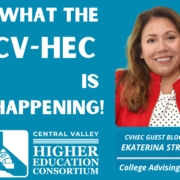
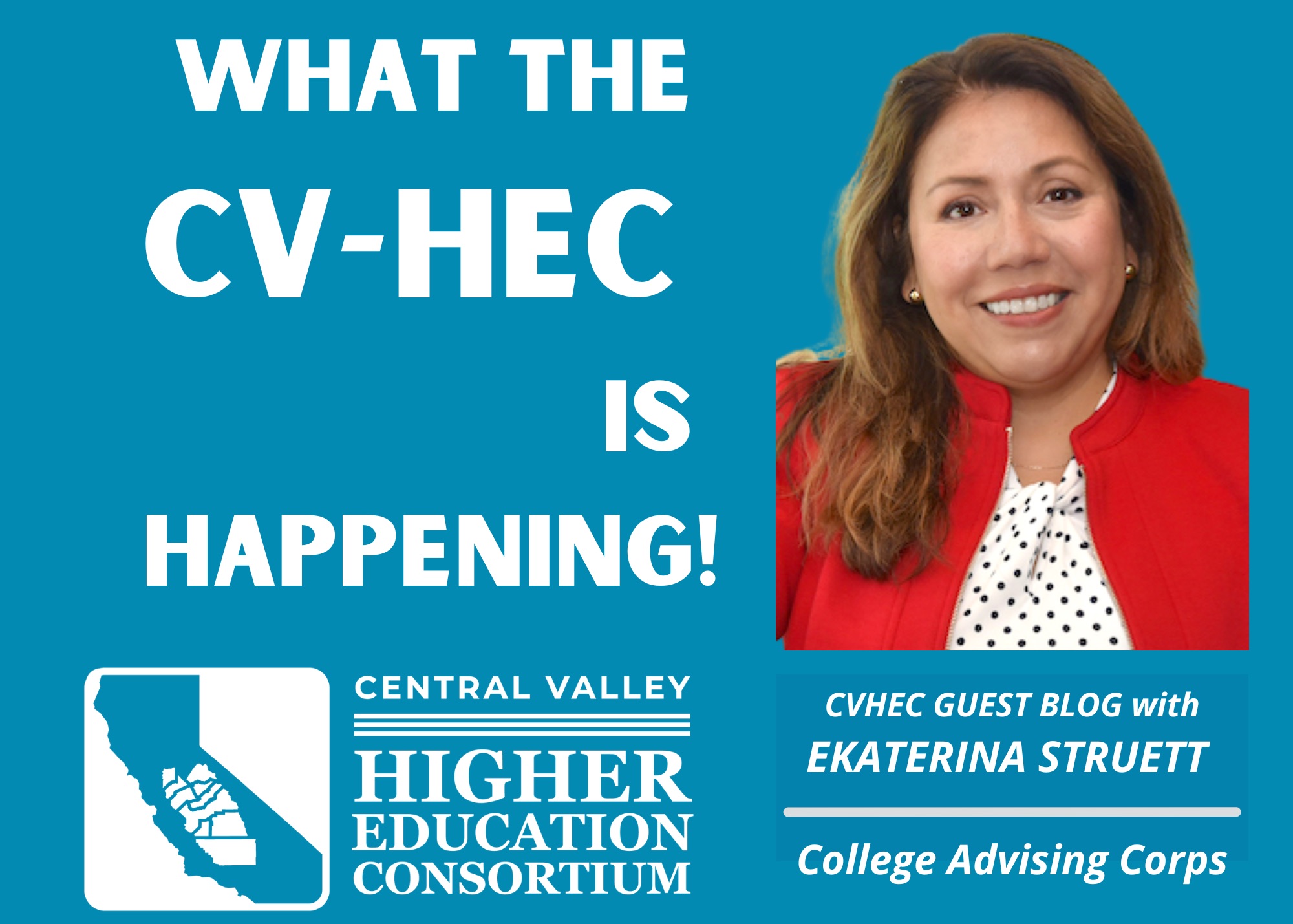
October is National Higher Education Month and for this month’s rendition of our “What the CVHEC is Happening Blog, we turn to the College Advising Corps, a national nonprofit that has helped over 1 million students from low-income, first-generation and underrepresented backgrounds navigate their path to higher education and career success and an op-ed penned by its CEO Ekaterina Struett advancing the observation that “if we want young people to thrive after high school, we need to offer more than a diploma. We need to offer real guidance, grounded in partnership and trust.”
(We welcome feedback as well as ideas for future blog topics: Tom Uribes, cvheccommunications@mail.fresnostate.edu).
BY EKATERINA STRUETT
CEO – College Advising Corps
Fall marks the return of high school seniors for their final year — a season filled with both excitement and anxiety. In less than a year, they’ll don caps and gowns, walk across the stage, and celebrate a milestone that signals profound change. Families and communities will cheer, seeing in them pride, hope, and possibility.
Yet for too many students, especially those in under-resourced schools, uncertainty about the future lingers even on graduation day. Many leave high school without a clear plan, step into programs misaligned with their goals — or worse, into ones that exploit their aspirations without delivering real opportunity. At the heart of this uncertainty is a critical gap: a gap in support, guidance, and reliable information, precisely when students need it most to navigate their post-graduation paths.
Only 47% of Gen Z say they had enough information to make decisions about life after high school, according to research from Jobs for the Future. That means more than half of today’s graduates are stepping into adulthood without a clear understanding of their options. This isn’t just a failure of information — it’s a failure of connection and support.
And it’s not because young people lack talent or ambition. Too often, we as adults — educators, parents, counselors, mentors and community members — fail to slow down and listen. We’re quick to ask, “What’s next?” but not “What do you want for your future?” or “What support do you need to get there?”
If we want young people to thrive after high school, we need to offer more than a diploma. We need to offer real guidance, grounded in partnership and trust.
Effective advising doesn’t just happen in a counselor’s office. It can take place at the dinner table, on a lunch break, or in a conversation with a trusted adult. Whether you’re a parent talking to your child, a teacher checking in with a student, or a colleague offering advice to a teen in your life, we can all be advisers. And guidance starts with questions, not answers: What are you interested in? What kind of life do you want? What makes you excited about the future? These conversations create space for young people to reflect and be heard.
As adults, we often worry that young people spend too much time on screens and not enough on building real connections. But we’re just as guilty. We answer questions with links, send them to websites, or expect an app to do the listening for us. Meanwhile, we miss chances to engage meaningfully. If we truly want to connect, we have to step away from our own screens, carve out time, and show up with our full attention.
That might mean grabbing coffee, going for a walk, or just asking how a young person is really doing. A meaningful path forward doesn’t start with a form — it starts with a conversation.
From there, we can help them explore their options — whether that’s a four-year university, community college, trade certification or starting work with a plan for what comes next. Don’t stop at encouragement. Help them complete financial aid forms. Review applications. Connect them with someone in the field they’re curious about. Drive them to a college tour or career fair. Small, consistent gestures often make the biggest difference. You don’t have to have all the answers — you just need to be present and willing to help.
California has made important strides to support students, including new investments in school-based counseling and digital tools for academic and mental health services. These efforts are necessary. But they’re not enough.
The student-to-counselor ratio in California is still more than double the national recommendation. In too many schools, one counselor handles everything from schedules to crisis response to postsecondary advising. That isn’t sustainable if we want students to graduate with a supported path forward.
And while we believe deeply in the power of higher education — a bachelor’s degree remains one of the strongest levers for economic mobility — it’s not the only route to a meaningful life. Students shouldn’t be pressured into one definition of success. They need trusted adults who will walk alongside them, help them weigh options and support them in choosing paths that reflect their goals and strengths.
Before I led a college access organization, I worked in human resources. I hired people with all kinds of backgrounds — elite university grads, community college starters, GED holders, certified technicians. I learned that talent, adaptability and drive don’t always come in the packaging we expect. That experience shaped how I lead today: with a commitment to helping students recognize their potential, no matter their starting point, and supporting them in building futures that make sense for them.
A high school diploma is worth celebrating. But it should come with more than applause. It should come with a map — built in partnership with students and grounded in the belief that every young person deserves a future they can see, shape and own.
Let’s help them build it.
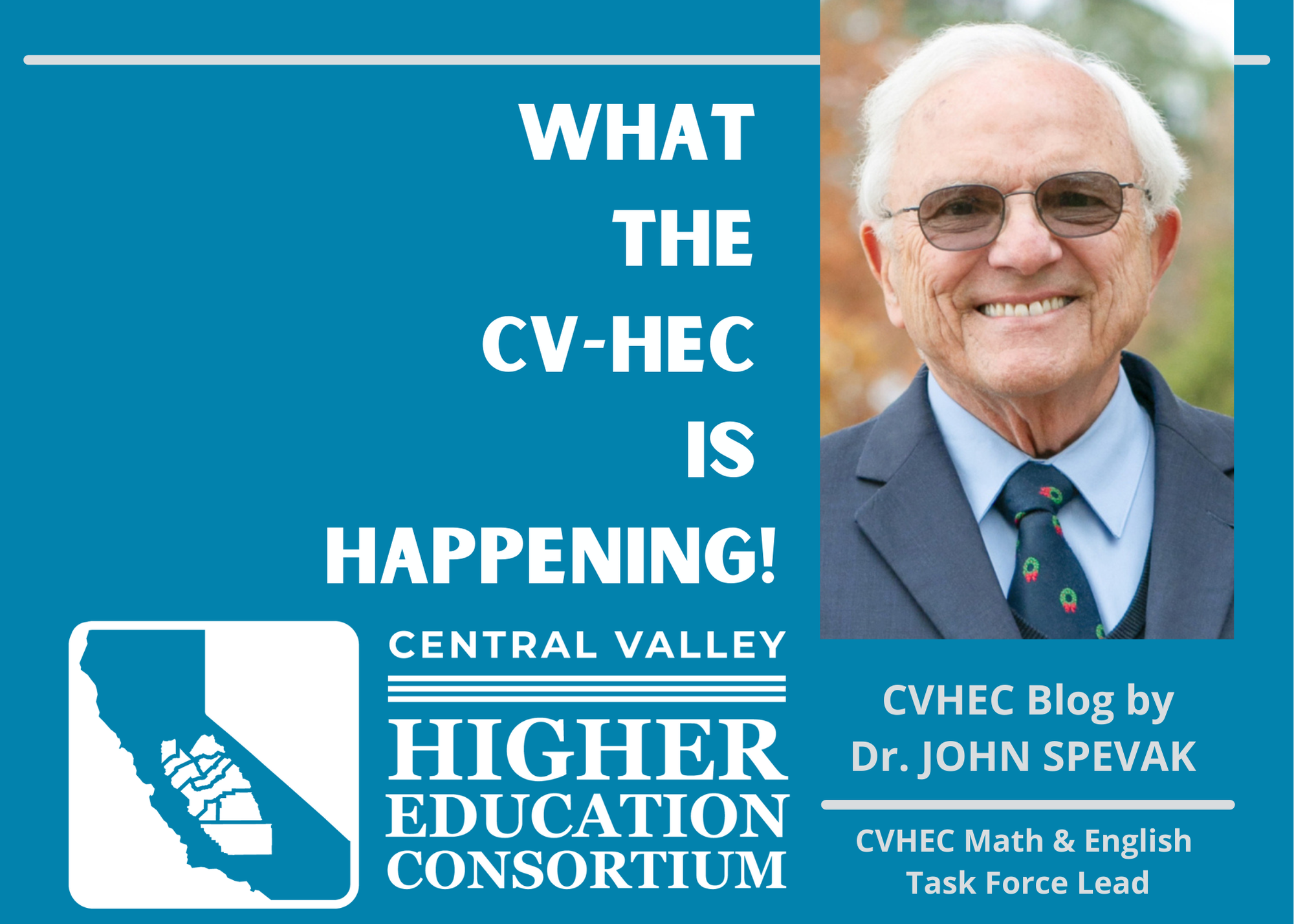 In the “What the CV-HEC is Happening” Blog for our September 2025, Dr. John Spevak presents an adaptation of a column he wrote for the August 6 issue of The Westside Express touting the effectiveness of higher education, its impact on students and the return on investment (ROI). Dr. Spevak, who is a vice president-emeritus of Merced College and currently a CVHEC lead, coordinates the English and Math Task Forces for the consortium. We welcome feedback as well as ideas for future blog topics: cvheccommunications@mail.fresnostate.edu.
BY DR. JOHN SPEVAK
CVHEC Math & English Task Force Lead
Vice President-Emeritus – Merced College
It seems these days that there is a war on education, especially on college education.
One national commentator wrote that college is an “overpriced scam.” Another stated that “many college degrees are useless.” I could cite dozens more, but I think most of my readers have heard some pundit say or write something similar.
These commentators believe that college isn’t worthwhile and that it’s too expensive. That may be true in some cases, but community colleges in California, like the college campuses on the Westside of the Central Valley in Los Banos and Firebaugh, prove these statements wrong.
Besides these two campuses, I have visited almost all of the other community colleges in California. They are friendly and welcoming to all students and accept 100% of all students who apply.
I have a long history with the Merced College campus in Los Banos. Over the past 50 years, I have heard hundreds and hundreds of students who attended that campus tell me the education they received there improved their lives significantly without hurting them financially.
I personally know many of these people. They have improved the quality of life in this community. Los Banos Campus alumni and alumnae are successful businesspersons, farmers, teachers, nurses, radiologists, sonographers and on and on. The same could be said for every California city which includes a community college campus.
People who claim that young people should not bother going to college always have a narrow definition of what a college is. College is not limited to four-year universities and abstract majors. “College” also includes community colleges, with programs that include education in what over the years has been called “vocational education,” “the trades” and “career technical education.”
The career tech programs on the Westside of the Central Valley include welding, agriculture, computer technology and emergency medical technician (EMT).
The main campuses of their colleges, in Merced and Coalinga, offer even more, including licensed vocational and registered nursing, mechanized agriculture and automotive technology. I would bet the complete list of career tech programs in California community colleges would list more than 100 vocational programs.
All of these programs provide the education and training that enables a person to earn a decent salary on a path to earn enough money for individuals to support themselves and their families. Any employer who has hired these students will tell you that their community college education was an important factor in hiring them.
But wait! There’s more! California community colleges, like the campuses in Los Banos and Firebaugh, also offer a wide variety of transfer programs that enable students to complete their first two years toward a four-year degree and then transfer to a university at very little or no cost.
These transfer students enter the universities as juniors and are well on their way to bachelor’s degrees in the sciences, business, advanced computer technology, and other fields that will enable them to earn a very significant income.
What I find ironic about people who say a college education isn’t worthwhile is that they themselves have a college education and they want their children to have a college education. These people feel, however, that OTHER parents’ children don’t need it.
They want their own children to have a college education because they know the facts. Studies show that a college education, two-year or four-year – significantly increases the earning capacity of graduates.
Over their entire working life, according to the Hamilton Project, the typical high school graduate will earn $580,000, the typical associate’s degree graduate will earn $855,000, and the typical bachelor’s degree graduate will earn $1.19 million in today’s dollars.
The key word in these statistics is “typical.” There are some cases of students with just a high school diploma earning more than a college graduate, but they are not typical. Another way of putting it is “What are the odds of earning a good income?” Smart parents, including those who declaim against a college education, know that the odds are with students with degrees.
When I talk with young people wondering if college is worth it, I suggest they go to something called “Program Pathways Mapper.” It’s an online site that’s free to all and doesn’t require a password. One way to get to the Mapper is to Google “Merced College Program Pathways Mapper.”
Once on the Mapper site, they can select one of the many career fields, like “Agriculture and Industrial Technology,” and scroll down to “Career Explorer.” There they can see the jobs available in that field, the average salary of that job and the education required, whether bachelor’s degree, associate’s degree, or high school diploma. For many it’s an eye-opening experience.
I also tell young people that a college education is no guarantee of a high-paying job. They need to have initiative and a work ethic and a willingness to adjust to the working world and its demands, as well.
My parents didn’t have a college education. In fact, they didn’t have a high school diploma. But they encouraged their children to get a college education, and for that I will be ever grateful.
I, in turn, encouraged my three children to get a college education, and they all did, including attending the Los Banos Campus of Merced College. That, and a strong work ethic, enabled them to go into careers that paid a good salary and enabled them eventually to own their own homes—all without significant student loan debt.
For anyone who has doubts about what I have written, I encourage you to look at a recent study done by College Futures Foundation (CCF): “Golden Returns: A Regional Look at the Return on Investment (ROI) of California’s Community and Career Colleges.”
As the CCF website puts it, “This new analysis ranks 327 community colleges and certificate-granting institutions—including 121 public, 186 for-profit, and 20 private non-profit—located within the state across 12 of California’s economic regions by how long it takes learners to recoup their educational costs.”
As the brief summary on the website states: “Forty percent of public two-year colleges enable students to recoup their costs in under a year, compared to just 5% of private non-profit and for-profit institutions.”
Anyone can go to the website, find their closest community college, and see how quickly students there recover their costs. Seeing the positive ROI is another way of pointing out to people who argue against a “college education” that they are way off base.
So before you believe anyone who tells you that a college education isn’t worth it, explore the issue on your own. And if you end up agreeing with me, encourage young people you know to attend their local public community college campuses.
There’s no better time to start than now.
John Spevak’s email is john.spevak@gmail.com.