
Math Task Force ‘Central Valley Way’ gains national math attention REGISTER As a July 1, 2025 deadline approaches regarding implementation of Assembly Bill 1705, the Central Valley Higher Education Consortium […]

Math Task Force ‘Central Valley Way’ gains national math attention REGISTER As a July 1, 2025 deadline approaches regarding implementation of Assembly Bill 1705, the Central Valley Higher Education Consortium […]

The drive is on to place the program’s master’s grads in Kern community college adjunct spots The Kern Master’s Upskill Program continues to forge ahead as four cohorts of […]


With the advent of the fall semester for our 28 member-institutions and for education throughout the nation, the Central Valley Higher Education Consortium presents a few words from Kevin A. […]
A sweeping new report, “Pathways to College Completion in the San Joaquin Valley,” by the Public Policy Institute of California (PPIC) found a multitude of factors contributing to lower […]
California’s San Joaquin Valley (SJV) has the lowest college enrollment and completion rates in the state, which both reflects and perpetuates the region’s economic challenges. Yet it could […]

The Central Valley Higher Education Consortium (CVHEC) is rolling out a new look that includes new logos presented in this issue and a revamped website later this winter.
The 28-member strong consortium covers 10 counties in the Central Valley and the new primary logo — keeping to tradition while simultaneously modernizing — captures our region in the center of the state in a rounded square shape to help with placement in a variety of compositions.
The stylization of the “CV” and its notable visual distinction in the logo-mark represents the agricultural roots of the Central Valley and its importance as the region that CVHEC serves. As the primary logo, this mark will be the most commonly used for CVHEC branded touch-points. The two alternate Logos will also be used from time-to-time with internal, local, state and national partners.
“With the exciting addition of a new full-time staff member, an updated strategic plan and new initiatives launched this year, this is right time to refresh our look,” said Ángel Ramírez, CVHEC finance and operations manager.

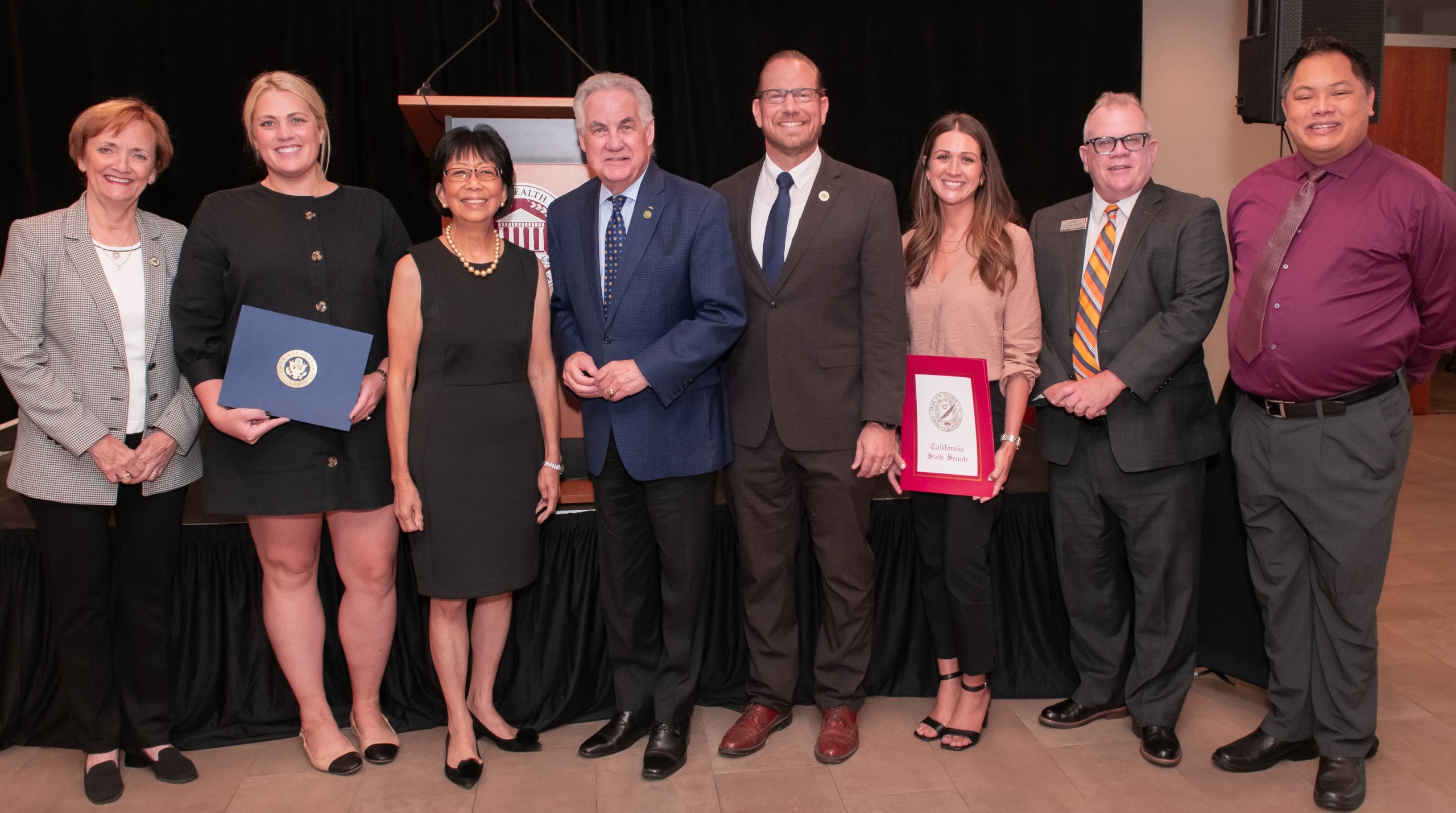
Celebrating the CSHU accreditation progress Aug. 10 (from left): Lynne Ashbeck, mayor of Clovis; Courtney Dunbar, district director for Congressman Vince Fong; Dr. Flo Dunn, founding president of CHSU; State Assemblyman Jim Patterson; Fresno County Supervisor Nathan Magsig; Jenna Welch, field representative for Senator Shannon Grove; Dr. John Graneto, founding dean of CHSU College of Osteopathic Medicine; Dr. Ronald Llenado, resident physician at UCSF Fresno Family Medicine Program and CHSU-COM Alum (2024).
(CLOVIS, Calif.)– The California Health Sciences University (CHSU), a member of the Central Valley Higher Education Consortium, held a celebration this week to commemorate achieving full accreditation for all its programs.
“Having our university accreditation recently reaffirmed, and our medical school, master’s program, and Simulation Center all achieving full accreditation is a significant milestone for our institution and a proud moment for all of us who are part of this vibrant community,” stated Dr. Florence Dunn, Founding President of CHSU, in her address at the event.
The Accreditation Celebration brought together over 300 people on the medical school campus in Clovis, including CHSU medical and pre-medical students, alumni, administration, faculty, staff, trustees, founders, elected officials, and community partners.
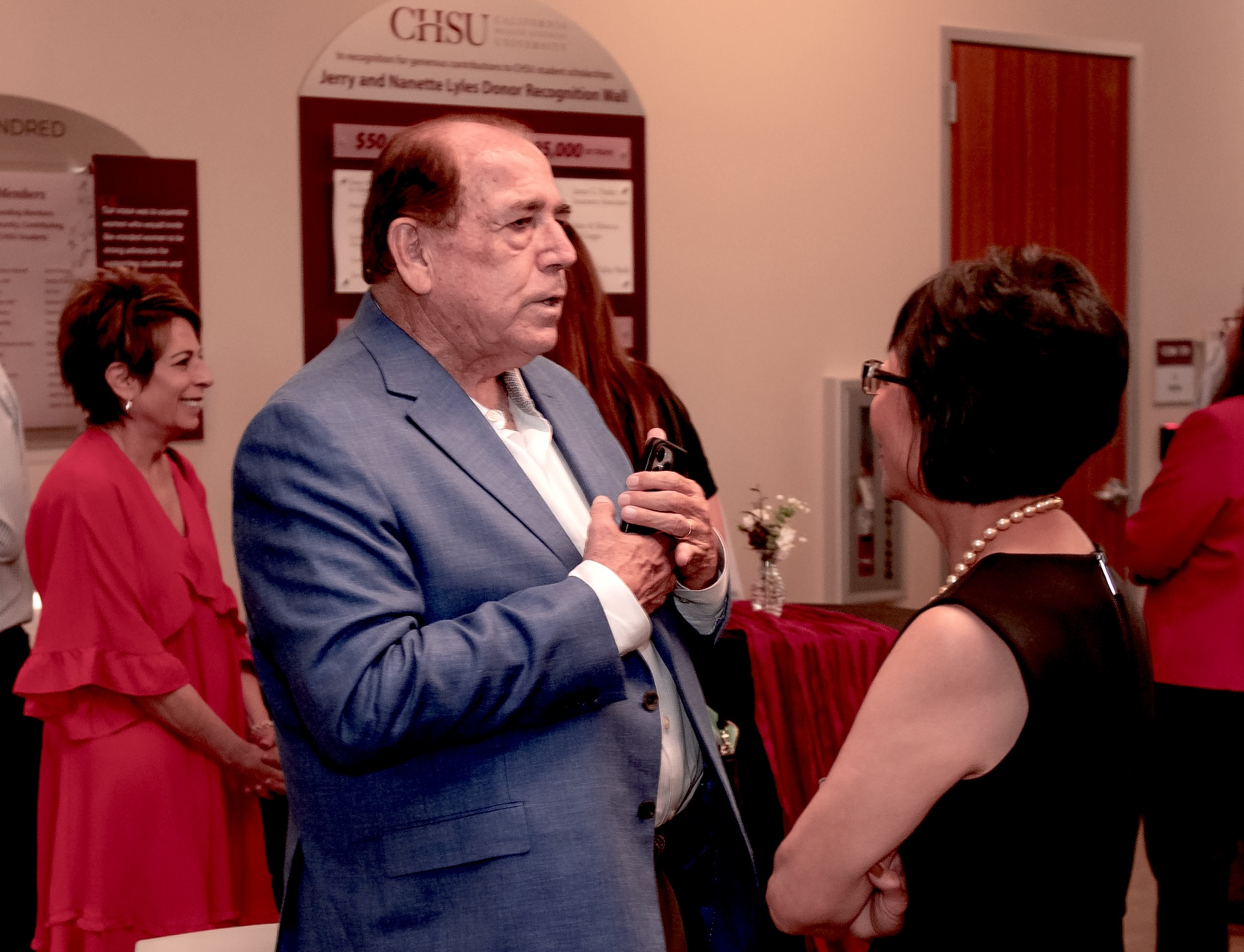
CVHEC Executive Director at the CHSU Accreditation Celebration with President Florence Dunn, a member of CVHEC Board.
Guests toured the Simulation Center for interactive experiences with high-fidelity manikins and augmented reality Holoanatomy demonstrations.
The founding dean of the CHSU College of Osteopathic Medicine, John Graneto, DO, stated, “In the past six months, we’ve had exciting news every month starting with our historic 100% residency match rate for our inaugural class of 2024 in March.”
Last April, full accreditation was granted for seven years to CHSU’s Doctor of Osteopathic Medicine program by the Commission on Osteopathic College Accreditation (COCA).
66 new physicians in the CHSU College of Osteopathic Medicine’s inaugural class of 2024 graduated at the Save Mart Center in May.
Ronald Llenado, DO, an alum from the CHSU College of Osteopathic Medicine’s inaugural class of 2024 is one of the 33% of his graduating class who matched for residency in the Central Valley. Dr. Llenado is now a first-year resident in the UCSF Fresno Family Medicine program.
“Matching at UCSF Fresno has been a dream come true. It allowed me to stay here in the Central Valley, where I’ve studied, built important relationships, and made a home. I’m also proud to say that CHSU graduates make up 25% of my intern class, further showing how CHSU is shaping the future of medicine right here in our community,” stated Ronald Llenado, DO, Resident Physician in the UCSF Fresno Family Medicine program and CHSU College of Osteopathic Medicine alum from the inaugural class of 2024.
He spoke at the Accreditation Celebration about his medical school experience at CHSU and connection to serving patients in the community through his clinical clerkships.
“The accreditation of CHSU is a landmark moment—not just for the school but for all of us who are part of its legacy. It’s a testament to the hard work, vision, and dedication that went into building a medical program that equips its students to serve our unique community and improve healthcare access for all,” remarked Dr. Ronald Llenado.
Other notable speakers at the celebration included long-time university supporters Assemblyman Jim Patterson, Fresno County Supervisor Nathan Magsig, and Clovis Mayor Lynne Ashbeck.
Mayor Lynne Ashbeck spoke about the CHSU medical school being transformational for this region.
“There is nothing more important that will define this region for the next 30 years than the health of our residents. If we can provide an environment where our families and kids can thrive, where our kids can actually see what it takes to become a doctor or other healthcare provider, and achieve those goals close to home and where we can all have access to those doctors to care for us then our region has a chance,” stated Lynne Ashbeck, Clovis Mayor.
Nathan Magsig, Fresno County Supervisor remarked, “There are going to be thousands of doctors that graduate from this facility and its going to change what the Central Valley gets to experience when it comes to care. I just want to say thank you to those individuals who were part of the vision to make this happen.”
Representatives from the offices of Congressman Vince Fong, Congressman Jim Costa, and Senator Shannon Grove also attended the event and presented CHSU with certificates of special recognition for achieving full accreditation for all its programs.
CHSU became accredited by the WASC Senior College and University Commission (WSCUC) in 2018. This summer, CHSU had its university accreditation reaffirmed by WSCUC.
When the fall semester began in July, the university received the news that all CHSU students are now eligible for Federal Financial aid to help them fund their medical school and master’s program education.
“These achievements are a shared victory with our entire community, and ultimately is for our students,” concluded Dr. Dunn.
Contact: Richele Kleiser, CHSU VP of Marketing and Communications at rkleiser@chsu.edu or 559 312 3892
See:
CHSU press release and photo gallery
About California Health Sciences University
California Health Sciences University (CHSU) is accredited by the WASC Senior College and University Commission (WSCUC). CHSU is the first university of its kind in the Central Valley and offers a local option for medical school and a master’s in biomedical sciences to help remedy the shortage of health care services offered in the Valley.
The CHSU College of Osteopathic Medicine (CHSU-COM) is accredited by the American Osteopathic Association’s Commission on Osteopathic College Accreditation (COCA). CHSU-COM now has about 600 medical students in attendance. The inaugural class of 2024 medical students graduated in May. The College matriculated its fifth cohort of over 150 students in July.
The university also offers a one-year Master of Science in Biomedical Sciences (MSBS) program at its College of Biosciences and Health Professions. The first cohort of MSBS students graduated in 2024, with over 60% of the graduates now attending the CHSU College of Osteopathic Medicine.
For more information about California Health Sciences University, visit chsu.edu or find them on Instagram, Facebook, and Linkedin.
###

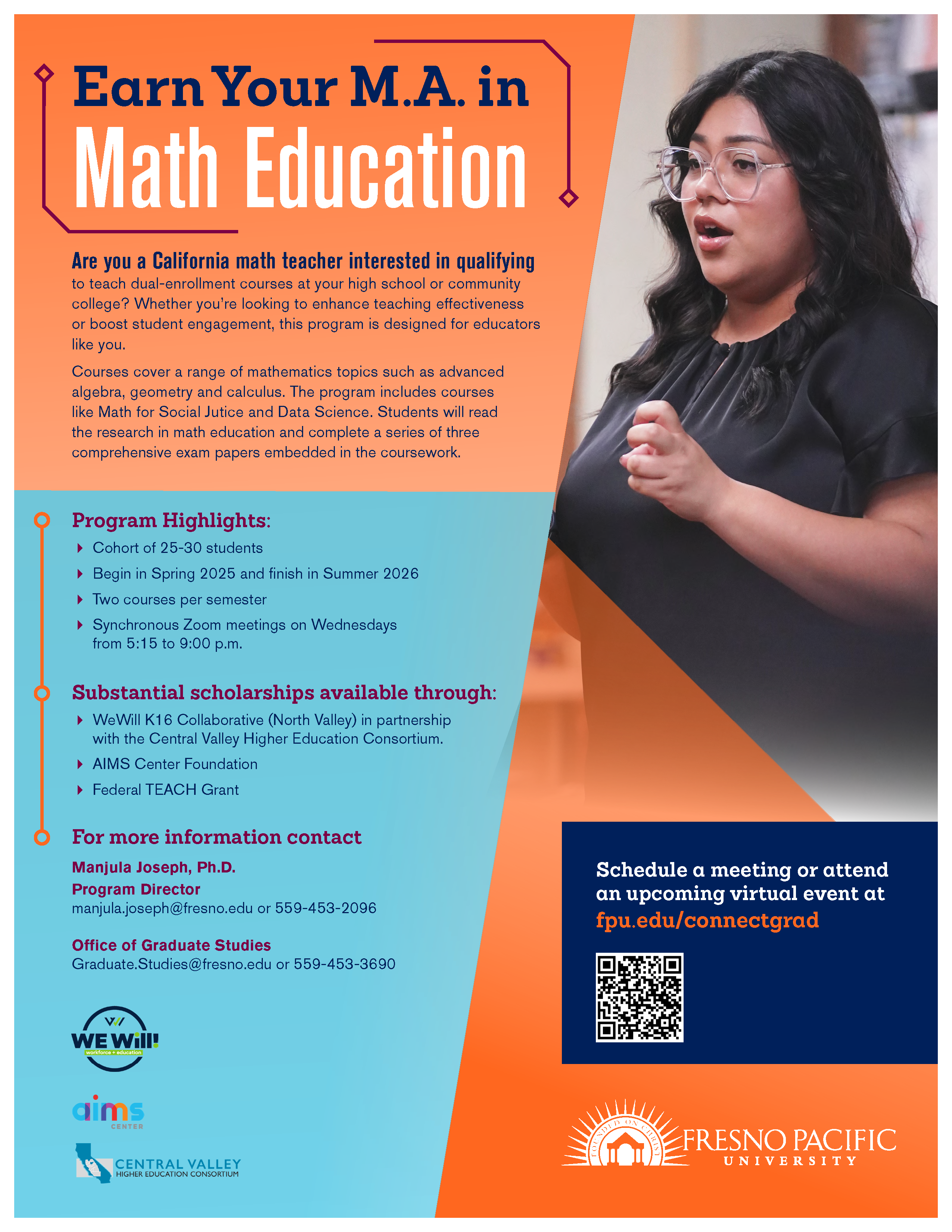
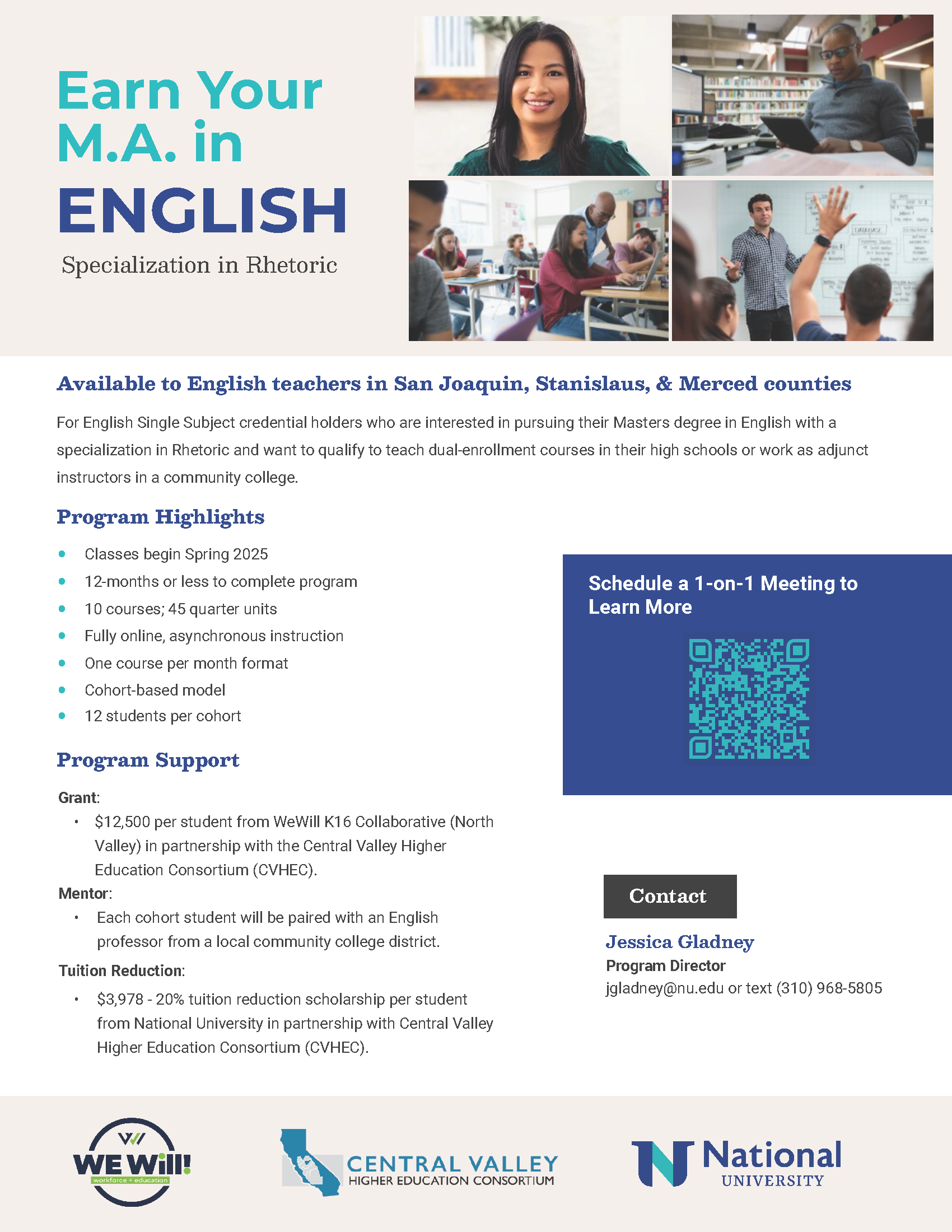 Recruitment of North Valley high school math and English teachers for dual enrollment qualification begins – info sessions set
Applications are now available for 24 North Valley high school math and English teachers to enroll in the WE Will! K-16 Collaborative Master’s Upskilling Program sponsored by the Central Valley Higher Education Consortium and offered by National University and Fresno Pacific University.
The MA Upskilling Program qualifies them to teach dual enrollment courses. The cohorts will begin in spring 2025. Registration for online information sessions is now available. See WE Will! Grant story.

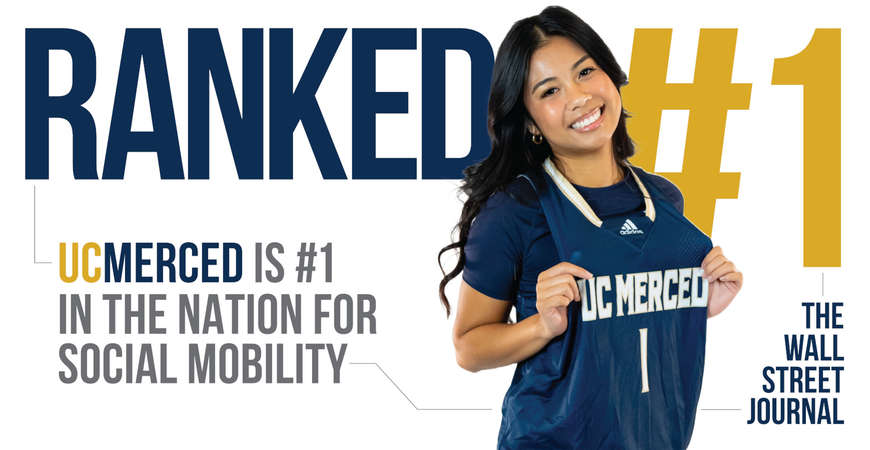
Several members of the CVHEC earned accolades in the WSJ rankings recently topped by UC Merced listed No. 1 for social mobility: California State University, Stanislaus came in second on the list of the top schools for social mobility; Fresno State was No. 4. and Fresno Pacific University was No. 14.
SEPTEMBER 09, 2024 3:19 PM
UC Merced is the No. 1 university in the nation for social mobility, according to new college rankings.
The Wall Street Journal recently teamed up with research partners College Pulse and Statista to rank the 2025 Best Colleges in the U.S., rating the top 500 universities in the United States.
In addition to awarding schools overall scores, the Wall Street Journal and College Pulse ranked universities based on best value, best salaries, student experience and social mobility.
“The WSJ/College Pulse Social Mobility ranking … rewards universities that take in the highest proportion of students coming from lower-income families,” the Wall Street Journal said, “while maintaining high graduation rates and having a positive impact on graduate salaries and minimizing the costs of attending the college.”
“At UC Merced, we routinely say that we don’t do what we do for rankings, but when you excel others will always take notice,” university Chancellor Juan Sánchez Muñoz said in a Sept. 4 news release. “We hope this recent acknowledgment will be yet another opportunity for people to learn about the exceptional culture of student success that has taken root at UC Merced.”
UC Merced landed at top of the WSJ/College Pulse Social Mobility ranking with a score of 86.8 out of 100
The university was No. 18 on the overall list of Best Colleges in the U.S. with a score of 84 out of 100, up from No. 59 in 2023.
According to the Wall Street Journal, it costs $13,450 per year on average to attend UC Merced, including tuition, fees, room and board and books and supplies.
However, the value added to graduates’ median salary attributable to them attending UC Merced is $33,874, the Journal found.
UC Merced has a variety of programs that have helped students excel academically, including the Center for Educational Partnerships and the Fiat Lux Scholars program.
The Center for Educational Partnerships works with Central Valley schools serving students in kindergarten through 12th grade help kids become “college and career ready,” UC Merced said on its website, while the Fiat Lux scholars program focuses on providing first-generation college students with academic success and housing options.
The university also partners with College Track, an organization that helps students from low-income community get their bachelor degrees.
About 60% of the student body of UC Merced is comprised of Pell grant-eligible students who have exceptional financial needs, and 65% are first-generation college students according to the news release on Sept 4.
California State University, Stanislaus, in Turlock came in second on the list of the top schools for social mobility.
California State University, San Bernardino, took third place, while Fresno State was No. 4. California State University, Los Angeles, rounded out the top five.
Elsewhere in the Central Valley, California State University, Sacramento, landed at No. 13, while Fresno Pacific University was No. 14 and UC Davis was No. 32.
These are the top 10 universities in the nation in terms of enhancing students’ social mobility, according to Wall Street Journal and College Pulse:
The Wall Street Journal partnered up with College Pulse and Statista to rank schools using “the latest data available for analysis, it said.
In the social mobility category, schools were scored based on the following components:
Social mobility salary impact
Social mobility graduation rate impact
See:
UC Merced press release: UC Merced Ranked No. 1 in the Nation for Social Mobility, No. 18 Overall
Fresno State News press release: Wall Street Journal ranks Fresno State in top five nationally for social mobility
Stanislaus State press release: Stanislaus State Ranks No. 24 in the Nation on Wall Street Journal’s 2025 Best Colleges