
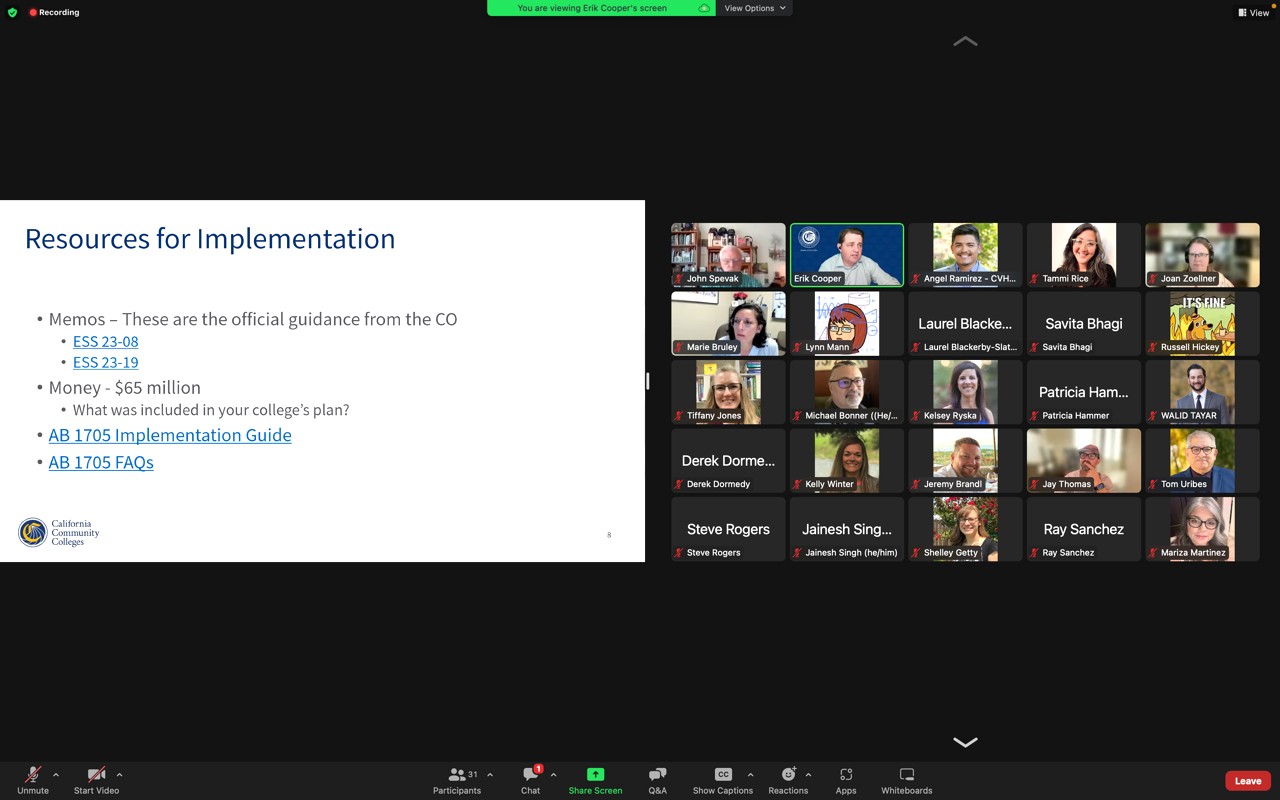
CVHEC’s Math and English Task Forces will resume meeting this fall in virtual sessions.

Central Valley colleges gear up for fall  

CVHEC Task Forces continue collaborative work to support equitable student outcomes


BY DR. JOHN SPEVAK
CVHEC Project Lead – Merced College Vice President-emeritus


As the fall 2025 semester unfolds, the Central Valley Higher Education Consortium (CVHEC) is once again turning its attention to two of the most persistent hurdles in student success: mathematics and English through two task forces established in the past seven years.

Beginning later this month, CVHEC’s Math Task Force and English Task Force — both consisting of at least one English and one math professor from each of the 15 CVHEC member community colleges in the 28-member consortium — will re-convene educators from across the Central Valley’s 10-county region in a new round of virtual meetings this fall, bringing renewed energy to collaborative solutions that help students succeed in gateway courses.

The Math Task Force, which started as 15 members and has expanded to more than 75 participants, will meet in a series of three Zoom convenings related to implementation of AB 1705 and the 15-member English Task Force is planning one meeting devoted to artificial intelligence.

The task forces, by sharing concerns and best practices, have helped Central Valley community colleges make a significant transition in pedagogy, shifting from a focus on student weaknesses to one on student strengths. The upcoming gatherings will continue a tradition of faculty-led innovation that has become a hallmark of the consortium’s work in recent years.

For the English Task Force, one Zoom meeting, “The Challenges and Opportunities of AI for English Professors in the Central Valley,” is scheduled for Wednesday, Oct. 29, from 3 to 4:30 p.m.

At the three Math Task Force sessions, Central Valley math professors will share their progress following two-plus years of discussing implementation of the state law in hybrid convenings that were entitled “The Central Valley Way for AB 1705” which included college research and data experts, deans and academic leaders from higher ed as well as from K-16 school districts with support from the Charles A. Dana Center at the University of Texas at Austin. The 2025-26 academic year is the first year AB 1705 must be implemented.

Each MTF virtual session is from 10 a.m. to noon:

  • Friday, Oct. 24 – “Calculus with a Corequisite” led by Professor Jeremy Brandl of Fresno City College
  • Friday, Nov. 7 – “Innovative One-Course Prerequisite” led by Professor Shelley Getty of Taft College;
  • Friday, Nov. 21 – “Data Collection and Analysis” led by Professor Nathan Cahoon of Taft College.

Professor Cahoon broke his group’s focus down further noting that a central tenet of AB 1705 and 705 has been to expand student choice.

“As we enter the validation phase for the one- and two-semester calculus precursors, it is essential to review the standards established by the Chancellor’s office,” Prof. Cahoon said.

He explains that the pass rate for students in the precursor classes and in the lowest tier must meet or exceed 50 percent, whereas the pass rate for direct placement, lowest-tier calculus students is 15 percent.

“The goal of this group is to ensure that the data collected and analyzed by the state is accurate,” he said. “There is still concern over previous research conducted by the RP group, and we look to validate the data they collected. A central tenet of AB 1705 and 705 has been to expand student choice. We hope to maintain student choice by preserving the option to take precursors to calculus as they choose.”

CVHEC formed the two groups soon after the passage of California Assembly Bill 705 in 2017 which mandated the elimination of remedial English courses and allowed students to go directly into transferable English courses.

That legislation also increased the options of transferable math courses students could take; mandated the elimination of remedial math courses for entrance into statistics and similar courses; and allowed students to go directly into transferable statistics and similar courses.

And it encouraged increased support for students, including corequisite courses.

The more recent passage of AB 1705, an amplification of AB 705, affected math more than English by expanding AB 705 to include STEM math courses. The Math Task Force continues to work, through sharing and collaboration, toward finding ways to allow the largest numbers of students to go into transferable calculus courses and, when necessary, pre-calculus courses.

AB 1705 went into effect this fall 2025 semester and gives community colleges two years to implement new math courses, including Calculus I with a corequisite and, for each college, one innovative pre-calculus course. At the end of those two years, the California Community College Chancellor’s office will determine if each college has submitted sufficient data to verify the effectiveness of the new courses.

Meanwhile, the English Task Force continues to work, also through sharing and collaboration, toward continuous improvement in teaching and learning in English courses. In ETF meetings during the last two years, much time was spent talking about artificial intelligence.

Discussions like this about AI have been happening across all disciplines, but they are especially important for English professors, since they work at having students not only read and think critically on their own but also write in their own personal voice.

The CVHEC Math and English Task Forces represent one of the consortium’s most impactful strategies: creating faculty-led communities of practice that span institutions and sectors; serving as a collaborative space for faculty to discuss curriculum alignment, address equity gaps and share best practices.

For CVHEC Executive Director Dr. Benjamín Durán, the task forces underscore the consortium’s methodology of collective problem-solving across the Valley – a region-wide commitment to what the consortium calls “The Central Valley Way” towards achieving its mission of enhancing a college-going culture in the region.

“When faculty come together across campuses, they create solutions that no single institution could achieve alone,” Dr. Durán said. “That’s what makes these task forces so powerful for our region and, most importantly, for our students across the Central Valley. For them, the results of this work may mean not only passing a math or English class but truly unlocking the path to transfer, degree attainment and career success.”

Dr. Durán adds that CVHEC has been pleased to convene the task forces and to help facilitate meetings “because the consortium believes in the talent of Central Valley Math and English Task Force professors and their ability to respond to challenges and opportunities effectively as they create a positive ‘Central Valley Way to Student Success’ for their math and English students.”


Also see:

English Task Force

Math Task Force

Wrap up: CVHEC Math Task Force Convening Mar. 28


Reelected to the CVHEC Board of Directors Executive Committee for one-year terms that began Oct. 1: University of California Merced Chancellor Juan Sánchez Muñoz, Fresno State President Saúl Jiménez-Sandoval and West Hills Community College District Chancellor Robert Pimentel

 Chancellors Muñoz, Pimentel and President Jiménez-Sandoval get new three-year terms

Three Central Valley higher ed leaders were re-elected to new three-year terms on the executive committee of the Central Valley Higher Education Consortium Board of Directors effective Oct. 1, announced Dr. Benjamín Durán, CVHEC executive director.  

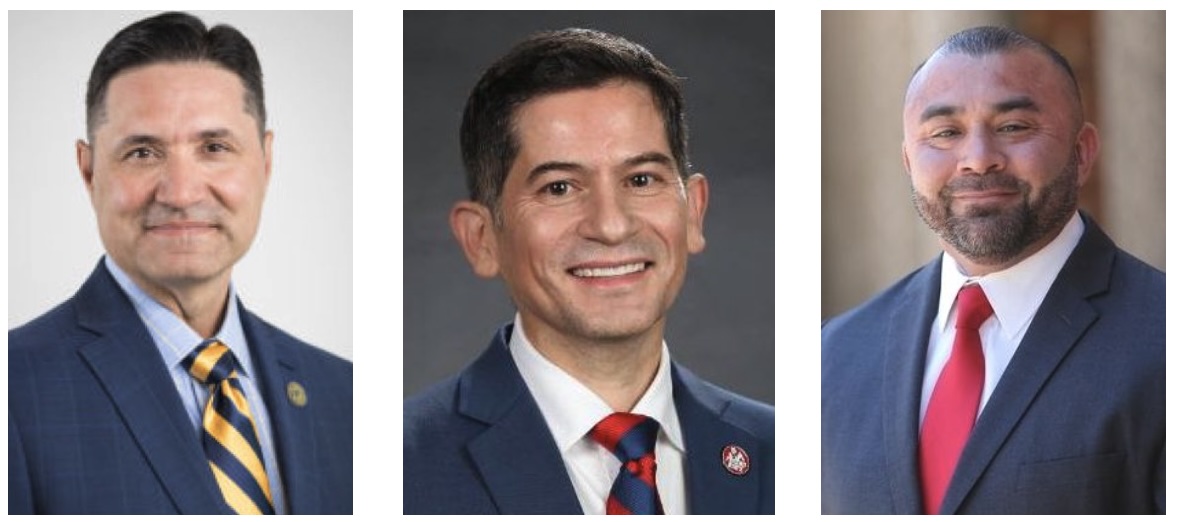
Dr. Juan Sánchez Muñoz, chancellor of University of California Merced, who is currently serving a one-year term as chairperson for the board that began in January, was re-elected to the executive committee along with Fresno State President Saúl Jiménez-Sandoval and West Hills Community College District Chancellor Robert Pimentel. The previous three-year terms for all three expired Sept. 30.

The CVHEC Board of Directors  consists of the chief executive officers of 28 institutions of higher education in the valley’s 10-county region that comprise the consortium membership. The executive committee conducts business on behalf of the board when it is not available, especially for timely or urgent matters, and sets the agenda for board business, Durán said. 

Per CVHEC bylaws, each higher education segment has a set number of representatives on the committee who are elected by the full board of directors.  Seven executive committee members serve three-year terms beginning in October the first year.

“The executive committee acts as a smaller, more agile governing body, often handling operational issues and strategic planning between full board meetings, and serving as a sounding board for CVHEC internal leadership,” Durán explained.

The full board meets quarterly with the next session being planned  for an early December target date, said Ángel Ramírez, CVHEC associate director.

Executive meetings are also held four times a year prior to board meetings with the first meeting of the 2025-26 executive committee planned for early November at UC Merced where the committee will vote to fill the secretary, treasurer and chair position from among its membership, Ramírez said.

At the recent CVHEC board retreat in August, Chancellor Sánchez Muñoz welcomed the valey higher ed  leaders and said about CVHEC’s next steps, “We need to work together to support our students. We’re here to create a vision for how we celebrate.” [

President Jiménez-Sandoval said, “Being reelected for three more years to the executive board of CVHEC is a tremendous honor, as it allows us to continue our noble work in our Valley. This continuity of leadership will allow us to be intentional about our resolve to harness the power of AI, build a strong pipeline between community colleges and four-year institutions, and promote the power of higher education.”

The membership of the 2025 CVHEC Executive Committee by segment with their terms noted is:

• CALIFORNIA STATE UNIVERSITIES (2)
President Saúl Jiménez-Sandoval, Fresno State (2025 –2028)
President Britt Rios-Ellis, CSU Stanislaus (2024 –2027)

• CALIFORNIA COMMUNITY COLLEGES (3)
NORTH – President Chris Vitelli, Merced College (2024 –2027)
CENTRAL – Chancellor Robert Pimentel, West Hills Community College District (2025 –2028)
SOUTH – President Brent Calvin, College of the Sequoias (2024 –2027)

• UNIVERSITY OF CALIFORNIA (1)
Chancellor Juan Sánchez Muñoz, UC Merced ( 2025 –2028)

• PRIVATE/INDEPENDENT (1)
President Andre Stephens, Fresno Pacific (2024 –2027)

National Higher Education Month

CVHEC … a regional collaboration dedicated to
student access, retention and completion for students  

Greetings CVHEC friends and colleagues … 

We welcome you to our October newsletter and especially to National Higher Education Month!  

It is fitting that this month we observe the value of higher education by presenting the direction the Central Valley Higher Education Consortium will undertake in the next three years or so following a strategic planning retreat by our board of directors in late August.

Composed of the CEOs of our 28-member institutions of higher education, the board was hosted by CVHEC Board Chair and UC Merced Chancellor Dr. Juan Sánchez Muñoz for the retreat where 23 of our 28 board members attended and participated in the day-long facilitated session held Aug. 20 at the beautiful UC Merced campus.

After revisiting the origins of CVHEC for the benefit of new leaders in the valley and discussing the vision and mission of the consortium, the group held an earnest and collaborative discussion about its future direction.  The focus was on the next three years of CVHEC as we continue to foster and maintain a regional collaboration dedicated to student access, retention and completion for our students.  

With this in mind, the Central Valley leaders of academia identified these four areas to pursue diligently, going forward:

  • Data Sharing and Regional Dashboards
  • Workforce Aligned Program Development
  • Artificial Intelligence (AI)
  • Enrollment & Reconnecting/Re-engaging students (who left prematurely)

As the board and CVHEC staff prepare to pursue the new work ahead, we are not abandoning the areas we have been focusing on in the last few years.  We will continue to support initiatives such as the Central Valley Transfer Project and the efforts around implementing dual enrollment throughout the valley such as the Master’s Upskilling Program and its mentor component (both featured in our September e-newsletter).  

Additionally, the English Task Force and the Math Task Force will continue their remarkable groundbreaking work. We have found that when faculty come together and collaborate across campus boundaries, they create solutions that no single institution could achieve alone.  That’s what makes these task forces so powerful for our region and, most importantly, for our students throughout the Central Valley. 

For students, the results of this task force work may mean not only passing a math or English class but truly unlocking the path to transfer, degree attainment and career success.

And in furtherance of National Higher Education Month, we hope you will enjoy this month’s “What the CV-HEC is Happening” Blog by Ekaterina Struett, CEO of  College Advising Corps, a national nonprofit that has helped low-income, first-generation and underrepresented backgrounds navigate their path to higher education and career success, Be the guide every graduate deserves.”  I believe you will agree that it is a very relevant thought-piece, which Ms. Struett first wrote for EdSource and modified slightly for our audience, that is well worth reading as we all endeavor to strengthen support systems for student success in higher ed.  

Please enjoy this month’s edition as much as I have.

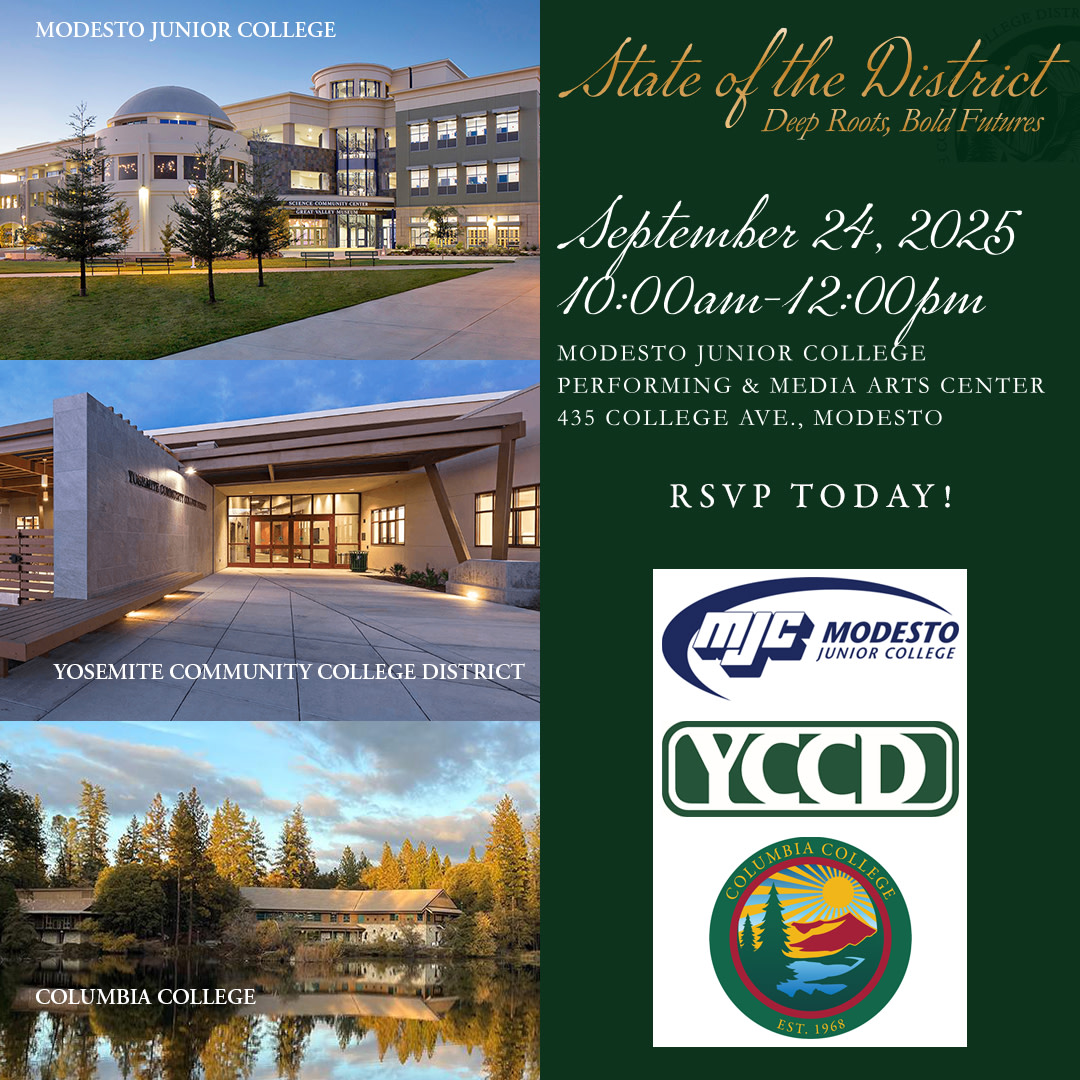
First YCCD  State of the District address

Interim Chancellor Tran praises community partnerships, innovation at MJC event

BY VIVIENNE AGUILAR
CV Journalism Collaborative

In a year when many California colleges faced the possibility of deep budget cuts, Yosemite Community College District leadership offered a brighter vision in the first-ever State of the District address Wednesday.

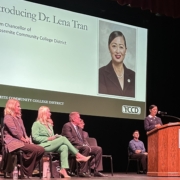
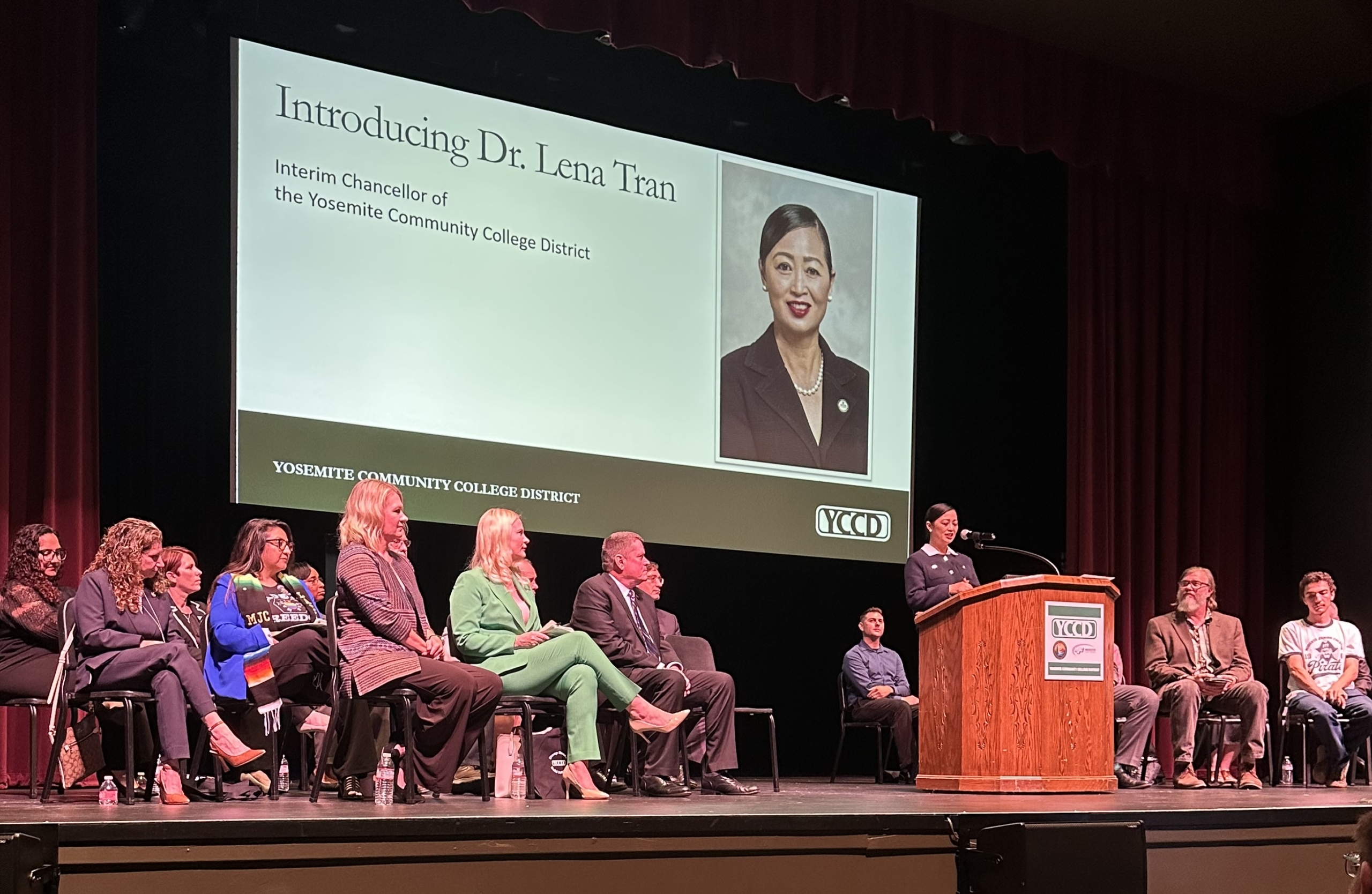
Dr. Benjamín Durán, CVHEC executive director, with Dr. Lena Tran, interim chancellor of YCCD, at her first state-of-the-district address Sept. 24 held at Modesto Jr. College.

Interim Chancellor Lena Tran spoke to about 200 assembled fellow administrators, staff, faculty, students and community members on the Modesto Junior College east campus in a speech showcasing the slogan “Deep Roots, Bold Futures.”

In her opening remarks, Tran recounted the barriers she faced to obtain higher education as an immigrant who was brought to America from Vietnam at 8-years-old, and connected her experience to those she hears from students of YCCD colleges.

She acknowledged the sacrifice and struggle community college students in the region face as they work to improve themselves and ultimately, their families and communities.

“That is why I stand here, not only as your interim chancellor, but as someone who deeply understands what it means to fight for that promise. That is why this year’s theme is deep roots and bold futures,” she said.

Since taking on the role of interim chancellor for the district in May, Tran said she and the board of trustees drew on her recent experience as president of Columbia College to create the program. In that role, she held State of the College events at the beginning of each semester, so it was natural for her to continue the tradition.
YCCD oversees MJC and Columbia College in Sonora.

Student enrollment across the district went down slightly in the 2023-24 academic year at 28,500. The year before, YCCD reported 30,000 students between the two colleges.

While the district only operates two schools, its coverage area reaches all of Stanislaus and Tuolumne counties, and parts of Alpine, Calaveras, San Joaquin, Merced and Santa Clara counties.
The district’s 2024-25 budget is more than $170 million, over $20 million more than the previous academic year.

In the last academic year, YCCD helped 2,400 students obtain associate degrees and 83% of career program graduates found employment after graduation. More than half of all YCCD students identify as female, and just over half identify as Hispanic. The district reported 32% of all students are enrolled full-time.
While the California State University and University of California systems initially both faced the prospect of big cuts from the state budget, funding for the state’s 116 community colleges has largely remained intact. The state legislature eventually backed off the deepest cuts.
Darin Sousa, a classified employee at MJC, said he didn’t know what to expect from an event like this, since there has never been one before, and was simply excited to learn what the district’s leadership had to say.

“I’ve worked part time with the athletics department (at MJC) for over 20 years. Now I’m a full time employee, but this is the first time I’ve seen (the district) host an event like this,” he said.
Gov. Gavin Newsom sent congratulations to YCCD for their inaugural program.

“The Central Valley, as you know, is the backbone of our economy and the targeted investments in agriculture, manufacturing and the trades we’re giving more Californians the skills to support their families and strengthen their communities,” he wrote in a message, read by Jesse Ryan, president of the Campaign for College Opportunity.

Health care and agriculture are two of the most notable and necessary workforces in the region, according to Tran. In an effort to innovate and strengthen these sectors, YCCD is connecting its students with local and global experts in these fields.

The district offers students in the health care field dual-enrollment within rural high schools, like the ones in Calaveras and Sonora.
In Modesto, students studying animal husbandry, a sector of agriculture, are being connected with experts in Europe.

This summer, the district combined over $15,000 in scholarship funds from dairies around the Modesto-area to send MJC’s dairy judging to represent the state and country in The Royal Highland Show, a global competition held in Scotland.

Matthew Gutierrez, 19, serves as YCCD student trustee and is studying plant science and education at MJC. He told The Modesto Focus that he’s a product of the district’s strategic planning, especially when it comes to their plans to integrate tools like artificial intelligence and virtual reality into classrooms.

In his agricultural courses, Gutierrez is learning firsthand how artificial technology can be used to improve genetic engineering in plant science.

“It’s not really a future thing. I think it’s already happening,” he said.

Later this year, Gutierrez will intern at Generation Growers Inc., a Modesto-based and family-owned nursery as he plans his transfer to a university.

Tran praised student leaders like Gutierrez for energizing her team and showing them why their work matters.

“Our job is to give them that gift of hope, the tools to achieve their goals, while also reminding them the importance of being humble,” she said.

For more information on career pathway opportunities at Modesto Junior College, visit the school’s “Accelerated Careers Training (ACT)” webpage.

— Vivienne Aguilar is a reporter for The Modesto Focus, a project of the Central Valley Journalism Collaborative. Contact Aguilar at vivienne@cvlocaljournalism.org.

The CVHEC Board of Directors and team members convened Aug. 15 at UC Merced for a hybrid strategic planning retreat. Attending in person: (FRONT): Fresno State President Saúl Jiménez-Sandoval; CHSU President Flo Dun; Coalinga College President Carla Tweed; YCCD Interim Chancellor Lena Tran; San Joaquin Delta College Superintendent/ President Lisa Aguilera Lawrenson; Madera Community College President Ángel Reyna; Clovis Community College President Kim Armstrong; Merced College Superintendent/ President Chris Vitelli; CVHEC Dual Enrollment Lead Kristin Clark; UC Merced Chancellor Juan Sánchez Muñoz. (MIDDLE): CVHEC Admin Assistant Priscilla Arellano; Fresno City College President Denise Whisenhunt; Bakersfield College Interim President Stacy Pfluger; Taft College Acting Superintendent/ President Leslie Minor; CVHEC Executive Director Benjamín Durán; Reedley College President Jerry Buckley. (BACK): CVHEC Associate Director Angel Ramirez; WHCCD Chancellor Robert Pimentel; Lemoore College President James Preston; Modesto Junior College President Brian Sanders; Fresno Pacific University President André Stephens; College of the Sequoias President Brent Calvin.  (Photo: Juan Rodriguez – UCM).

CVHEC board sets direction for next 3-5 years

with collaborative focus on student success


BY TOM URIBES
CVHEC Communications/Media Lead

Leaders from colleges and universities across California’s Central Valley gathered at the University of California, Merced for a one-day Strategic Planning Retreat hosted by the Central Valley Higher Education Consortium (CVHEC) Board of Directors Aug. 20.

The session marked an important milestone in the consortium’s 23-year history, as presidents, chancellors and higher education CEOs from across the region came together to chart a bold course for the next three to five years, said Dr. Benjamín Durán, CVHEC executive director, .

“This was a ‘roll up your sleeves’ kind of day,” Durán said, reflecting the spirit of the retreat. “It was about open discussion, candid collaboration, and making decisions that will set the state and direction for CVHEC in the years to come.”

A Trusted Voice for Higher Education Advocacy and Collaboration in the Valley

Hosted by UC Merced Chancellor Juan Sánchez Muñoz, the retreat began with welcome remarks that underscored the importance of regional collaboration in advancing higher education opportunities.

The day carried special significance as participants reflected on CVHEC’s origins. Founded at California State University, Fresno under the leadership of President-Emeritus John Welty, the consortium has grown into a trusted voice for higher education advocacy and collaboration in the Valley.

Current Fresno State President Saúl Jiménez-Sandoval noted in a social media post after the event the historical connection he found in reminiscing about his predecessor.

“This is a deeply meaningful program to our university and region,” President Jiménez-Sandoval said. “It represents not just a partnership but a shared responsibility to lift up the Central Valley through education. I look forward to our continued intentional collaboration on so many areas — from AI to transfer pathways to joint research projects.”

The retreat agenda featured a presentation by Durán and Ángel Ramírez, associate director, who revisited CVHEC’s founding story and outlined its core purpose: strengthening higher education access and success across the Central Valley.

“When institutions across the Valley work together, we amplify our impact for students, families, and communities,” said Ramírez, who previewed a draft of a video currently in progress telling the CVHEC story.

Their presentation highlighted the consortium’s current initiatives, including:

  • The Central Valley Transfer Project, streamlining student movement between community colleges and universities.
  • Expansion of dual enrollment programs.
  • And Math alignment efforts including the Math Task Force and CV Math Bridge work.

Dr. Kristin Clark, chancellor-emerita of the West Hills Community College District participating as a former CVHEC board member, reinforced CVHEC’s uniqueness. She served on the board including as chair until her retirement from WHCCD last year.

“The CVHEC Board of Directors is made up of CEOs. That’s powerful,” she said. “It means we have the ability to drive collective impact at the highest levels of our institutions. We are not duplicating anyone’s work. We are doing what no single institution can do alone. That’s why this board matters.”

Collaborative Workshops: From Challenges to Solutions

Facilitated by Nitya Wakhlu and Greg Netzer of Drawbridge Innovations, the retreat emphasized interaction and problem-solving. Prior to the retreat, board members participated in a survey identifying regional challenges most pressing to their institutions.

During the session, participants divided into small groups to tackle those challenges. Using structured templates, they explored questions such as:

  • What is the core challenge we need to solve?
  • Who is impacted, and what are we hearing from stakeholders?
  • What role should CVHEC play, and how can institutions collaborate?
  • What barriers exist, and what resources are needed?

Each group developed a “challenge charter” and presented their ideas to the full board. Using a dot-voting process, members prioritized three to five strategic initiatives for CVHEC to pursue over the next three to five years. Champions were identified for each initiative to ensure follow-through and accountability.

“This is the hard part,” said Wakhlu with a smile. “It’s easy to generate ideas. It’s harder to commit to action. But today you’ve done both.”

“This was the consortium at its best,” Dr. Duran said. “We saw CEOs from across the Valley not only identify shared challenges but also commit to being part of the solution. That’s the spirit of CVHEC.”

Building Toward the Future

The retreat outcomes included:

  • Stronger relationships among member CEOs.
  • Deeper understanding of CVHEC’s history and ongoing work.
  • Clear priorities for regional collaboration.
  • Champions stepping up to lead the next phase of CVHEC initiatives.

In addition to the retreat, UC Merced staff offered participants a guided campus tour, showcasing the university’s growth and commitment to serving the Valley.

Reflecting on the day, Associate Director Ramírez expressed optimism for what lies ahead.

“This was more than just planning,” Ramírez said. “It was about reaffirming our shared purpose and commitment in CVHEC’s work. Together, we can expand opportunities and outcomes for every student we serve.

A spring of productivity in uncertain times

Focusing on our mission to stimulate a college-going culture in the Central Valley

Greetings CVHEC friends and colleagues … 

I hope you are all enjoying a well-deserved summer break and that your 4th of July with family and friends last month was a wonderful time.  This traditional national holiday is especially important to us all today in these uncertain times.

With the launch of our summer edition of the CVHEC e-newsletter, we reflect on an eventful and impactful spring semester and summer recess as we head into the 2025/26 Academic Year.  In this first half of the year, CVHEC colleges and universities engaged in several initiatives and projects that emerged organically in the region from faculty, staff and leaders who are dedicated to student success in all its forms. These productive efforts support our mission to stimulate a college-going culture for the improvement of the lives of our students and their families as well as improving the economic and social well-being of the Central Valley – the very essence of the CVHEC mission.

It is rewarding and heartwarming to see faculty and staff in the CVHEC region from the state’s four segments of higher education — community colleges, California State University campuses, University of California campuses, and our independent partners– all working collaboratively to implement strategies that reach across our ten-county region.

It is especially rewarding to see this power of collaboration through the eyes of an out-of-state partner and observer who joined us at our CVHEC Higher Education Summit in May: Dr. Brandon Protas from our partner organization, Complete College America. In addition to serving on a summit panel regarding the importance of data, Dr. Protas authored this month’s “What the CV-HEC is Happening” Blog where he aptly shares his thoughts on what he has experienced working with CVHEC.  I know you will enjoy reading about his national perspective of the unique culture he observes in the CVHEC universe.

Also, in our annual mid-year review, you will see a recap of the great work our intersegmental partners produced in these first six months around such initiatives like a regional transfer project that is a statewide model; and implementation of dual enrollment throughout the valley. This includes collaboration with K-12 partners towards student success in gateway courses like math and English by providing upskilling opportunities for high school teachers to earn master’s degrees in those two subject areas thus qualifying them to teach dual enrollment community college courses at their respective high schools).

We are looking forward to the second part of this year and all that the fall semester promises to bring.

To further strengthen our internal structure and objectives so we can support our consortium member institutions, the CVHEC Board of Directors will meet this summer to strategically plan for the next three years. These valley higher ed leaders will identify and deliberate new initiatives and approaches to serving and continue lifting our student populations as they pursue their academic goals.

The board will also examine how the region can come together to deal with the current national environment that is hostile to higher education and the decades-long mission of universities and colleges in the United States.  Stay tuned with our fall newsletters for updates regarding the direction of the consortium for the rest of 2025-26 and beyond.

I truly hope you enjoy this summer edition of the newsletter and find it worthy of your time. We encourage you to forward it to colleagues and urge them to subscribe to become part of the communications network we are building in the Central Valley for higher education professionals and partners locally, statewide and nationally.

Until the next issue, we wish you a productive but restful and enjoyable summer.