





CVHEC website refresh: “a sense of recommitment” that showcases the recent forward momentum of the consortium with its 25th anniversary approaching in two years.
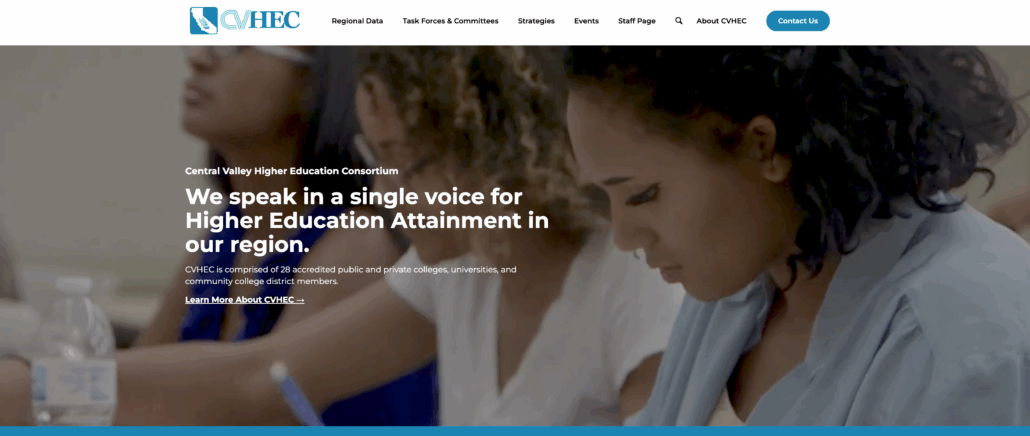
(NOV. 12, 2025) — As part of an ongoing branding upgrade, the Central Valley Higher Education Summit rolls out its 2025 website refresh this month designed to enhance user friendliness and showcase the recent forward momentum of the consortium with its 25th anniversary approaching in two years.
“This refresh underscores the momentum we have established in the past few years such as our new logo last fall, the board retreat this summer identifying four new goals and the continuation of scalable work we have undertaken in various areas such as dual enrollment, transfer and our math and English task forces and communications such as our e-newsletter,” said Dr. Benjamín Durán, CVHEC executive director.
Angel Ramírez, CVHEC associate director who has spearheaded the consortium progress with Duran since he began as an intern in late 2014, calls it “a sense of recommitment.”
“Our website update reflects the momentum we’ve built as a region. We’re coming together with new energy and focus to strengthen partnerships and keep building on the college-going culture that supports every student in the Central Valley,” Ramírez said.
The website blends the conventional features with specific consortium strategies such as:
Customized strategy features that chronicle CVHEC’s various initiatives and emphasize the consortium’s focus include such pages as:
The website also features pages showcasing how boots-on-the-ground higher ed professionals in the region help accomplish these CVHEC strategies through committees and task forces:
Ramirez said next stages of development include building out the Masters Upskilling Program and CVDEEP pages.
“Like any website, it’s a work-in-progress so we encourage viewers to keep an eye out for ongoing upgrades and updates announced in our monthly e-newsletter,” he said.
Overall, Ramírez cites the web refresh as a symbol of the consortium’s forward thrust in this issue’s “What the CVHEC Happening Blog,” where he reflects on his 10th anniversary.
“Launching our newly refreshed website, building on the momentum of last year’s new logo – it isn’t just a design update; it’s a statement that CVHEC is stepping forward, more visible, more confident, and ready to lead,” he writes. “Seeing it all come together made me pause and realize that this is what growth looks like. Not just bigger programs, but a stronger identity, a renewed purpose, and a clear sense of direction.”
He also said a video documentary chronicling the CVHEC story is currently in progress and set for release in the spring as part of the communications component he began when he first joined CVHEC that included bringing in retired Fresno State public affairs specialist Tom Uribes in 2020 to coordinate communications and media relations and help build the consortium presence in general.
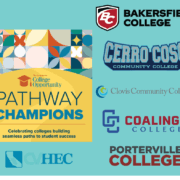
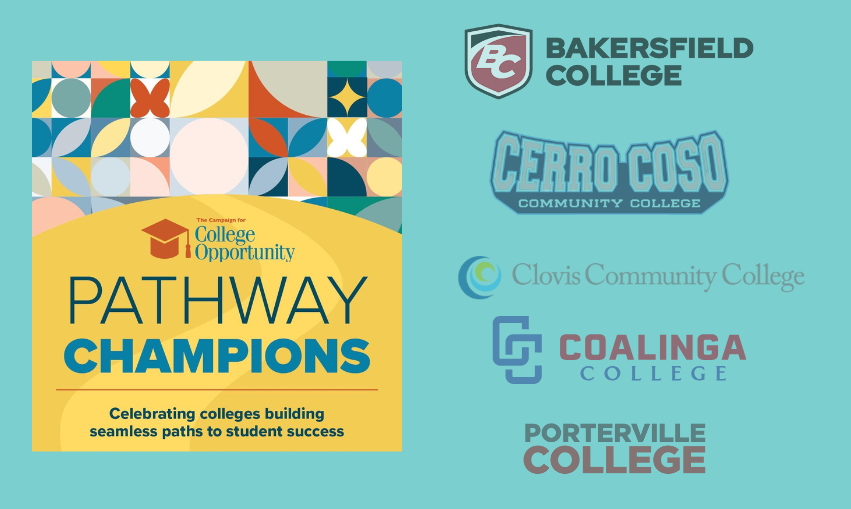
These five CVHEC community college members were recently recognized as 2025 Pathway Champions by the Campaign for College Opportunity. All are actively involved in the consortium’s Central Valley Transfer Project.
(NOV. 12, 2025) — The Campaign for College Opportunity recently honored 40 California Community Colleges and California State Universities (CSU) – including five Central Valley Higher Education Consortium members – as 2025 Pathway Champions for their work paving pathways to college and economic opportunity for thousands of California students by strengthening the transfer process.
The CVHEC-member California Community Colleges and California State Universities honored in a virtual awards presentation Oct. 23 as part of National Transfer Student Week (Oct. 20-24) for their work implementing equitable placement and Associate Degree for Transfer (ADT) policies were: Bakersfield College, Cerro Coso Community College, Coalinga College, Clovis Community College and Porterville College. (See category breakdown below).
According to CCO’s website press release, the 40 higher education institutions selected statewide were awarded for their efforts in implementing two landmark policies:
These five, along with CVHEC’s 10 other community college members, have been working through the consortium’s Central Valley Transfer Project to create a clear path to transition between community college and the 10-county regions’s four-year institutions, said Ángel Ramírez, CVHEC associate director.
“Strengthening transfer pathways for valley students has been a goal of CVHEC since the launch of our CV transfer project in 2021 ,” Ramírez said.
This year, there were four categories (Pathway Champion of Placement, Pathway Champion of Placement Equity, Pathway Champion of Transfer, Pathway Champion of Transfer Equity) recognizing achievement and equity in placement and transfer outcomes.
The CCO website press release provided additional details:
“These reforms have been pivotal as students are increasingly being supported to succeed in courses that count towards their transfer goals and placed on an expedited, guaranteed path to a four-year degree, particularly Latinx and Black Californians, who have long faced disproportionate obstacles in completing their degrees.
“Supporting higher education is vital to the future of California, especially community colleges, where nearly two-thirds of California’s college students begin their higher education journey.
“Historically, transferring from community college to a four-year university has been filled with systemic barriers, with only seven percent of transfer-intending students being able to transfer within two years, prior to 2015. In the decade since, thanks to the implementation of ADT and placement policies, more students are transferring faster, with ten percent of current community college students transferring within two years and 19 percent after four years.
“While there is room for improvement, this growth showcases the vital importance of the work that this year’s Pathway Champions are doing and presents a major solution to the looming economic challenges that California faces.
Jessie Ryan, president of the Campaign for College Opportunity, said, “Our multiracial democracy and economy require us to support the growing majority of diverse students to complete college and earn a degree. At a time when students are increasingly questioning their place in higher education due to mounting attacks on their ability to thrive, we applaud the colleges that are courageously meeting the moment to implement the policies and practices we know transform student success and strengthen transfer in California.”
See:

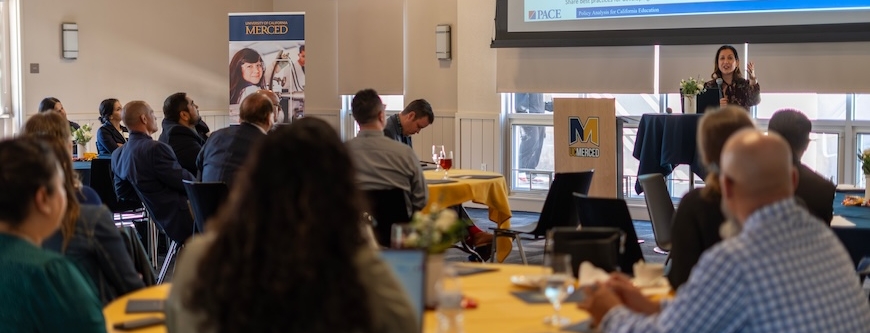
“We need programs that happen locally where high schools and community colleges deliver math and English courses so students come to college with those gateway courses out of the way,” said Central Valley Higher Education Consortium Executive Director Ben Duran (president emeritus of Merced College), at the recent Center for Educational Partnerships‘ PACE Listening Tour that featured Lupita Cortez Alcalá of Policy Analysis for California Education.
BY PATTY GUERRA
University Communications, UC Merced
(NOV. 6, 2025) — More than two dozen educators from kindergarten through college converged at UC Merced to discuss the challenges they’re facing and the opportunities ahead.
The Oct. 21 event, the PACE Listening Tour, hosted by the Center for Educational Partnerships, featured Lupita Cortez Alcalá, the newly appointed executive director of Policy Analysis for California Education (PACE).
PACE is an independent, nonpartisan research center housed at Stanford University and co-led by faculty directors at the University of Southern California and University of California campuses at Davis, Los Angeles and Berkeley.
“Our superpower is connecting research, policy and practice,” Alcalá said. “We provide evidence-based recommendations.”
Essentially, she said, the role of PACE is to work with educators to identify issues, find solutions and suggest actions. She also shared an overview of California’s TK-12 and higher education policies and budget for 2025-26.
“We want to hear from you – what key issues are impacting the K-16 education system?” Alcalá said. “What are the most pressing challenges and promising opportunities in education today and what actions can be taken to address them?”
Attendees, who came from districts spanning Stanislaus to Kern counties, shared issues that include funding uncertainty, lack of data sharing among systems and a dearth of students completing college-preparatory A-G courses in high school.
“It would really help if we could close the A-G achievement gap,” said Christiane Spitzmüller, vice provost for academic affairs and strategy at UC Merced.
Ben Duran, executive director of the Central Valley Higher Education Consortium (CVHEC) and former president of Merced College, pointed out that 40 percent of students drop out of school when they can’t pass college-level English and math courses.
“We need programs that happen locally where high schools and community colleges deliver math and English courses so students come to college with those gateway courses out of the way,” he said.
Duran also said there are efforts already underway to strengthen partnerships between the different levels of educational systems. Earlier in the day, he attended a State of Education event at UC Merced featuring superintendents of Merced County school districts.
“We are blurring the lines between high schools, community college and university,” he said.
That kind of collaboration is vital, said Orquídea Largo, associate vice chancellor of CEP and chief outreach officer at UC Merced.
“We need for our faculty to understand the needs of the communities that they intend to research,” Largo said. “CEP is prepared to serve as a liaison for our faculty and the communities we serve to strengthen relationships between researchers and K-12 practitioners.”
Jorge Aguilar, superintendent of the Wonderful College Prep Academy in Delano and Lost Hills, agreed.
“We somehow have to formalize an incentive structure for K-12 practitioners to feel more comfortable and lean into this idea that your work can benefit students more if you work with researchers.”
Sandra Fuentes, dean of early college at Reedley College, said her institution is interested in taking part in research that identifies best practices.
Alcalá said the region is uniquely positioned to address some of these issues.
“What’s great about the Central Valley is you know each other,” she said. “You can act a little faster and quicker.”
UC Merced, with its large first-generation student population, is well-positioned to lead change for the entire educational community.
“We tell people all the time we think UC Merced is the most exciting place in higher education in North America,” Spitzmüller said. “Students come with ambition and grit, but many have not had the same opportunities other students have had.”
Alcalá said she would return in January to share an update on the next proposed state budget and its impact on higher education.
A follow-up summit is planned in the spring, Largo said.
“We are hoping to bring researchers, faculty and K-12 practitioners together so they show how an effective post-secondary research and K-12 practitioner relationship can form.”
See original UC Merced PACE story.
UC MERCED MEDIA CONTACT: Patty Guerra
Public Information Officer
Office: (209) 769-0948
