
‘Continuing the CVHEC Way

to AB 1705 Success’ – Part II

Math Task Force resumes AB1705 curriculum planning April 19 with
a look at chancellor options, adding high school principals voices to the convo


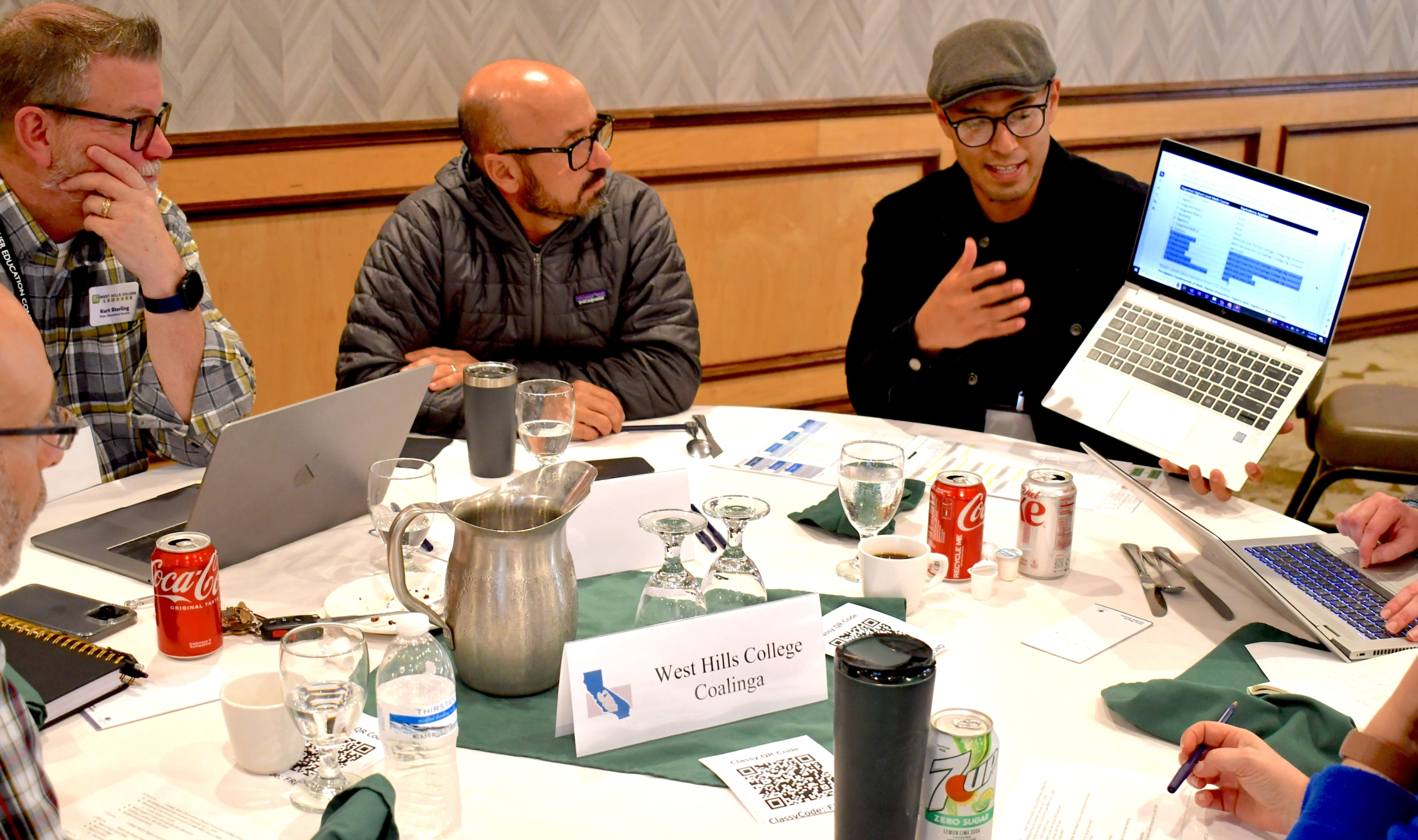
Many of the best math minds in the Central Valley will resume their Assembly Bill 1705 compliance deliberations April 19 for the latest Central Valley Higher Education Consortium (CVHEC) Math Task Force convening,  “Continuing the CVHEC Way to AB 1705 Success – Part II” from 9 a.m. to 3 p.m. at the DoubleTree by Hilton Hotel Fresno Convention Center.

The agenda released last week includes a look at recent guidance from the California Community College Chancellors Office (CCCCO) and introduction of a new Principal’s Strand to the ongoing discussions as they work towards compliance with the final stage of AB1705 by July 1: validation of equitable placement, support and completion practices for STEM programs.

Participants are encouraged to register for the free event by the April 17 deadline said John Spevak, CVHEC regional coordinator who oversees the consortium’s Math Task Force.

About 85 community college math educators, administrators and institutional researchers are expected to re-convene for the day long CVHEC event co-facilitated by the Charles A. Dana Center (University of Texas at Austin), following up two virtual sessions in the fall and two in-person meetings.

This third in-person event on the topic is drawing many new faces with four principals and five other K-12 representatives registered to attend for input regarding what impact AB1705 will have at the high school level and how to work together to align math efforts.

Secondary education leaders registered to attend are:

  • Lisa Castillo – Cutler-Orosi Joint Unified School District director
  • Matt Gehrett – Dinuba Unified School District director
  • Christine Johnson – Dinuba Unified School District math coach
  • Celeste Azevedo – Mariposa County High School principal
  • Marlena Celaya – Orosi High School principal
  • Stasha Tiller – Riverdale High School principal
  • Beu Her – Sanger High School deputy principal
  • Christina Rubalcava – Stanislaus County Office of Education Math Project coordinator
  • Brett Toliver – Stockton Unified School District principal


In addition to college administrators and institutional research participants, registration has also been received from representatives of the California State University Chancellors Office, the California Academic Partnership Program, the Fresno State Department of Curriculum & Instruction and the College Readiness Program, Citrus College (Glendora CA), MESA, STEM counselors and college articulation officers.

“Once again, this is an agenda which is engaging and interactive and enables the best math minds in the Central Valley to determine the best path forward to math success for Central Valley students in light of AB 1705 and in light of the recent memo from the Chancellor’s Office,” said Spevak, who is also a vice president-emeritus of Merced College.

He encouraged CVHEC community college members not yet involved to send a delegation of its math educators as well as administrators and institutional researchers to continue collaboration on curriculum discussion that would lead to fulfilling the last phase of the state law signed into law in 2022.

In what has been dubbed “the Central Valley Way,” the Math Task Force and convening participants have gathered to explore five strands of curriculum planning:

  • Validating Prerequisites;
  • Designing Precalculus for 2025;
  • Math Support Outside and Inside the Classroom;
  • Building an AB 1705 Campus Team; and
  • Guided Self-Placement.

In a Dana Center analysis for CVHEC of the CCCCO memo issued Feb. 27 outlining options for the colleges to consider, Joan Zoellner noted that while the memo provides direction on the validation process for transfer­ level math placement and enrollment practices for STEM programs, it severely restricts the options for the number of transfer-level prerequisite courses that shall be offered prior to calculus.

“The options for that prerequisite course are limited by the memo and validation options as well”, said Zoellner, who is the Dana Center’s Launch Years Initiative lead.

Consortium community colleges were asked to review the chancellor’s office memo and some of the findings presented to determine how it affects their respective campus for discussion at the upcoming session including working with campus IR department to confirm the numbers and results prior to the April 19 convening.

To open the April 19 event, Spevak will be joined by Dana Center representatives Tammi Perez-Rice, Frank Savina, and Cassidy Kist in welcoming the participants.

Perez-Rice will provide of an overview of AB1705 and the Dana Center analysis of the CCCCO Memo sent to community colleges Feb. 27 to clarify and discuss options available for compliance. (See the What the CV-HEC is Happening Blog in this issue).

The group will then break out into these one-hour planning sessions:

  • Option A planning – the Central Valley Calc 1 coreq
  • Option D planning – the Central Valley Calc 1 prereq
  • Options B and C – validating prerequisites
  • High School Principals

Lynn Cevallos, College Bridge president, introduces a new Principals Strand which will feature high school leaders who currently work with the Central Valley Math Bridge Project.

“In our last session, at the behest of the only principal in attendance, Marlene Celaya of Orosi High, we realized the value of including K-12 voices at the table so we reached out to schools participating in our Math Bridge program with College Bridge,” Spevak said. “We appreciate the leadership of Marlene and Lynn Cevallos to expand our reach. We invite any other interested Central Valley K-12 officials to join us April 19.”

Following her session will be “Reports from Strand Leads:”

  • NATHAN CAHOON, Taft College: Validating Prerequisites: Quantitative And Qualitative;
  • JEREMY BRANDL, Fresno City College: Designing Precalculus for 2025 (designing calculus with support in 2025);
  • Holistic Student Support
    • MARIE BRULEY, Merced College: Building an AB 1705 Campus Team;
    • JAY THOMAS, Lemoore College: Guided Self-placement and Registration Process;
    • TINA AKERS, Modesto Junior College: Math Support Outside the Classroom —

Prior to the lunch break, Spevak will provide a preview of the afternoon breakout sessions which begins with follow up breakouts by strand.

For the final session of the day, college teams will meet to “Set Next Steps and Goals” under these topics: planning curriculum committee process; planning eval/validation; and planning how to set up registration process; and “Continuing the Central Valley Way — More than Just Compliance.”

In a closing 15-minute activity, college teams will each provide a report out.

“We appreciate the immense work by our regional community colleges in collaboration with CVHEC partners the Charles A. Dana Center from the University of Texas at Austin as well as College Bridge,” said Dr. Benjamín Durán, CVHEC executive director and president-emeritus of Merced College. “They are building pathways and eliminating barriers for our students looking to navigate the challenge of completing their gateway courses in college math.”

See:

AGENDA – The CVHEC Way to AB 1705 Success Part 2

CCCCO Validation Memo (Feb. 27, 2024)

What the CV-HEC is Happening Blog

This month’s “What The CV-HEC Is Happening” guest blog is presented by Joan Zoellner, M.A., Launch Years Initiative lead for the Charles A. Dana Center (University of Texas at Austin), co-facilitators of the CVHEC […]

This month’s “What The CV-HEC Is Happening” Blog takes a unique look at an unprecedented wave of leadership at five major Kern County education institutions:  California State University, Bakersfield; Kern […]

The winds of a prospering education scene

Greetings CVHEC friends and colleagues!

Welcome to spring 2024 and our March e-newsletter.

This issue carries some interesting articles beginning with a very unique situation in the South Valley where our regional lead, Tom Burke, provides a perspective from his role as chancellor-emeritus of the Kern Community College District regarding the unprecedented winds of change in five major Kern County education institutions in the past year alone.

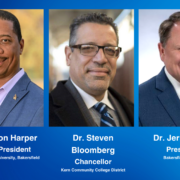
In previous issues, we have noted the appointments of Kern Community College District’s new chancellor, Dr. Steven Bloomberg, and Bakersfield College’s new president, Jerry Filger. Now we welcome them as both began their respective terms this month as well as their terms on the CVHEC Board of Directors. They are part of that transitioning educational leadership in Kern County that Chancellor-emeritus Burke presents in this month’s “What the CV-HEC is Happening” Blog.

Also, you will see our participation in the recent Digital Dual Enrollment Week campaign by the Dual Enrollment Coalition of California. We highlighted our Master’s Upskilling programs and recent graduates; one of the alumna of that program now teaching dual enrollment at Sanger West, Mrs. Jade Martinez and her students; our dual enrollment video with student success stories; and the work of our Math Bridge Program with partner College Bridge as they conduct student recruitment this spring.

We  also congratulate and welcome two new members of the California Community Colleges Board of Governors who make their homes in the Central Valley and are associated with two of our CVHEC member colleges: congratulations Cirian Villavicencio of San Joaquin Delta College in the North Valley, and Kern Community College District trustee Nan Gomez-Heitzeberg in the southern San Joaquin Valley.

The latter represents the first South Valley representation on the highest governing body in California’s community college system that advocates for nearly 2 million students at 116 colleges across the state, including our 15 CVHEC community college members. We thank them for the service they will be performing for this community.

And last but not least, we bid “farewell” to a cherished team member, Ms. Pricila Villanueva, our administrative coordinator since 2018 who moves into a fulltime position with Equitable Bank Standards, Beneficial State Foundation where she will continue her work as a champion for equity. Pricila, we wish your and your family all the success in the world!

As you can see, there is so much more in this issue as our e-newsletter continues to grow and provide a communications platform for the great higher education work underway in the Central Valley.  Please enjoy!

Secondary education voices invited to join discussion Discussions to improve calculus pathways for STEM students amidst a pending deadline this summer continues with the third “Central Valley Way to AB1705 […]

CVHEC joins dual enrollment partners

in statewide digital campaign

The Central Valley Higher Education Consortium participated in the Digital Dual Enrollment Week social media campaign conducted statewide Feb 26-March 1 by the California Alliance of Dual Enrollment Partnerships (CADEP).

The weeklong campaign followed the 2nd Annual California Dual Enrollment Equity Conference held Feb. 20-23 in Long Beach presented by CADEP, Career Ladders Project, and The Education Trust–West with fiscal agent the Foundation for Los Angeles Community Colleges.

The California Alliance of Dual Enrollment Partnerships is an affiliated chapter of the National Alliance of Concurrent Enrollment Partnerships (NACEP), is a unified coalition committed to the advancement of equity, student success and quality in dual enrollment programs in California.

Its vision is to unite individuals, state agencies and organizations committed to dual enrollment in California to promote and advance quality dual enrollment programming across the state.

For the social media campaign, dual enrollment partners were asked to promote a specific theme each day:

MONDAY – Feb. 26: Celebrate Dual Enrollment Success

TUESDAY – Feb. 27: Dual Enrollment Myth Busting

WEDNESDAY – Feb. 28: Dual Enrollment is an Equity Strategy – Widening the Front Door to College

THURSDAY – Feb. 29: Families, Communities and Dual Enrollment

FRIDAY – March 1: Innovations in Dual Enrollment

“We were able to incorporate several of our projects and dual enrolment student interactions over the past few years into the social media campaign,” said Tom Uribes, CVHEC communications/media coordinator.

CVHEC featured its Central Valley Dual Enrollment for Equity and Prosperity (CVDEEP) Projects and outcomes: Master’s Upskilling Project recent graduates; the consortium’s dual enrollment video; the Math Bridge project in collaboration with College Bridge; students who participated in the video and at CVHEC convenings sharing their success stories as well as their families; and visiting the dual enrollment classroom of Jade Martinez, a Sanger West High School English teacher  who completed the innovative Master’s Upskilling Project that qualified her to teach the community college courses at her high school.

CVDEEP is now looking ahead to its annual convening that will be held in the fall this year. Details will be forthcoming in future CVHEC newsletters.

For more info on CVHEC Dual enrollment work please visit. https://cvhec.org/dual-enrollment-in-the-central-valley/

Priscila Villanueva at the 2023 CVHEC Summit with Angel Ramirez and two student panelists, Hailee Guerra (left) and Jesús López Nuñez (right).


This issue brings another melancholy moment as we bid farewell to a key star of the Central Valley Higher Education Consortium team, Priscila Villanueva, our administrative coordinator since 2018.

Priscila will start a new position as community associate for Equitable Bank Standards, Beneficial State Foundation supporting community engagement for the Equitable Bank Standards initiative.

She has been instrumental in CVHEC’s mission with a focus on increasing educational equity in the Central San Joaquin Valley, said Dr. Benjamín Durán, CVHEC executive director.

“Priscila became an important part of our CVHEC family and will be dearly missed,” Durán said. “Her dedication and commitment to our mission was evident in all she did for us.  We wish her and her family all the best.”

Ángel Ramírez, director of operations and finance and Priscila’s immediate supervisor, credited her with playing a major role in the consortium’s increased growth the past eight years.

“Priscila always took care of the everything behind the scenes that most people don’t get to see, but her role with CVHEC allowed us to run smoothly, efficiently, and worry-free these last eight years,” Ramírez said. “I am eager to see where this new position takes her.”

Priscila said that from day one, “Dr. Durán and Angel set the pace for a dynamic and collaborative team. I have been privileged to have had a front seat to the CVHEC initiatives and all the good CVHEC has done in the Central Valley.

“I cannot thank Dr. Duran and Angel Ramirez enough for their leadership, constant support, care and love. I leave CVHEC having built invaluable relationships and connections. I will treasure and miss my work and team, but I am excited to see where they go next!”

CVHEC has announced a job search to fill the position as soon as possible, Ramirez said.

See Application.


KCCD Trustee Nan Gomez-Heitzeberg, Delta prof Cirian Villavicencio appointed


Two Central Valley community college representatives were appointed to the California Community College Board of Governors: Cirian Villavicencio, a professor at  San Joaquin Delta College in the North Valley, and Kern Community College District trustee Nan Gomez-Heitzeberg from the southern San Joaquin Valley.

Gov. Gavin Newsom announced the appointments Feb. 28 for the board, the highest governing body in California’s community college system that advocates for nearly 2 million students at 116 colleges across the state.

They will be working with systemwide Chancellor Sonya Christian, who served on the CVHEC board when she was a Central Valley higher education leader, to provide guidance and strategic direction to districts and community colleges in California by implementing the Governor’s Roadmap to Success for California Community Colleges.

They will also work with the chancellor to advance the California Community College’s “Vision 2030” action plan which focuses on improving student outcomes while focusing on four strategic areas: guiding field practice, removing barriers, fostering policy reform, and supporting college implementation.

“We are delighted that in addition to Chancellor Christian, the Central Valley can now claim two new members of the California Community Colleges Board of Governors,” said Dr. Benjamín Durán, executive director, of the Central Valley Higher Education Consortium.


“We are especially pleased that these two new BOG members — coming from the north and south regions of our valley — provide the governing board with true representation from throughout our nine-county region,” Durán added. “Please join us in extending a Central Valley congratulations to the two new Board of Governors members.”

Gomez-Heitzeberg, who taught at Porterville College and was an administrator at Bakersfield College, is a lifelong advocate for education who has witnessed firsthand the transformational power of community colleges.

“My experiences in the classroom, as an administrator, and as a trustee have strengthened my advocacy,” said Trustee Gomez-Heitzeberg. “I appreciate the opportunity to represent the Central Valley and look forward to working with my colleagues to bring Vision 2030 to implementation across the State.”

She brings more than 30 years of experience in serving the disinvested rural student populations of Kern County in various roles, including as: a tenured faculty at Porterville College; an interim president and vice president of Instruction at Bakersfield College; a director of Bakersfield College’s Delano Campus; and the associate vice chancellor for Kern CCD Child Development Centers.

Upon her retirement from BC’s administration, Gomez-Heitzeberg was first elected to serve on the Kern CCD Board of Trustees in November 2018.

Kern CCD Board of Trustees President John Corkins noted that the Southern San Joaquin Valley had been lacking representation on the Board of Governors for a long time.

“Trustee Gomez-Heitzeberg has a deep understanding of what our students here in the Central Valley need to be successful,” Corkins said. “Through her appointment to this important governing body, she will be a tireless advocate for Central Valley students and a voice for higher education in the Valley up in Sacramento.”

Former Kern CCD Chancellor, Tom Burke has worked with Trustee Gomez-Heitzeberg in a variety of roles over the last 25 years.

“Her extensive experience working to provide higher education opportunities for students in the San Joaquin Valley will serve the Valley well as she joins the Board of Governors as the only representative from the Southern Central Valley,” said Burke who is now a regional coordinator for CVHEC helping lead its Kern Master’s Upskilling Program and Central Valley Transfer Project.

Villavicencio, a Delta College Political Science professor and co-chair of the Department of Political Science who will assume one of two faculty seats on the board, said he is “deeply humbled” by the Governor’s appointment.

“I will help represent and elevate the voices of 1.9 million California community college students, as well as 56,000 of my fellow faculty colleagues,” said Villavicencio who received Delta’s Distinguished Faculty Award in 2020.

“While our system faces many challenges from artificial intelligence to closing equity gaps among our underserved and disproportionately impacted students, I know there are many opportunities to improve our system and the lives of our students.”

Dr. Villavicencio has over 18 years of experience in higher education and has been active in local, state, and national politics, including serving as a staffer for the California Asian American Pacific Islander Legislative Caucus in the state Capital. He was elected twice as a delegate to the Democratic National Convention in support of former President Barack Obama in 2008 and 2012.

“We are so very proud of Dr. Villavicencio and his commitment to serve the entire community college system in California,” said Delta College Superintendent/President Dr. Lisa Aguilera Lawrenson, a CVHEC board member.

“The fact that he was selected to represent professors from all over the state speaks to the high quality of our Delta College faculty and their determination to help students succeed,” President Lawrenson added.

The Board of Governors of the California Community Colleges was established in 1967 to provide statewide leadership to California’s 73 community college districts, which operate 116 community colleges.


The Board has 18 voting members as specified in statute. Twelve members are appointed by the Governor, require Senate approval for six-year terms, and must include two current or former local board members. Five members are appointed by the Governor to two-year terms and include two students, two faculty members, and one classified member. The lieutenant governor also serves as a member of the Board.


###


See:

Announcement from the California Community College Chancellor’s Office
Announcement from Gov. Newsom’s office

Kern press release [checking with KCCD PIO to see if they will post it. If not, we can post the pdf)

Delta press release


Modesto Junior College math professor Tina Akers-Porter discusses her strand group’s deliberations at “The Central Valley Way to AB1705 Success” Convening Jan. 26 where a call for a “principals task force” by Orosi High School Principal Marlena Celaya would bring more secondary education voices to the table.

‘Something extraordinary is happening in math in California’s Central Valley’

Math Task Force latest AB1705 session leads to calls

for more data, high school input, re-convene April 19

BY TOM URIBES
CVHEC Media/Communications Coordinator

Realizing that state guidance surrounding Assembly Bill 1705 remains elusive, valley community college math educators and officials forged ahead at “The Central Valley Way to AB1705 Success” convening Jan. 26 in Fresno with a determined and unified mindset to develop implementation plans that will serve the best interests of their students including a follow-up session set for April.

In addition, the Central Valley Higher Education Consortium (CVHEC) Math Task Force discussion centered around five strands of curriculum planning for implementation before the law goes into effect July 1, two aspects emerged at the lively day-long work session: the increased participation of institutional researchers for pertinent data-collecting and a call for a “principal’s task force” to bring upper secondary education voices to the table.

Presented by CVHEC, the convening — the latest in a series of deliberations since fall — was attended by 82 representatives from the consortium’s 19-member community colleges, one high school principal and campus research professionals.

They agreed to reconvene April 19 for reports on follow-up work that will occur as a result of this most recent event. Registration for that event will open next month with additional details forthcoming.

Facilitated by the Charles A. Dana Center at the University of Texas at Austin, the session last month reviewed five strands of curriculum planning: Validating Prerequisites; Designing Precalculus for 2025; Math Support Outside and Inside the Classroom; Building an AB 1705 Campus Team; and Guided Self-Placement.

“With tensions high and little guidance surrounding AB1705, the 19 community colleges and districts that comprise the CVHEC nine-county region are rolling up their sleeves and getting to work on this math movement the ‘Central Valley Way’,” summarized Tammi Perez-Rice of the Dana Center.

Perez-Rice, who co-facilitated the event, said the convening was solely dedicated to working and planning at a regional and institutional level in two parts. The first part was dedicated to expanding the five work groups that emerged from the Nov. 17 webinar and creating a plan to move forward.  The second half of the convening was devoted to institutional planning.

“The fruits produced from these convenings are already being felt around the region,” Perez-Rice said.  “The plans and implementations emerging from these convenings are more than just a response to AB705 and AB1705; they cultivate systemic reforms that will benefit all students in the CVHEC region and beyond.”

John Spevak, CVHEC regional coordinator who oversees the consortium’s Math Task Force and co-facilitator of the Jan. 26 gathering, said in the short-term, the five strands work groups will continue to communicate and provide updates in preparation for the April 19 convening. The strand leads are preparing summaries of their Jan. 26 breakout discussions and member college teams are preparing summaries of the tentative plans they developed in the afternoon breakout sessions for oral reports in April.

“In the longer term, our Math Task Force will continue to monitor what the California Community College Chancellor’s Office says, while mainly going forward with our own Central Valley approach to the five strands.”

That “Central Valley Way” stems from the work undertaken by the CVHEC Math task Force, first formed in 2019, in the past year that was intensified with four work sessions beginning Oct. 6 in a virtual convening with CCC vice-chancellor Eric Cooper. The first in-person session followed Oct. 13 in Fresno and another virtual session was held in two parts Nov. 17 before the Jan. 26 session.

These sessions may represent the only concerted effort by a region’s community college math community actively meeting to collaborate across campus boundaries for ways to unite as one voice and determine a curriculum course of action that meets the law’s intent, Spevak said.

“We at CVHEC, along with the Dana Center representatives and our College Bridge partners in the Math Bridge Program, feel that something extraordinary is happening in math in the Central Valley of California,” Spevak said.

After the Jan. 26 session ended, Perez-Rice reiterated a point she made the first time she visited Fresno for the first in-person convening last fall:

“This collaboration today was amazing. As I travel and talk to math faculty all over the country, what I see pulsating from the CVHEC community here in Central California is just compassion; caring about their students; putting their students first; understanding what their students need; and more importantly collaborating with each other working across institutions to make things happen.”

Inviting secondary ed voices to ‘align syllabi’

A key development of the convening was the assertion and agreement that a crucial next step is “to involve high schools in the discussion and determine how to breakdown barriers between systems for a cohesive collaborative effort to put students first across the state of California,” a message delivered by Marlena Celaya, principal of Orosi High School who was the only secondary education official in attendance.

Celaya’s comments, first in a strand session and later in general comments before the assembled group, resonated with the community college professionals as she offered to lead a task force of principals/administrators who would unify with the CVHEC community college math educators for implementation strategy — to listen and hear what the needs are and how to meet those needs.

“I’m willing to lead this work because I don’t want people to go through the wars I went through teaching algebra and volunteering all my time,” said Celaya, a former math teacher at Dinuba High School. “We would want to  hear from community colleges and say to them ‘what do you need?’

“We heard something from you today: ‘I want to know what courses are offered at the high school and what does that course description look like?’ Aligning syllabi is what I’d like to do,” Celaya said. “Mathematics is my passion.”

Perez-Rice said the April 19 convening promises more high school representation, with over twelve principals who are part of the Math Bridge Program by CVHEC and College Bridge being invited. Other secondary education officials from throughout the valley are welcome she said.  

Participant feedback: ‘great to see we’re not alone in this …’

After the event, several participants shared their assessment of the Jan. 26 convening.

“The conversations were amazing and we really appreciated being here,” said Joshua Lewis, chair of the Bakersfield College Mathematics Dept.

“There have been so many legislative changes and so many unknowns it’s nice to see the work that other campuses are doing and realize that we’re not alone, that we have shared values; that we have shared emphasis on student learning and really care about doing right by all of our students,” he added.

Nathan Cahoon, Taft college math professor, felt that the efforts of CVHEC’s Math Task Force as exhibited at the convening is strengthening the voice of the valley’s math community which will have an impact.

“It was amazing to work with incredible professionals who have some really amazing ideas,” he said. “I know I took many good notes about ideas to implement at our college.  The connections we are building here with each other will be powerful down the road as we build a cohesive effort to get some good research together that we can send to the state as one voice from all the colleges.”

Modesto Junior College math professor Marina Hernandez said coming together within the region is relished because when attending other statewide or national conferences, the focus is not as localized.

“It was very helpful to learn what other colleges in the Central Valley are doing because we share similar student population and resources characteristics and their best practices are applicable to us here in our region,” Hernandez said.

Tina Akers-Porter, Modesto Junior College math professor, said the Math Task Force work has helped her better understand what AB1705 is and what it means for her students.

“I feel like I have a better understanding of some of the challenges of the legislation and what others are worried about,” she said.  “We share some of those worries but it’s great to hear different points of view on that. A byproduct of this is we are seeing how we need to support underprepared students more, inside and outside the classroom, and sharing ideas to do that.”

Shelly Getty, Taft college math faculty and a strand leader, echoed Akers-Porter: “We left knowing we are going to start some specific tutoring and targeting students for tutoring. We will try to advertise it better and recruit so students get more access to the services we already provide which will greatly impact them.  We shared some good ideas on how to do that effectively.”

Marissa Martinez, Taft college math professor, said, “We have our work cut out for us. There’s a lot of things that we have to address with a lot of moving parts. Everything keeps changing but it was great to be able to see that we’re not alone in this, that we’re working together to better serve our students.”

She said this intercollegial collaboration and the feedback from the colleges helps “so we don’t have to reinvent the wheel — what worked, what didn’t work.”

Next steps? Data research

“I would say the next step is collecting our data to see how the numbers show where we are so we can prove that these courses are important for our student success,” Martinez said.

This data aspect was also a key part of the convening as institutional research professionals were invited and directly participated such as Arooj Rizvi, research analyst in the Office of Institutional research and Effectiveness at San Joaquin Delta College.

“Researchers have a monumental role in the implementation of AB 1705 because policymakers are going to depend a lot on what we are able to produce as a group or even as an institution,” Rizvi said. “Being a part of these conversations helps us to see the bigger picture, the context and the requirements of what exactly it is that we are looking for in the data.”

She said it was exciting to hear at the convening what area colleges are going through.

“I realized how similar our challenges are from institution to institution, “she said.  “Working through that together and being solution-oriented is something that’s going to take all of us towards a beneficial direction. Seeing us all here today was a defining moment in history.”

Owynn Lancaster, vice president of academic strategy for CVHEC partner College Bridge, said the event was “a huge success seeing folks come together from math to talk about math and really pool their resources to address actual challenges.

“The most powerful focus of change in education is always the educator,” Lancaster said. “I know everything’s heaped on them but in a lot of ways they have the greatest power of the greatest agency for this.”

For more info: centralvalleyhec@gmail.com

For CVHEC media inquiries: Tom Uribes – cvheccommunications@mail.fresnostate.edu (or text 559.348.3278).

See also:

Math Task Force

https://bit.ly/MTFconveneKSEE24

Valley’s math ed experts unite to address AB 1705 challenge for student success

The CVHEC Way to Math Success — Implementing AB1705

Math Task Force begins discussion of AB1705 implementation – Nov. 17 next
CVHEC Math Task Force meets in-person Oct. 13 for AB 1705 follow-up

NEWS RELEASE – CVHEC Math Task Force: Impactful legislation (AB 1705) Convenings Oct. 6 & 13

CVHEC Website Feature: Math Task Force Page

PHOTO GALLERY