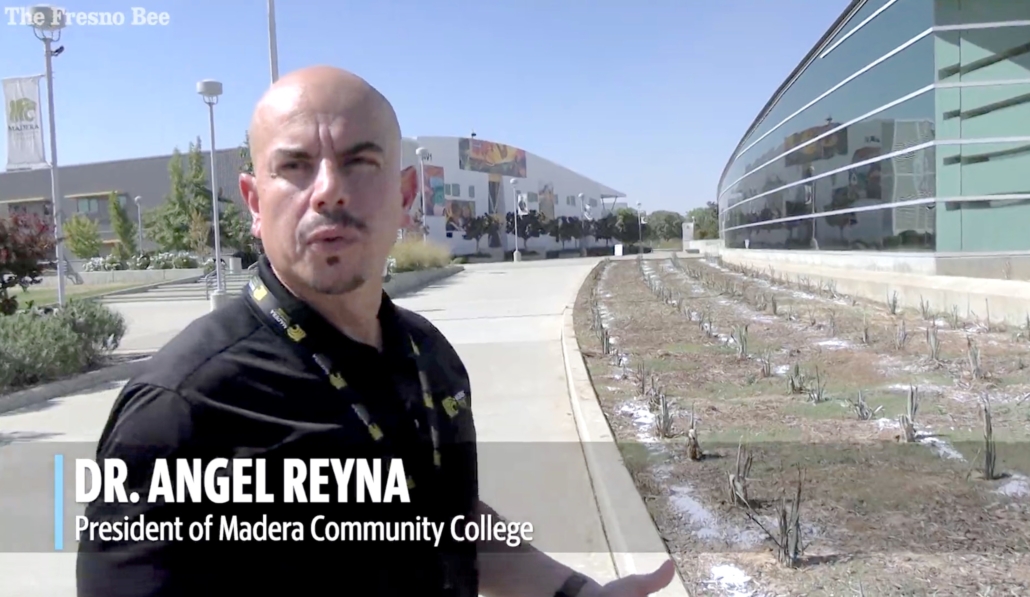
In a Fresno Bee video published last fall, Madera Community College President Ángel Reyna explains the college’s new academic Agave Distilling Program that will begin later this fall, he announced at his recent State-of-the-Campus address.

President Reyna provides update in his
State-of-the-Campus address

In his recent state-of-the-campus address, Madera Community College President Ángel Reyna announced that the college’s new academic Agave Distilling Program will roll out later this fall as a community education course with a credit curriculum currently in the development stages.

In a story published last fall, The Fresno Bee reported that community college students will work with a local winery where they will use commercial-grade equipment to make alcoholic spirits from the increasingly popular agave plant, famous for its production of tequila and mezcal in Mexico.

“Establishing an academic agave distilling program would be an innovative step for the state’s youngest community college: not only would it be the first of its kind at a public college in California, but it would train the future workforce of the state’s growing agave industry,” the story reported.  

President Reyna told The Bee that, in the long-term, capitalizing on agave-based education could lead to an economic and cultural boost for Madera County.

At his campus address Oct. 3, he said Madera Community College is now leasing the Balbas American Winery located in south Madera and that $300,000 worth of equipment has been purchased. The program will plant 10-20 acres of various agave on campus and MCC plans to collaborate with the University of California Merced and UC Agriculture and Natural Resources for agave-related research.

President Reyna said in addition to its training and educational aspects, the vision of the Madera Community College academic Agave Distilling Program is to:

  • build a hotel, restaurant, bar and distillery
  • establish the “Bi-National Agave Route”
  • create a museum to illustrate the history of agave-tequila, mezcal and MCC’s work in this academic endeavor

Background:

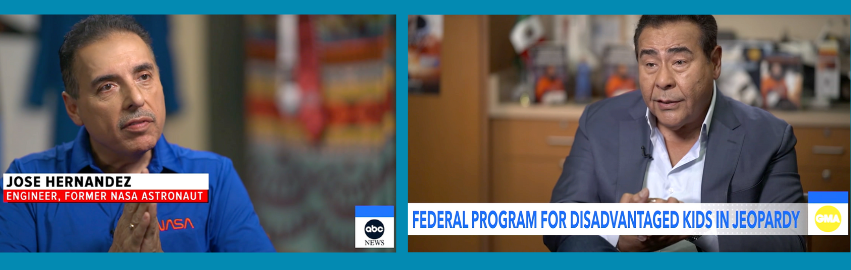
Future of Federal Programs at risk – ABC Good Morning American (Sept. 8)

“You and I wouldn’t be here if those programs didn’t exist,” Quinones told Hernandez. “You and I both picked vegetables as migrant farm workers and then our wildest dreams came true.” Hernandez agreed. “Without the TRIO program, I never would have achieved my dream of becoming an astronaut,” he said. “I don’t think I would have been prepared for the rigors of graduate school. I have found education to be the great equalizer.”

Pacific alum Jose M. Hernandez, NASA astronaut, featured in ABC News report

about TRIO with fellow Upward Bound alumnus John Quinones

BY MERRITT MCLAUGHLIN
Senior Writer – University of the Pacific

University of the Pacific’s leadership in improving access, retention and graduation rates for first-generation students and students with disabilities through the TRIO program received national recognition on Good Morning America recently.

The television appearance Sept. 8 — part of a segment on TRIO’s impact on students across the country — highlighted Pacific’s long-standing commitment to providing resources to underserved students. Pacific has supported low-income students through TRIO since 1979, helping more than 1,400 students stay on track, graduate and launch successful careers.

“Our TRIO success students are no different than any other college student in the United States,” said Vice President of Student Life Maria Blandizzi during the segment. “They have brilliance and ability that will matter to all of us and to future generations.”

Current students Simran Mann ’27, in the Eberhardt School of Business, and Mark Castaneda ’26, in the School of Engineering and Computer Science, shared their experiences while Pacific alumnus and former NASA astronaut Jose Hernandez ’84 joined Good Morning America host John Quinones to discuss the TRIO Upward Bound program, which both men participated in as students.

“You and I wouldn’t be here if those programs didn’t exist,” Quinones told Hernandez. “You and I both picked vegetables as migrant farm workers and then our wildest dreams came true.”

Hernandez agreed. “Without the TRIO program, I never would have achieved my dream of becoming an astronaut,” he said. “I don’t think I would have been prepared for the rigors of graduate school. I have found education to be the great equalizer.”

Upward Bound is one of several programs under the TRIO umbrella. Funded by the U.S. Department of Education, it partners with Pacific students to offer tutoring and a six-week college exploration summer program for students from nearby Edison High School.

Pacific also recently launched the First Gen Hub last year to support all first-generation students. The collaborative space includes study rooms, a computer lab, a kitchen and common areas on the ground floor of the McCaffrey Center.

“We all are going through this college journey together and we all are trying our best to reach our best potential,” Mann said. “It really makes my college degree much more accessible and it makes me feel a lot more confident in my space of being at college.”

The hub supports Pacific’s equity programs, including the Community Involvement Program, Success TRIO and Promise Scholars, and also serves first-generation students who are not enrolled in an equity program.

“I was homeless for about eight years. I’m very proud of the things that I have been able to overcome,” Castaneda said. “Without programs like TRIO, without that type of support, the growth and healing and resilience that I’ve developed doesn’t happen.”

The U.S. Department of Education recently awarded Pacific a $1.7 million grant to improve college retention and graduation rates for first-generation students and students with disabilities.

The five-year TRIO Student Support Services grant will help 200 students per year receive academic tutoring, financial aid, scholarship guidance, career exploration, personal and academic counseling and mentoring.

Current Pacific students can apply for the program’s services online.

See: original Pacific press release.

For University of Pacific media inquiries, contact Sallie Poggi, Pacific Chief Communications Officer: 209.932.4436 or spoggi@pacific.edu

Click here to add your own text

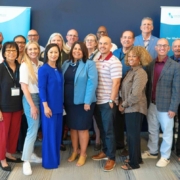
The CVHEC Board of Directors and team members convened Aug. 15 at UC Merced for a hybrid strategic planning retreat. Attending in person: (FRONT): Fresno State President Saúl Jiménez-Sandoval; CHSU President Flo Dun; Coalinga College President Carla Tweed; YCCD Interim Chancellor Lena Tran; San Joaquin Delta College Superintendent/ President Lisa Aguilera Lawrenson; Madera Community College President Ángel Reyna; Clovis Community College President Kim Armstrong; Merced College Superintendent/ President Chris Vitelli; CVHEC Dual Enrollment Lead Kristin Clark; UC Merced Chancellor Juan Sánchez Muñoz. (MIDDLE): CVHEC Admin Assistant Priscilla Arellano; Fresno City College President Denise Whisenhunt; Bakersfield College Interim President Stacy Pfluger; Taft College Acting Superintendent/ President Leslie Minor; CVHEC Executive Director Benjamín Durán; Reedley College President Jerry Buckley. (BACK): CVHEC Associate Director Angel Ramirez; WHCCD Chancellor Robert Pimentel; Lemoore College President James Preston; Modesto Junior College President Brian Sanders; Fresno Pacific University President André Stephens; College of the Sequoias President Brent Calvin.  (Photo: Juan Rodriguez – UCM).

CVHEC board sets direction for next 3-5 years

with collaborative focus on student success


BY TOM URIBES
CVHEC Communications/Media Lead

Leaders from colleges and universities across California’s Central Valley gathered at the University of California, Merced for a one-day Strategic Planning Retreat hosted by the Central Valley Higher Education Consortium (CVHEC) Board of Directors Aug. 20.

The session marked an important milestone in the consortium’s 23-year history, as presidents, chancellors and higher education CEOs from across the region came together to chart a bold course for the next three to five years, said Dr. Benjamín Durán, CVHEC executive director, .

“This was a ‘roll up your sleeves’ kind of day,” Durán said, reflecting the spirit of the retreat. “It was about open discussion, candid collaboration, and making decisions that will set the state and direction for CVHEC in the years to come.”

A Trusted Voice for Higher Education Advocacy and Collaboration in the Valley

Hosted by UC Merced Chancellor Juan Sánchez Muñoz, the retreat began with welcome remarks that underscored the importance of regional collaboration in advancing higher education opportunities.

The day carried special significance as participants reflected on CVHEC’s origins. Founded at California State University, Fresno under the leadership of President-Emeritus John Welty, the consortium has grown into a trusted voice for higher education advocacy and collaboration in the Valley.

Current Fresno State President Saúl Jiménez-Sandoval noted in a social media post after the event the historical connection he found in reminiscing about his predecessor.

“This is a deeply meaningful program to our university and region,” President Jiménez-Sandoval said. “It represents not just a partnership but a shared responsibility to lift up the Central Valley through education. I look forward to our continued intentional collaboration on so many areas — from AI to transfer pathways to joint research projects.”

The retreat agenda featured a presentation by Durán and Ángel Ramírez, associate director, who revisited CVHEC’s founding story and outlined its core purpose: strengthening higher education access and success across the Central Valley.

“When institutions across the Valley work together, we amplify our impact for students, families, and communities,” said Ramírez, who previewed a draft of a video currently in progress telling the CVHEC story.

Their presentation highlighted the consortium’s current initiatives, including:

  • The Central Valley Transfer Project, streamlining student movement between community colleges and universities.
  • Expansion of dual enrollment programs.
  • And Math alignment efforts including the Math Task Force and CV Math Bridge work.

Dr. Kristin Clark, chancellor-emerita of the West Hills Community College District participating as a former CVHEC board member, reinforced CVHEC’s uniqueness. She served on the board including as chair until her retirement from WHCCD last year.

“The CVHEC Board of Directors is made up of CEOs. That’s powerful,” she said. “It means we have the ability to drive collective impact at the highest levels of our institutions. We are not duplicating anyone’s work. We are doing what no single institution can do alone. That’s why this board matters.”

Collaborative Workshops: From Challenges to Solutions

Facilitated by Nitya Wakhlu and Greg Netzer of Drawbridge Innovations, the retreat emphasized interaction and problem-solving. Prior to the retreat, board members participated in a survey identifying regional challenges most pressing to their institutions.

During the session, participants divided into small groups to tackle those challenges. Using structured templates, they explored questions such as:

  • What is the core challenge we need to solve?
  • Who is impacted, and what are we hearing from stakeholders?
  • What role should CVHEC play, and how can institutions collaborate?
  • What barriers exist, and what resources are needed?

Each group developed a “challenge charter” and presented their ideas to the full board. Using a dot-voting process, members prioritized three to five strategic initiatives for CVHEC to pursue over the next three to five years. Champions were identified for each initiative to ensure follow-through and accountability.

“This is the hard part,” said Wakhlu with a smile. “It’s easy to generate ideas. It’s harder to commit to action. But today you’ve done both.”

“This was the consortium at its best,” Dr. Duran said. “We saw CEOs from across the Valley not only identify shared challenges but also commit to being part of the solution. That’s the spirit of CVHEC.”

Building Toward the Future

The retreat outcomes included:

  • Stronger relationships among member CEOs.
  • Deeper understanding of CVHEC’s history and ongoing work.
  • Clear priorities for regional collaboration.
  • Champions stepping up to lead the next phase of CVHEC initiatives.

In addition to the retreat, UC Merced staff offered participants a guided campus tour, showcasing the university’s growth and commitment to serving the Valley.

Reflecting on the day, Associate Director Ramírez expressed optimism for what lies ahead.

“This was more than just planning,” Ramírez said. “It was about reaffirming our shared purpose and commitment in CVHEC’s work. Together, we can expand opportunities and outcomes for every student we serve.

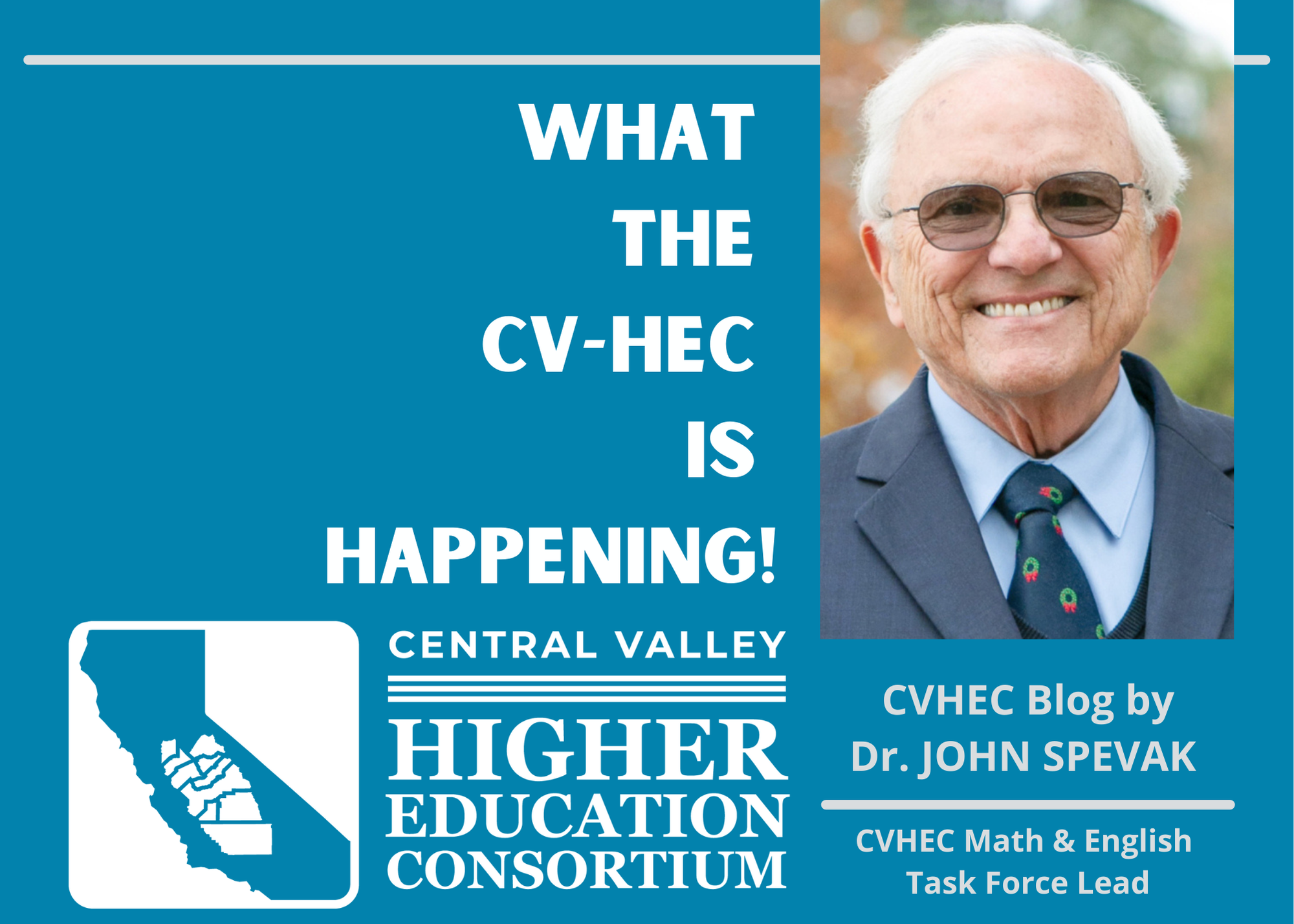
In the “What the CV-HEC is Happening” Blog for our September 2025,  Dr. John Spevak presents an adaptation of a column he wrote for the August 6 issue of The Westside Express touting the effectiveness of higher education, its impact on students and the return on investment (ROI).  Dr. Spevak, who is a vice president-emeritus of Merced College and currently a CVHEC lead, coordinates the English and Math Task Forces for the consortium. We welcome feedback as well as ideas for future blog topics: cvheccommunications@mail.fresnostate.edu.


Please, no war on college education

… and check out your local community college for true return-on-investment

BY DR. JOHN SPEVAK
CVHEC Math & English Task Force Lead
Vice President-Emeritus – Merced College


It seems these days that there is a war on education, especially on college education.

One national commentator wrote that college is an “overpriced scam.” Another stated that “many college degrees are useless.” I could cite dozens more, but I think most of my readers have heard some pundit say or write something similar.

These commentators believe that college isn’t worthwhile and that it’s too expensive. That may be true in some cases, but community colleges in California, like the college campuses on the Westside of the Central Valley in Los Banos and Firebaugh, prove these statements wrong.

Besides these two campuses, I have visited almost all of the other community colleges in California. They are friendly and welcoming to all students and accept 100% of all students who apply.

I have a long history with the Merced College campus in Los Banos. Over the past 50 years, I have heard hundreds and hundreds of students who attended that campus tell me the education they received there improved their lives significantly without hurting them financially.

I personally know many of these people. They have improved the quality of life in this community. Los Banos Campus alumni and alumnae are successful businesspersons, farmers, teachers, nurses, radiologists, sonographers and on and on. The same could be said for every California city which includes a community college campus.

People who claim that young people should not bother going to college always have a narrow definition of what a college is. College is not limited to four-year universities and abstract majors. “College” also includes community colleges, with programs that include education in what over the years has been called “vocational education,” “the trades” and “career technical education.”

The career tech programs on the Westside of the Central Valley include welding, agriculture, computer technology and emergency medical technician (EMT).

The main campuses of their colleges, in Merced and Coalinga, offer even more, including licensed vocational and registered nursing, mechanized agriculture and automotive technology. I would bet the complete list of career tech programs in California community colleges would list more than 100 vocational programs.

All of these programs provide the education and training that enables a person to earn a decent salary on a path to earn enough money for individuals to support themselves and their families. Any employer who has hired these students will tell you that their community college education was an important factor in hiring them.

But wait! There’s more! California community colleges, like the campuses in Los Banos and Firebaugh, also offer a wide variety of transfer programs that enable students to complete their first two years toward a four-year degree and then transfer to a university at very little or no cost.

These transfer students enter the universities as juniors and are well on their way to bachelor’s degrees in the sciences, business, advanced computer technology, and other fields that will enable them to earn a very significant income.

What I find ironic about people who say a college education isn’t worthwhile is that they themselves have a college education and they want their children to have a college education. These people feel, however, that OTHER parents’ children don’t need it.

They want their own children to have a college education because they know the facts. Studies show that a college education, two-year or four-year – significantly increases the earning capacity of graduates.

Over their entire working life, according to the Hamilton Project, the typical high school graduate will earn $580,000, the typical associate’s degree graduate will earn $855,000, and the typical bachelor’s degree graduate will earn $1.19 million in today’s dollars.

The key word in these statistics is “typical.” There are some cases of students with just a high school diploma earning more than a college graduate, but they are not typical. Another way of putting it is “What are the odds of earning a good income?”  Smart parents, including those who declaim against a college education, know that the odds are with students with degrees.

When I talk with young people wondering if college is worth it, I suggest they go to something called “Program Pathways Mapper.” It’s an online site that’s free to all and doesn’t require a password. One way to get to the Mapper is to Google “Merced College Program Pathways Mapper.”

Once on the Mapper site, they can select one of the many career fields, like “Agriculture and Industrial Technology,” and scroll down to “Career Explorer.” There they can see the jobs available in that field, the average salary of that job and the education required, whether bachelor’s degree, associate’s degree, or high school diploma. For many it’s an eye-opening experience.

I also tell young people that a college education is no guarantee of a high-paying job. They need to have initiative and a work ethic and a willingness to adjust to the working world and its demands, as well.

My parents didn’t have a college education. In fact, they didn’t have a high school diploma. But they encouraged their children to get a college education, and for that I will be ever grateful.

I, in turn, encouraged my three children to get a college education, and they all did, including attending the Los Banos Campus of Merced College. That, and a strong work ethic, enabled them to go into careers that paid a good salary and enabled them eventually to own their own homes—all without significant student loan debt.

For anyone who has doubts about what I have written, I encourage you to look at a recent study done by College Futures Foundation (CCF):  “Golden Returns: A Regional Look at the Return on Investment (ROI) of California’s Community and Career Colleges.”

As the CCF website puts it, “This new analysis ranks 327 community colleges and certificate-granting institutions—including 121 public, 186 for-profit, and 20 private non-profit—located within the state across 12 of California’s economic regions by how long it takes learners to recoup their educational costs.”

As the brief summary on the website states: “Forty percent of public two-year colleges enable students to recoup their costs in under a year, compared to just 5% of private non-profit and for-profit institutions.”

Anyone can go to the website, find their closest community college, and see how quickly students there recover their costs. Seeing the positive ROI is another way of pointing out to people who argue against a “college education” that they are way off base.

So before you believe anyone who tells you that a college education isn’t worth it, explore the issue on your own. And if you end up agreeing with me, encourage young people you know to attend their local public community college campuses.

There’s no better time to start than now.

John Spevak’s email is john.spevak@gmail.com.